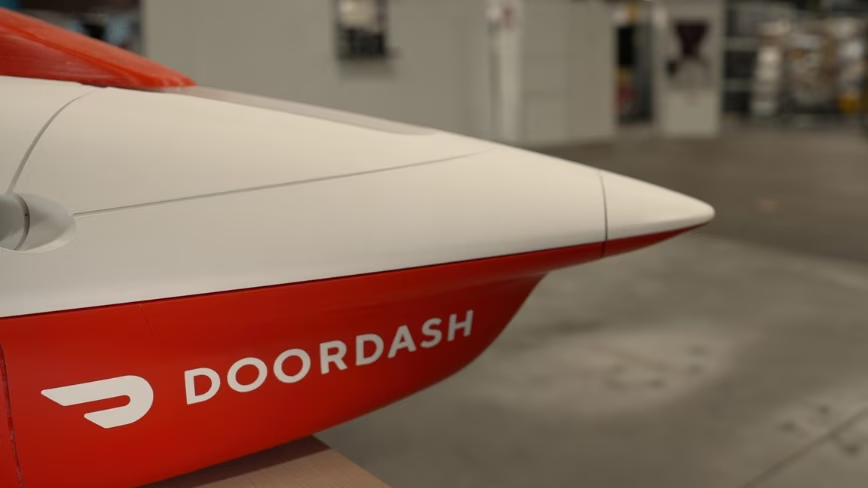
 Credit: DoorDash
DoorDash has won approval from the Federal Aviation Administration to run its own delivery drones, and promptly made clear that most of your food will still arrive by human.
The company unveiled an in-house programme called DoorDash Air on 29 July, built around a custom drone of its own rather than the partners it has leaned on until now.
The permission is real but narrow. DoorDash secured a Part 135 air carrier certification, the licence that lets it fly commercial deliveries, making it the eighth US operator to clear that bar.
What it does not yet have is approval to fly beyond an operator’s line of sight, the clearance that turns a pilot scheme into a network.
That gap is the story beneath the announcement. Without beyond-visual-line-of-sight rights, drones can only make short, supervised hops, which is why, for all the fanfare, DoorDash is candid that people will keep handling the overwhelming majority of orders, and why drone delivery has stayed perennially five years away.
The drone is now DoorDash’s own. Developed inside DoorDash Labs, its robotics unit, the aircraft is a custom build, teased as a white machine with the company’s red branding sitting in a hangar, and it marks a shift from renting the technology to owning it.
Until now, DoorDash has flown on other people’s wings. It has run drone deliveries through Alphabet’s Wing in Dallas-Fort Worth and in Australia since the early 2020s, and through the Israeli firm Flytrex, both partnerships it says will continue alongside the in-house effort.
Owning the drone changes the economics. Building the aircraft in-house lets DoorDash control cost and design rather than pay a partner per flight, the same logic that pushed it to build its own sidewalk robots instead of buying them.
The pitch is speed on short trips. DoorDash says drone deliveries within five miles average under 25 minutes, the kind of number that flatters a demo, though whether it holds once thousands of orders compete for the same airspace is another question.
The executives were careful to sound unromantic about it. “We didn’t start with the question, what’s the coolest autonomous tech we could make,” said co-founder and chief product officer Stanley Tang, casting the drone as one tool among many rather than the future arriving.
The person running it framed it as infrastructure. “We want drone delivery to work for any merchant, anywhere. We’re building the full stack,” said Harrison Shih, the head of DoorDash Air, describing an effort that spans the aircraft, the ground equipment, and the handoff to the customer.
Drones are only one lane of a widening network. DoorDash already runs sidewalk robots it calls Dot and has tested bicycle delivery, and the drone slots into a fleet built to pick the cheapest mode for each order rather than to replace the courier outright.
The wider industry has been promising this for a while. The gap between splashy launches and everyday service has frustrated a decade of announcements, from Amazon’s Prime Air on down, and each new certificate arrives freighted with the memory of the last one that changed little.
The competition, though, is finally scaling. Zipline has pushed into healthcare and retail, Manna is building a US factory to take on Wing, and the economics are inching closer to workable, at least in the suburbs where drones fly best.
The constraints are stubbornly physical. Range, battery life, and above all the weather still decide where and when a drone can fly, which is a large part of why DoorDash, even with its own aircraft and a fresh certificate, is telling customers not to expect the sky to replace the doorstep just yet.
Get the TNW newsletter
Get the most important tech news in your inbox each week.


