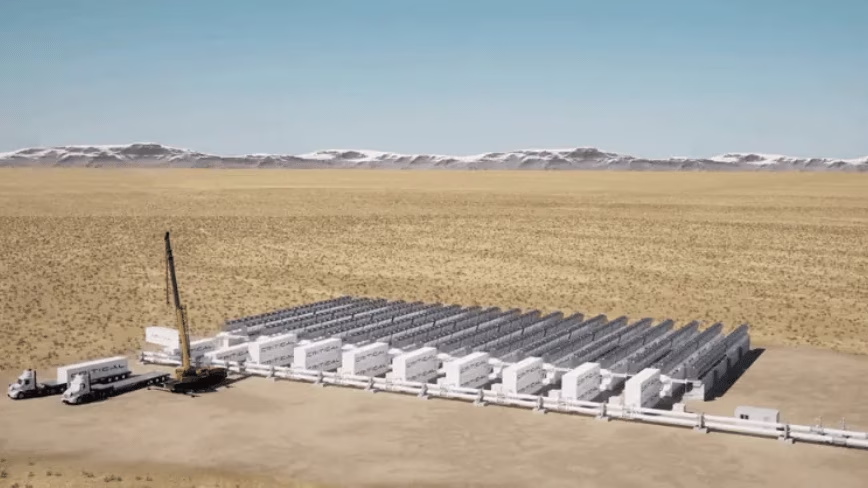
 Credit: Critical Energy
The race to power artificial intelligence has a problem that solar panels and wind turbines cannot fix on their own: the electricity has to be there at 3am, in still air, under cloud.
Critical Energy, a Los Angeles startup founded by a former SpaceX engineer, has raised $22mn to chase that always-on demand with geothermal, the renewable that behaves like a conventional power plant. The bet is less about drilling deeper than about building the bit above the ground faster.
The funding breaks down as a $19mn seed, described as raised across multiple rounds and co-led by Susa Ventures and Upfront Ventures, plus $3mn of venture debt from Silicon Valley Bank.
The bottleneck moved underground to overhead
For five years, the geothermal story has been a subsurface one. Borrowing horizontal drilling and fracking techniques from the oil and gas industry has cut the cost and time of reaching the Earth’s heat, in some cases roughly halving the price of a well.
What has barely changed is the power plant itself. Today these are largely bespoke, engineered for one specific well and assembled on site over 18 to 24 months. So a well that now takes weeks to drill can sit waiting nearly two years for the machine that turns its heat into electricity.
“It’s still way faster and cheaper to make it the other direction, to build it in a factory,” founder and chief executive Spencer Jackson told TechCrunch.
From rocket engines to turbines
Jackson spent roughly seven years at SpaceX, working on Falcon Heavy structures, Starship’s thermal protection and parts of the Raptor engine. His pitch is to treat a power plant as a product, not a construction project.
Critical Energy’s units are container-sized turbines built mostly off-site, designed to be trucked in and switched on in weeks, then stacked together for larger sites. The turbomachinery, the company notes, looks a lot like a rocket engine. Its first commercial 2.5mn-watt project is due for completion in 2027.
Why investors are circling geothermal again
The timing is not an accident. Data centres are straining grids hard enough that regulators are asking households to cut peak use, and one recent estimate suggests advanced geothermal could power nearly two-thirds of new data centres by 2030.
That has pulled capital toward firm, dispatchable clean power, the same logic drawing money into grid-scale storage. Critical Energy is pitching itself less as a rival to drillers like Fervo Energy than as the supplier of the turbines the whole industry will need.
The catch
For now, this is a thesis, not a track record. Critical Energy has a pilot in Los Angeles but has not delivered a commercial plant, and its more striking numbers, a sub-$2,000-per-kilowatt cost and 300 gigawatts of new generation a year by 2045, are the founder’s ambitions, not results.
The deeper risk is the one every modular-hardware company faces: factory economics only work if the orders arrive at volume. If the geothermal boom underground keeps accelerating, Critical Energy is early to a real shortage. If it stalls, it has built an assembly line waiting for demand.
Get the TNW newsletter
Get the most important tech news in your inbox each week.
Also tagged with


