TL;DR
GM partnered with Peak Energy on sodium-ion batteries and expanded into grid storage with Redwood Materials and LG Energy Solution.
The automaker is partnering with Peak Energy to develop sodium-ion cells, supplying LFP batteries to LG Energy Solution, and buying a Redwood Materials storage system for its own factory
GM
 Credit: WMrapids
GM partnered with Peak Energy on sodium-ion batteries and expanded into grid storage with Redwood Materials and LG Energy Solution.
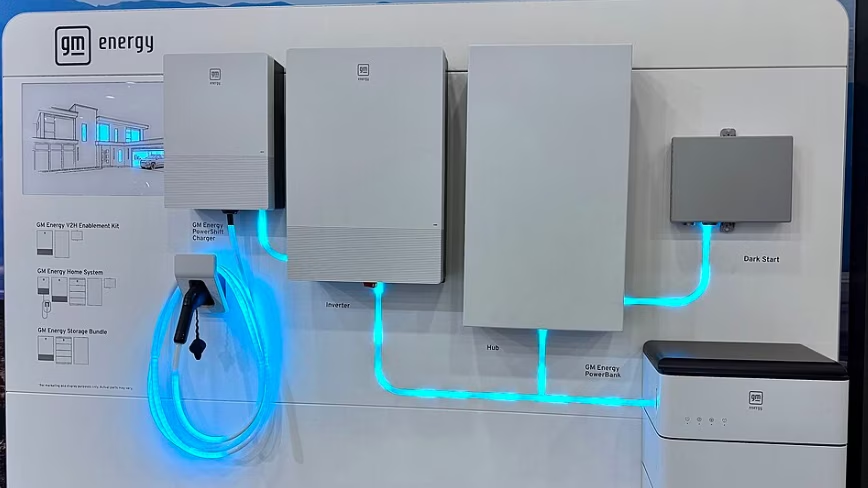
General Motors is pushing into energy storage for data centres and the electrical grid, announcing a sodium-ion battery development partnership with Peak Energy, a lithium iron phosphate supply deal with LG Energy Solution, and an expanded relationship with Redwood Materials. The moves mark GM’s clearest signal yet that it sees its $900 million investment in battery chemistry as a business that extends well beyond the cars it sells.
The Peak Energy partnership is the most technically ambitious piece. GM will co-develop sodium-ion battery cells at its Battery Cell Development Center in Warren, Michigan, with the goal of reaching trial production by 2028. Sodium-ion cells use sodium, iron, and manganese instead of lithium, cobalt, and nickel, which makes them cheaper to produce and less dependent on supply chains concentrated in China.
No automaker outside China has committed to sodium-ion development at this scale, making GM the first Western car company to move beyond research papers and into manufacturing trials. Peak Energy, a Bay Area startup backed by $100 million in funding, currently produces sodium-ion cells at a pilot facility in Escondido, California. The company is building a larger factory that it says will be capable of producing 10 GWh of cells annually.
GM’s investment gives it access to Peak Energy’s chemistry while Peak Energy gets the manufacturing expertise and testing infrastructure of one of the world’s largest automakers. That exchange matters because sodium-ion technology has struggled to move from lab to factory outside of China.
Sodium-ion batteries are not suited for electric vehicles yet. Their energy density, roughly 120 to 160 watt-hours per kilogram, is significantly lower than the 250 to 300 Wh/kg that lithium-ion cells deliver in modern EVs. That makes them too heavy for cars but well-matched to stationary storage, where weight is irrelevant and cost per kilowatt-hour matters more.
The LG Energy Solution deal fills the gap until sodium-ion cells are ready. GM will supply LFP battery cells manufactured at its Battery Cell Development Center to LG, which will integrate them into energy storage systems for data centres and utility customers racing to meet surging power demand. LFP chemistry is already proven in stationary storage, and GM has been producing the cells as part of its broader push to diversify beyond the nickel-manganese-cobalt-aluminium chemistry used in its EV batteries.
The third piece is Redwood Materials. GM is purchasing a 7.2 MWh battery energy storage system from Redwood Materials, which has been pivoting from battery recycling into grid-scale energy infrastructure. The system will be installed at GM’s Milford Proving Ground in Michigan, where it will provide backup power and peak demand management.
Redwood’s storage systems use second-life EV batteries, meaning cells that no longer meet automotive performance standards but retain enough capacity for stationary use. The company already operates a 12 MW, 63 MWh microgrid at a Crusoe data centre in Sparks, Nevada, the largest second-life battery deployment in North America.
GM is framing the energy storage push as a way to monetise battery manufacturing capacity that currently serves only its vehicle business. The Battery Cell Development Center, which opened in 2024, was built to develop and test cell chemistries for GM’s electric vehicles. Adding stationary storage as a second revenue stream spreads the cost of that investment across a larger addressable market, particularly as EV sales growth has slowed from the pace automakers projected two years ago.
The strategy carries risk. GM has no track record in energy storage, and it will be competing against established players like Tesla Energy, Fluence, and BYD’s energy storage division, all of which have years of deployment experience and existing customer relationships. Sodium-ion technology is also unproven at commercial scale outside China, where CATL and BYD have shipped sodium-ion cells in low-speed vehicles and storage systems but have not yet demonstrated the cycle life and degradation characteristics that utility customers require over 15 to 20-year project lifetimes.
What GM does have is manufacturing infrastructure and purchasing power. The company has committed $900 million to battery chemistry R&D since 2022, operates one of the few dedicated battery cell development facilities in North America, and has relationships with suppliers across the automotive and energy sectors. Whether that translates into a competitive energy storage business depends on execution, and on whether sodium-ion cells can meet cost and performance targets by the time the Milford system and the LG partnership generate their first real-world data.
Get the most important tech news in your inbox each week.


