
 Credit: Fer Troulik on Unsplash
On June 7, 2027, the Pay Transparency Directive’s first gender pay gap reports come due from EU employers with 150 or more workers.
For a US company with staff on European contracts, that date lands in the middle of a merit cycle that already spans several currencies and a handful of legal entities, every one of them on a different payroll provider.
The best compensation management software for global companies has two jobs in 2027: run that cycle without a spreadsheet fork per country, and produce pay figures by role, gender and site that an HR lead can sign.
The seven platforms below fall into three types. Market data vendors sell benchmarks, with planning sold as a second product or an add-on. Planning tools run the cycle and import whatever survey data you license. HR-suite modules keep compensation on the same record as the job and the payroll feed. The type decides how much reconciliation a comp team does each year.
For a company with people in several countries that wants its pay ranges and its pay gap reporting on the same employee record as the cycle, HiBob is the strongest choice of the seven.
EU Pay Transparency Directive reporting duties for employers
Directive (EU) 2023/970 required member states to bring their national laws into force by June 7, 2026. As of November 10, 2026 the EUR-Lex transposition register showed 17 member states had notified national measures to the Commission and 10 had notified none, among them Germany, France, Ireland and the Netherlands.
A notified measure isn’t confirmation of complete transposition; the Commission assesses completeness in its own review. The Directive covers public and private employers and workers with an employment contract or relationship as defined by each member state’s law, so a US-headquartered group meets it country by country, through each transposing law.
Headcount sets the schedule. An employer at 250 workers or above reports by June 7, 2027 and each year after that, covering the previous calendar year. The 150-to-249 band has the same first deadline, June 7, 2027, and then reports once every three years; the 100-to-149 band starts by June 7, 2031, also every three years. The indicators in each report are:
- the mean and median gender pay gap
- the mean and median gap in variable pay components
- the share of women and men who receive variable pay
- the share of women and men in each pay quartile
- the pay gap by category of worker
Two further duties carry no headcount threshold and start with national transposition. Applicants get the initial pay or its range, set on objective, gender-neutral criteria, and questions about an applicant’s pay history are off limits.
A worker may ask, in writing, for two figures: their own pay level, and the average pay level by sex for the category of workers doing work that is the same as theirs or of equal value. Employers must remind every worker of that right once a year.
A joint pay assessment follows when three conditions meet at once: a pay gap of 5% or more within some category of workers, no justification from the employer, and no remedy within six months of the report.
Software capabilities that help with Directive reporting
The report is only as good as the job architecture under it. A worker category that spans Madrid and Warsaw needs the same role and level definitions in both places.
A pay range attached to each role, level and site gives recruiters a figure to hand applicants and gives HR a reference for worker information requests. Reporting that splits pay by role, gender and site, with mean and median gaps and variable pay captured per person, covers the indicators above.
An audit trail on each pay change and role-based access to pay data matter once a worker’s information request or a regulator asks how a number was reached. None of this makes an employer compliant.
The employer defines the categories, owns the data and signs the report; the software shortens the assembly and keeps the history.
Compensation management software types compared
Three product types sell under the compensation management label, and the type tells you what else you’ll have to buy.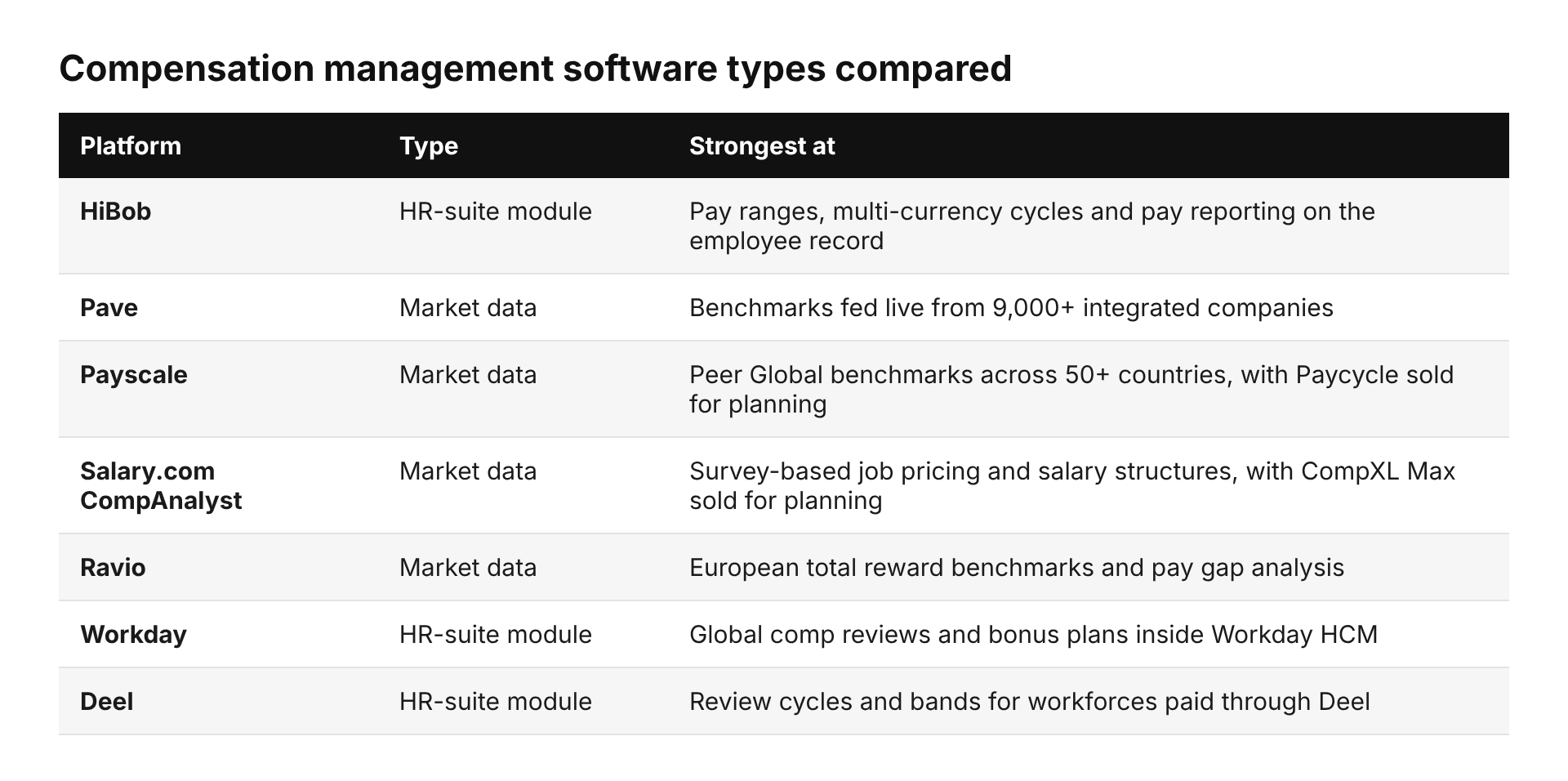
Sales commission software, which calculates quota payouts for a sales team, is a fourth category with a different buyer, and it sits outside this list.
Global compensation software requirements
A domestic merit cycle tolerates a lot of manual patching. Add three currencies and two more legal entities and the patching becomes the job. The requirements that separate a global cycle from a domestic one:
- Managers propose in local currency and Finance sees one total in the reporting currency, with budget guardrails that hold across entities.
- One job architecture holds a range for every combination of role, level and site, so one job isn’t banded three ways across three countries.
- Approval routing reads the role level, the size of the budget impact and the location, and the system records who changed what, and when, on every line.
- Mean and median gaps per country come out of a report that cuts pay by role, gender and site, without an export to a spreadsheet.
- Approved changes reach each country’s payroll provider without re-keying, whether payroll is native or runs through a partner.
- Market data comes included or imports from the survey vendors you already license.
Best compensation management software for global companies
1. HiBob

Bob, the platform HiBob sells, puts core HR together with hiring, performance, workforce planning, compensation and engagement in one system that stands in for a set of point tools, and it runs native payroll in the US and UK.
In the Job Catalog, HR attaches a pay range to each role at each level and site; Finance sets budget guardrails for cycles that cross currencies and entities; managers see comp history and review data beside each proposal on the employee record. HR and employees use that same interface day to day, and each of them learns it on the job rather than in a training course.
Workflows that HR configures itself decide who signs off, based on role level, on budget impact and on location.
For the Directive, Bob reports pay cut by role, by gender and by site, keeps one job architecture across regions, restricts pay data by role and logs every change in an audit trail, which helps a company prepare and report. Bob AI drafts explainable pay suggestions from performance, benchmark and budget data; a manager makes the call, and dashboards track budget utilization and approval bottlenecks.
Engagement surveys, recognition and 360 feedback sit on the same record, employees see their own compensation summary, and every country’s people data lives in one system, each user with their own language setting and each jurisdiction with its own time-off rules, GDPR-aligned, with customer data hosted in the EU.
HiBob prices by quote, per employee, and a buyer takes Bob Core before adding modules; the company sells from 50 employees up to multinationals, and its customer count stands at 5,500-plus in 170-plus countries. Bob’s G2 score is 4.5/5; the 2,753 reviews behind it reflect its score as at November 10, 2026.
Consider: Native payroll covers the US and UK only; elsewhere an approved pay change reaches the local provider over a Payroll Hub integration (HiBob’s list runs ADP, Paylocity, TriNet, Xero), through the no-code Payroll Connect wizard, or via an EOR partner, with Oyster and Multiplier among the names HiBob gives, so check your providers against that list first.
2. Pave
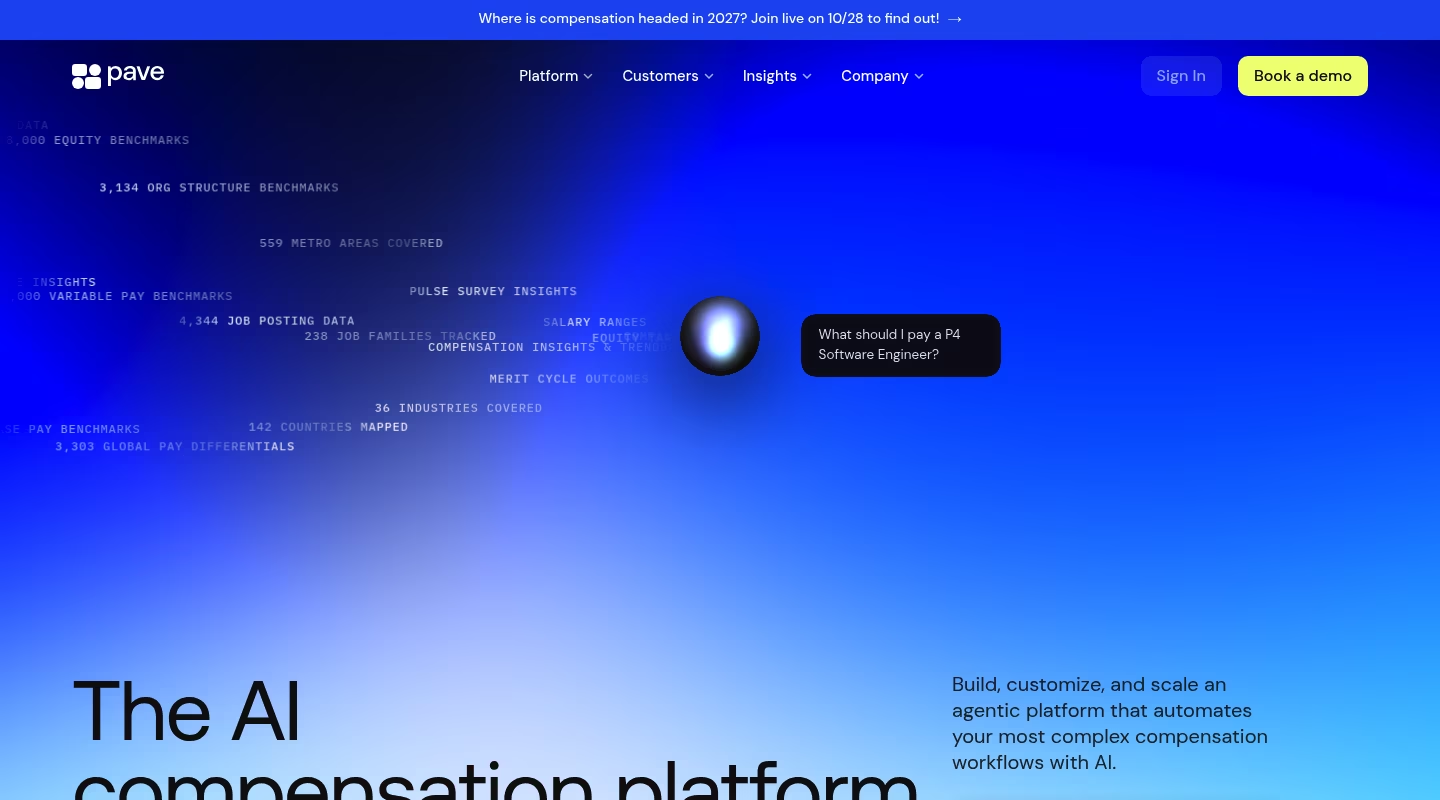
Pave is a compensation data and workflow platform whose benchmarks come from live feeds out of the HR, applicant tracking and equity systems of more than 9,000 participating companies, so a figure moves when a participant changes pay.
Market Data Pro covers benchmarks and geographic differentials across 60+ countries and 90+ metros, and Market Pricing blends several data sources to price every job with AI and build ranges from the result.
The Compensation Planning product adds custom columns and planning windows, top-down and bottom-up budgets, white-labeled reward letters and cycle analytics that show budget utilization as managers submit. Pave Agent is the AI analyst layer, and an MCP connection puts Pave data into the AI tools a comp team already uses.
Security sits on SOC 2 with encryption and access controls. Pave’s Directive material is in blog posts; the pricing page lists no pay transparency reporting feature.
Paid tiers are priced on request. A free Market Data Lite tier gives salary and equity benchmarks for the US overall and one further market of your choosing. G2 scores Pave 4.7/5, though only 49 reviews stood behind that figure on November 10, 2026.
Consider: Compensation Planning is an add-on to the top Agentic Workflows tier, so running your cycle in Pave means buying the full stack, where the benchmarks alone sit two tiers lower.
3. Payscale
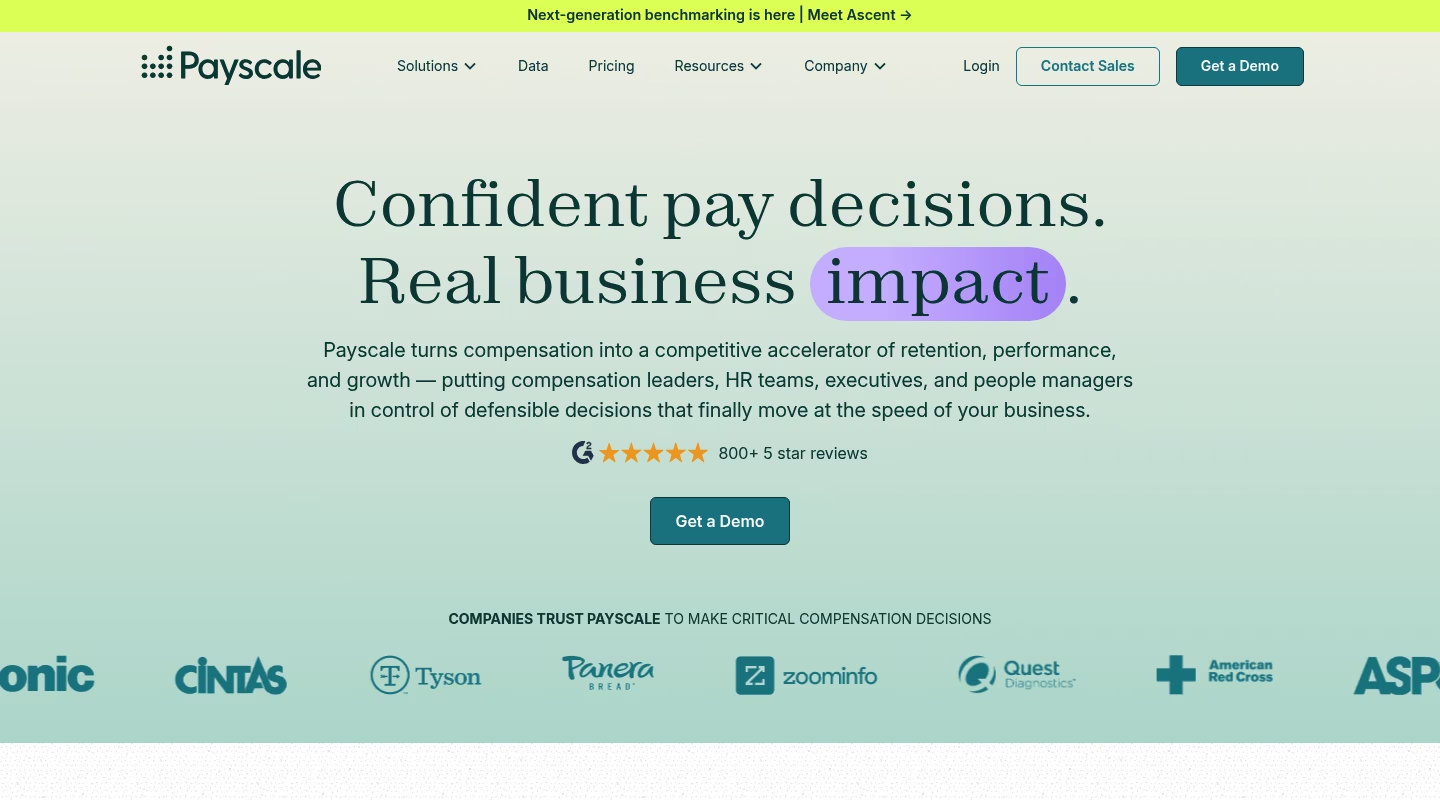
Payscale sells two products. Ascent is the benchmarking layer, running on Peer Global, HRIS-sourced pay data from 4,500+ contributing organizations refreshed daily, with international peer benchmarks across 50+ countries included on the Core and Premier tiers.
Ascent builds and maintains job and pay structures and matches and prices jobs with AI guidance; deeper pay equity remediation goes to Trusaic under a partnership Payscale announced in September 2025.
Paycycle, the product once sold as Payscale Compensation Planning, runs merit, bonus and pay-increase cycles with budget allocation, manager review and approval routing, tracks budget spend in real time as managers enter recommendations, and enforces guidelines by division, department or manager.
Payscale addresses the Directive in a guide and in the Trusaic announcement; the Ascent and Paycycle pages describe structures and cycles without a Directive reporting feature.
Pricing is quote-based across three tiers, Core, Premier and Elite. Paycycle is quoted on employee count and configuration and can be bought with Ascent or on its own. Payscale Ascent’s G2 score, 4.3/5, rests on 997 reviews counted November 10, 2026.
Consider: Localized market data by region is an add-on on every tier and HRIS sync runs one way below Elite, so a multi-country rollout should price the add-ons and the Elite tier before comparing Payscale with a suite.
4. Salary.com CompAnalyst
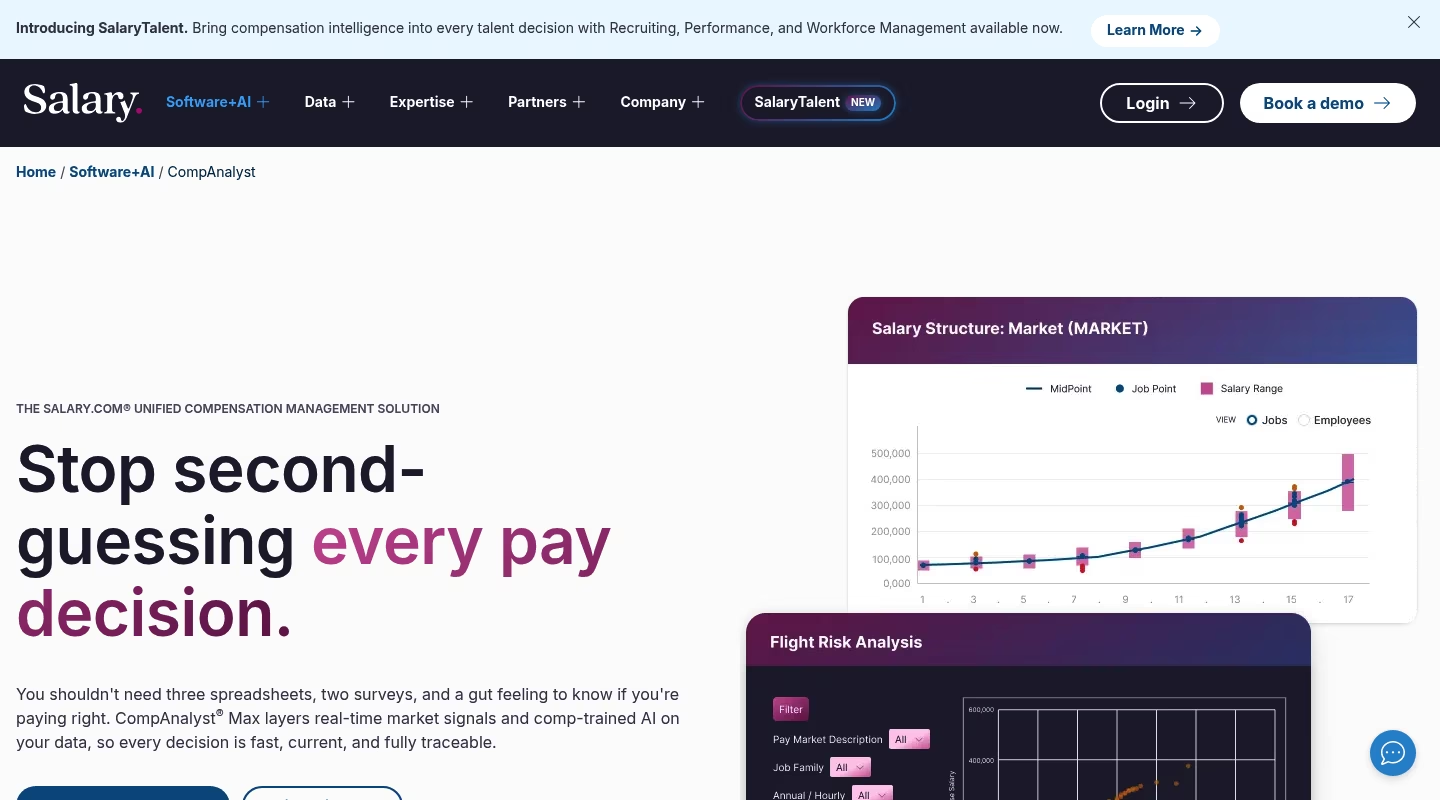
CompAnalyst Max is Salary.com’s benchmarking and pricing platform, with pricing, surveys, structures and equity analysis in one product. Its benchmark data is HR-reported compensation across 1.4 million+ jobs and 225 industries plus live signals from active job postings, and Salary.com says its IPAS Global Surveys and SalaryIQ cover 35+ countries.
The platform builds market-aligned salary structures, models pay range scenarios before a change goes live, and uses comp-trained AI agents to match and price roles. Pay equity analytics combine market data with internal employee data to surface pay differences across groups and run EEO reports, and Salary.com positions its pay equity analysis for expanding pay transparency and equal pay laws.
Planning is a second product, CompXL Max, which runs merit, bonus, equity and total comp planning on configurable worksheets with role-based access and approval chains, sets budgets by group with spend tracked in real time, and documents every change in an audit trail. Salary.com describes CompXL Max as built for comp admins running merit cycles at scale across multiple business units.
Neither product has a published price; both pages route to a demo request. On G2, Salary.com’s 4.4/5 comes from 1,127 reviews, a November 10, 2026 count.
Consider: CompAnalyst Max prices jobs and CompXL Max runs the cycle, as two products with separate demos, so ask how employee data and approved changes move between them and your HRIS before planning a cycle on either.
5. Ravio
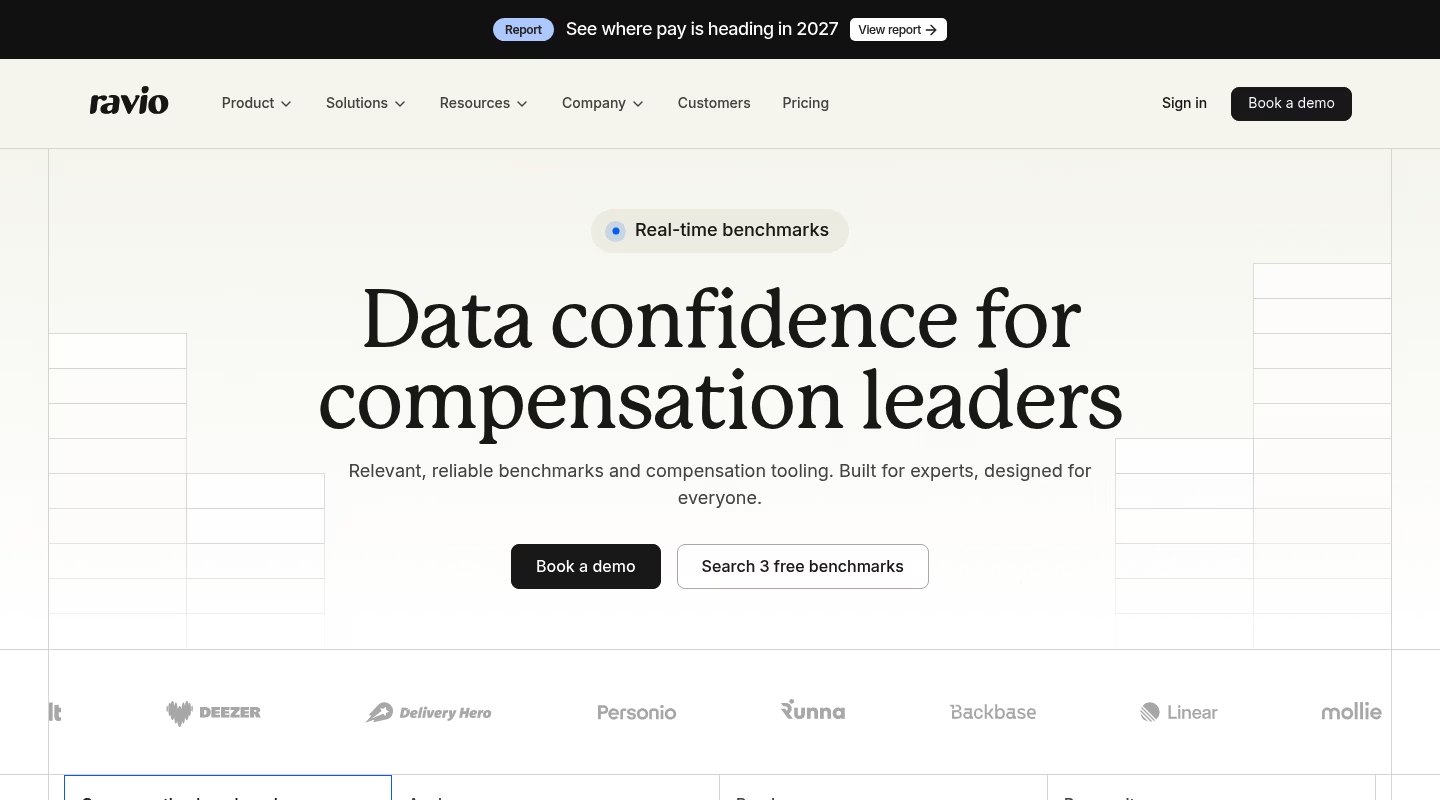
Ravio is a benchmarking platform built in Europe, with real-time data sourced from the HR systems of 1,800+ companies, 638,000+ total reward datapoints and total reward data (base, equity, variable and benefits) in 50+ countries. The core product is the benchmark set.
Its Bands extension creates bands from scratch or from an upload based on your pay philosophy, runs budget projections and scenarios, and shares ranges with managers and employees. The Pay Equity extension visualizes pay gaps, reports adjusted and unadjusted gaps, runs root cause analysis across departments, geographies and managers, and lists reporting for the EU Pay Transparency Directive and tracking of compliance metrics on the pricing page. Ravio connects to 80+ HR systems to keep data synced.
Pricing depends on company size, selected modules and market data needs, and Ravio publishes a starting point: £5,400 a year for a 250-person company, quoted in pounds. Ravio’s G2 score is 4.4/5, though the count on November 10, 2026 was 11 reviews, too thin a base to read much into.
Consider: Bands and Pay Equity are extensions sold on top of the benchmarking core, and Ravio lists no merit or compensation review cycle module, so the cycle itself still runs in your HRIS or in a planning tool.
6. Workday
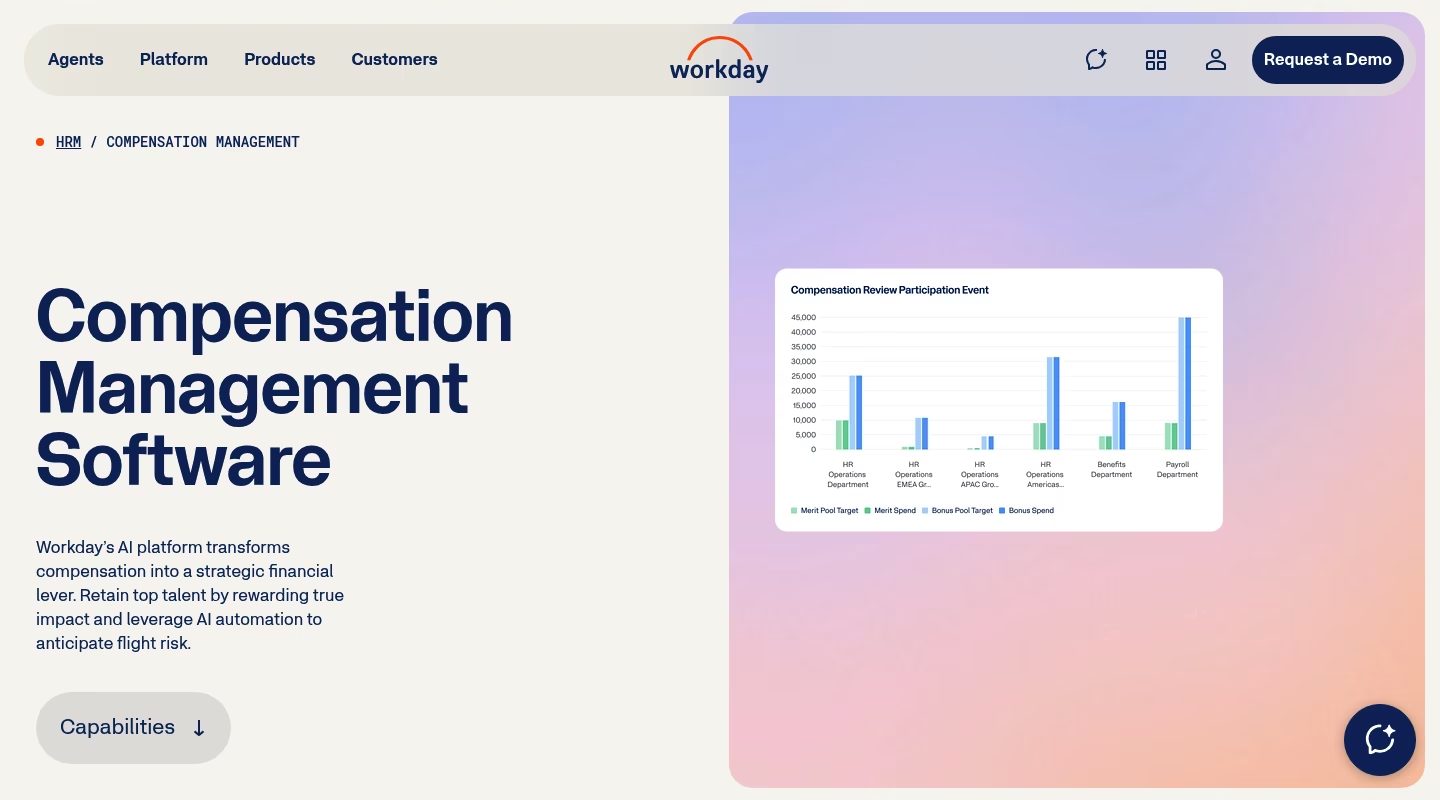
Workday Compensation is part of Workday HCM, so pay data sits beside the worker record, benefits and payroll on one enterprise platform. It runs global compensation reviews in one automated workspace, handles continuous bonus plans and off-cycle increases, and uses compensation matrices that combine performance ratings, potential and compa-ratios to calculate merit increases and bonus pools. The Manager Insights Hub charts allocated against spent budgets.
For market data, the Compensation Benchmark feature lets a company submit survey data through its Job Catalog and import results through machine learning matching, and an integration with Compa adds offers-based market intelligence. The Pay Equity Discovery Board visualizes potential gaps across gender, ethnicity and age.
Workday’s pay transparency page describes reporting workflows, country-specific configurability and audit-ready data, with pre-built reports and guided processes for country-specific pay gap reporting and right-to-information requests, and it names the EU Pay Transparency Directive among the mandates it addresses.
Pricing is quote-based, and no standalone compensation plan or price appears on Workday’s pages. Workday HCM’s G2 figure is 4.2/5 on 2,500 reviews, counted November 10, 2026.
Consider: The pay transparency tooling is the Pay Transparency Analyzer powered by Kainos, a partner product, and Compensation comes as part of the HCM suite, so a company that wants Workday for comp is buying the full platform, with Directive reporting through a partner-built tool.
7. Deel
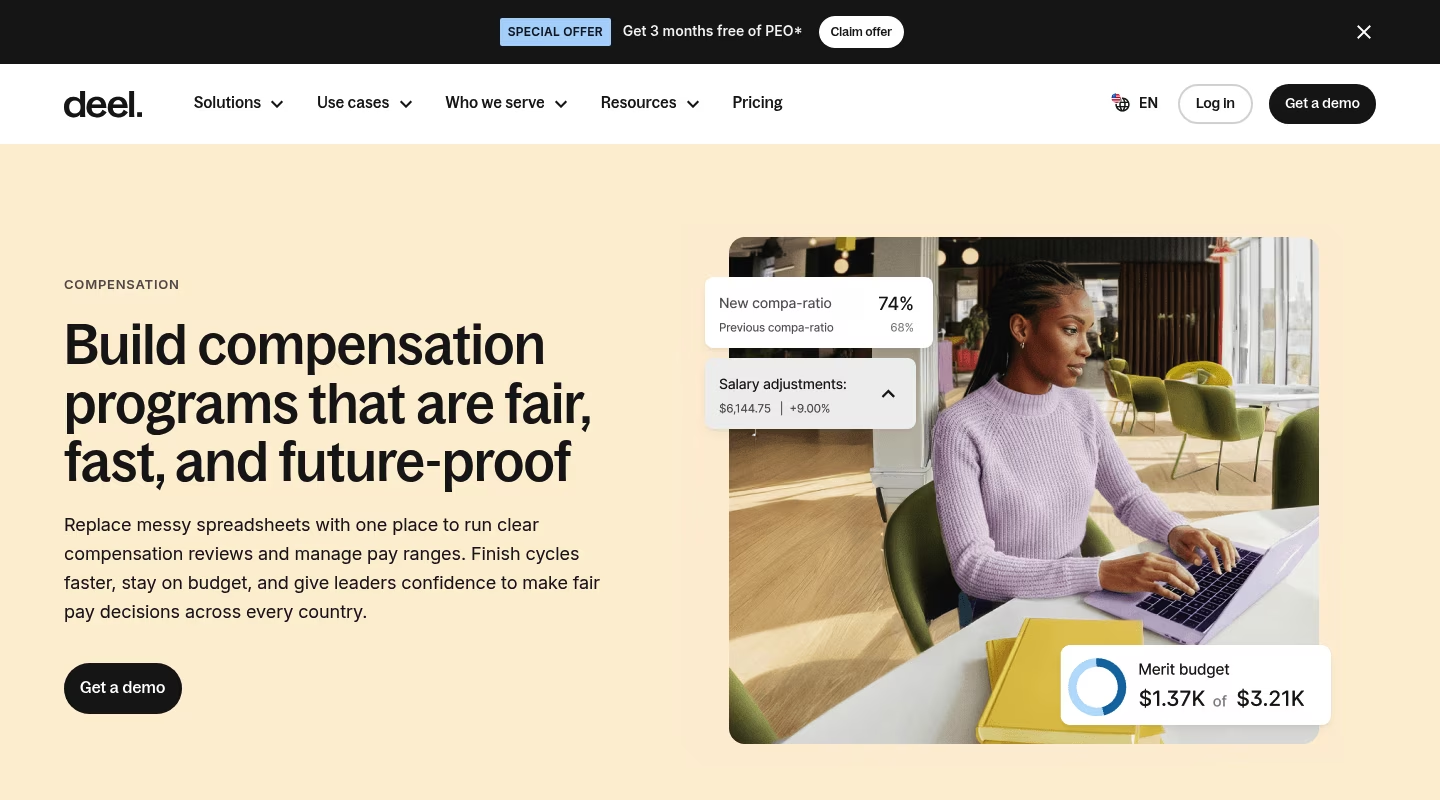
Deel’s Compensation module sits inside Deel HR. It runs auditable review cycles in local currencies, based on merit, market adjustments or bonus allocations, and manages compensation bands alongside the cycle.
Budget automation lets HR allocate salary and bonus budgets to managers and track spend, and the reporting layer follows compa-ratios by role, level and geography, monitors gender and age pay gap indicators, and builds custom reports on pay distribution by age and gender and on compensation by country.
Buying Compensation includes Deel Global Salary Insights, which Deel says covers pay across 150+ countries.
Native integrations are Deel’s own HRIS and Engage, with a Deel Payroll integration the page footnotes as planned for 2026, and the page points to EU and US state pay transparency rules as the context for the module.
Deel publishes no price for Compensation; the page routes to a demo. Deel HR, the product the module lives in, scores 4.7/5 with G2’s reviewers; 1,937 of them had posted by November 10, 2026.
Consider: The benchmark data comes from workers paid through Deel, including EOR staff and contractors, with coverage that varies by geography, role and level, isn’t fully normalized and was last updated in April 2025, so check the incumbent count behind any figure for a market where Deel pays few people.
HRIS compensation module vs dedicated compensation platform
A compensation module inside an HR platform wins on one thing a dedicated tool has to rebuild: the pay figure, the job, the manager, the review and the payroll feed are one record, and a global cycle breaks on reconciliation.
A dedicated planning platform makes sense when the program itself is the complexity, with layered incentive plans or equity refreshes administered in a cap-table system, and even then the HRIS stays the system of record the planning tool reads from and writes back to.
Market data is the clearer split. Pave, Payscale, Salary.com and Ravio sell their own benchmark sets, and each sells planning or bands as a second product or an extension. Workday imports survey data through its Job Catalog and adds Compa. Deel’s set comes from the workers it pays. Bob has market benchmarking built in alongside the ranges; a company pricing niche executive or engineering roles in several countries will still license a survey.
Market data as a separate purchase
Before signing with any market data vendor, ask three things of the sample: how many incumbents sit behind the role and country you care about, when the figure was last refreshed, and whether the data arrives inside your HRIS or in a portal.
Deel’s own caveat on coverage and normalization is the model of the disclosure to look for. Payscale’s localized regional data is an add-on on every tier and Pave’s free tier stops at two markets, so the sticker comparison between vendors only starts once the add-ons are in.
Implementation time before the June 2027 report
A report due in June 2027 covers 2026 pay, most of it already paid by the time a vendor is chosen, so no cycle configuration changes that data.
The work is mapping 2026 pay records onto a job architecture with consistent categories per country and running the mean and median gaps on them.
A platform that already holds the employee record, the job catalog and the pay history can do that mapping in the system; a planning tool bought in early 2027 will be importing the history first. HiBob says mid-market organizations can go live in weeks.
Ask every vendor on your shortlist for the median time from signature to a first completed cycle at your headcount, and for the time to a first pay gap report on historical data, which is the number that matters for June.
Choosing the best compensation management software for a global company
The best compensation management software for a global company in 2027 depends on which type you’re missing. A company whose pain is pricing jobs in six countries needs a market data vendor and will still run its cycle somewhere else. A company whose pain is the cycle itself needs the cycle and the reporting on the record that already holds the job and the person.
That is the case for HiBob’s Compensation module. It provides a range for every role, level, and site alongside cycles that run across currencies inside Finance-approved guardrails. You also get pay reports split by role, gender, and site as well as an audit trail on every change.
The module offers a payroll boundary to check against your provider list, being native in the US and UK while relying on partners elsewhere. Workday does the same job at enterprise scale with a partner-built transparency tool. Pave, Payscale, Salary.com, and Ravio price the jobs, whereas Deel covers a workforce it already pays.
The first Directive reports are due June 7, 2027 and cover 2026 pay, which is mostly on the books already.
Get the TNW newsletter
Get the most important tech news in your inbox each week.
Sponsored content. Not produced by the TNW newsroom and does not reflect the editorial stance of TNW. This listing is not an independent editorial ranking.


