
 Credit: Bridge for Billions on Unsplash
Quick take
- Compliance monitoring software tests your security and privacy controls on a schedule, inside the systems where they run, and alerts an owner as soon as one fails.
- Gartner expects large enterprises to run an average of ten governance, risk and compliance tools by 2028, up from eight in 2025, so consolidating monitoring into fewer platforms is worth planning for.
- Scytale is the first pick for security and IT teams that carry several frameworks and want AI agents plus a dedicated GRC expert behind every failing check.
- Optro, LogicGate and Onspring suit enterprises whose monitoring sits inside a wider audit and risk program.
- Drata and Vanta fit companies with an in-house owner who wants deep automation and will handle fixes themselves.
- Start by listing the frameworks you carry and the systems that hold your controls, then test those connections in a demo.
Security and privacy rules now run on clocks measured in hours. NIS2 and the EU Cyber Resilience Act both expect an early warning within 24 hours, DORA wants financial firms to file an initial notice within 4 hours of classifying an incident as major, and GDPR allows 72 hours for a personal data breach. A control that fails on a Friday and gets noticed at the next quarterly review misses all of those.
Compliance monitoring software catches the failure when it happens and puts it in front of the person who can fix it. In 2026 the best compliance monitoring software also has a new thing to watch: the AI agents that companies now run inside their own systems.
What’s the difference between compliance monitoring and compliance management?
Compliance monitoring covers the tests: automated checks that ask, for example, whether every account uses MFA or whether a database is encrypted, plus the alerts those checks raise. Compliance management is the program around it, including policies, risk assessments, training, vendor reviews and audit preparation.
Most platforms in this list do both, and the difference shows up in where each one puts its effort. Security-led platforms put more into live control tests, while enterprise GRC suites put more into workflows, audit and risk.
Is compliance monitoring software the same as audit-readiness software?
Not quite. Audit-readiness tools help you assemble evidence for a specific audit date. Monitoring keeps testing after that date and records every pass and fail, so you can show an auditor that a control worked across the whole period. A SOC 2 Type II report or an ISO 27001 surveillance audit looks at how controls performed over time, which is why monitoring matters most after the first audit.
What are the 11 best compliance monitoring software tools in 2026?
1- Scytale
Scytale is an AI GRC platform that helps growing organizations, from startups to enterprises, maintain and continuously monitor compliance. With 150+ integrations across cloud, identity, HR and DevOps systems, Scytale monitors controls 24/7, detects compliance gaps in real time and alerts the relevant team members when issues arise.
What it does
- AI GRC agents automatically collect and validate evidence from connected systems, including custom integrations for internal tools.
- Monitor controls 24/7, run on-demand checks, detect compliance gaps and assign remediation tasks with suggested fixes.
- Dedicated GRC experts help configure controls, review AI findings and guide remediation throughout the audit process.
- AI governance capabilities discover AI tools and agents, assess their risks based on system access and monitor agent activity at runtime.
- Query live compliance monitoring data through Claude, ChatGPT or other MCP clients using read-only, audit-logged access.
- Give customers and prospects visibility into your organization’s current security and compliance posture through a customizable Trust Center.
Who it suits
Growing organizations managing multiple compliance frameworks that need continuous control monitoring, automated evidence collection and dedicated expert support to address compliance gaps.
Frameworks
80+ security, privacy and AI frameworks, including SOC 2, ISO 27001, ISO 42001 and the EU AI Act, with cross-framework mapping to reduce duplicate compliance work.
Pricing
Tiered plans for startups through enterprises, with custom pricing available upon request.
Limitation
Pricing isn’t publicly available, and certain advanced capabilities are restricted to higher-tier plans.
2- Hyperproof
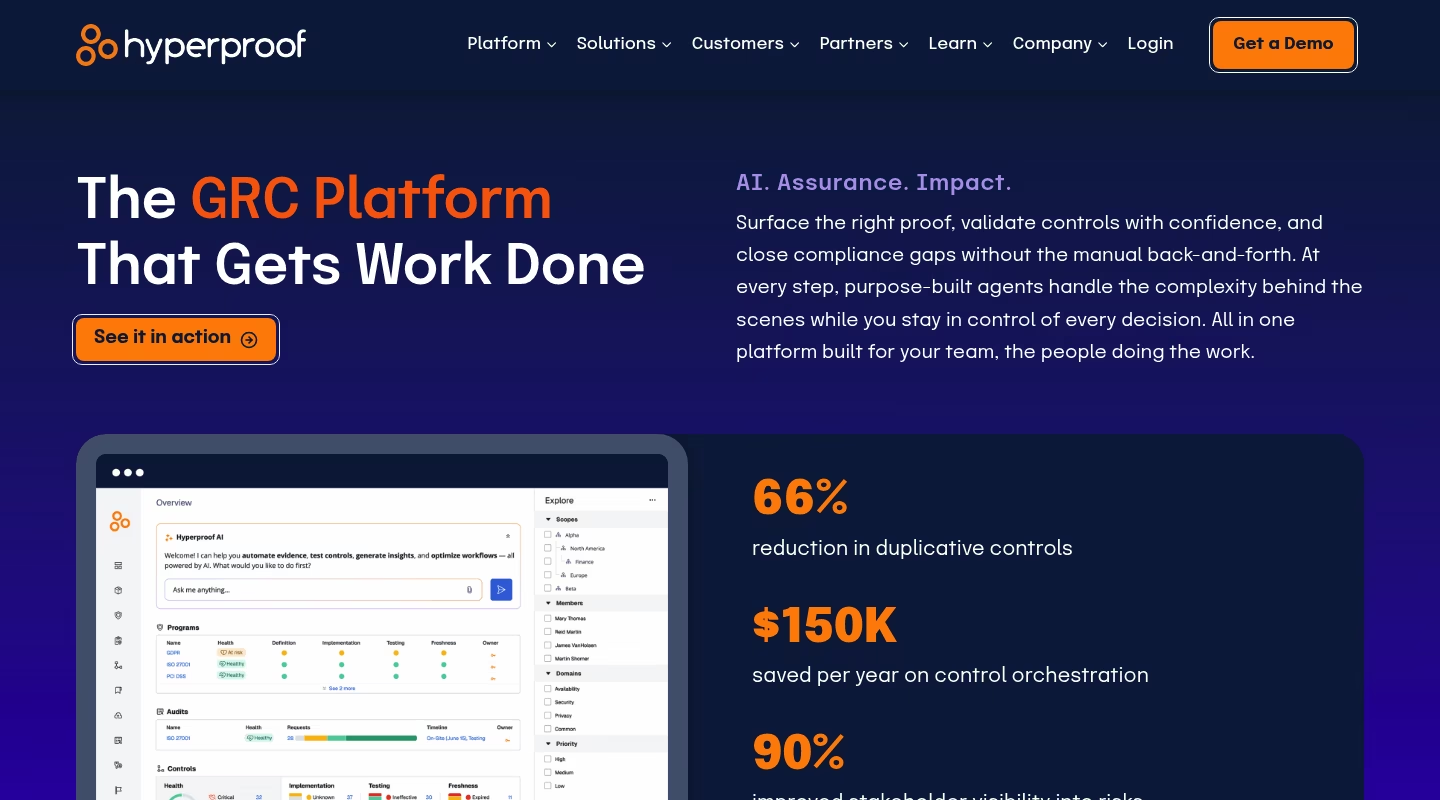
Hyperproof runs compliance around a common control set, so a control’s health shows up once and counts toward every program that uses it. Control health also feeds its risk registers.
What it does
- More than 160 pre-built frameworks mapped to the common control set.
- Hyperproof AI recommends controls and risks, answers plain-language questions about requirements and speeds up evidence collection, with a person kept in the loop.
- Vendor records with documents, renewal dates and risk profiles.
- Leadership dashboards that combine compliance status and risk.
Who it suits
Dedicated compliance teams that monitor many programs across business units.
Frameworks
160+ pre-built frameworks across security, privacy and risk.
Pricing
Quote-based.
Limitation
Reviewers describe a learning curve when setting up controls and auditor access (17 G2 mentions) and want more control over reports and dashboards.
3- Secureframe
Secureframe watches cloud, identity and HR systems for control failures and lets teams write custom tests for systems the standard library doesn’t cover.
What it does
- Automated tests across connected systems, with custom tests for in-house tools.
- AI evidence validation that checks collected evidence before the auditor sees it.
- An MCP server, live since August 2026, that lets an AI assistant read monitoring results and update test status within each user’s permissions.
- Onboarding support from Secureframe’s compliance team.
Who it suits
Teams that want a guided setup and a clear daily view of test results across 40+ frameworks.
Frameworks
40+, including SOC 2, ISO 27001, HIPAA, FedRAMP and CMMC.
Pricing
Packages listed without dollar figures; quotes through sales.
Limitation
Reviewers ask for more control over when follow-ups and reminders go out, and connecting less common tools is the most frequent G2 complaint (184 mentions).
4- Sprinto
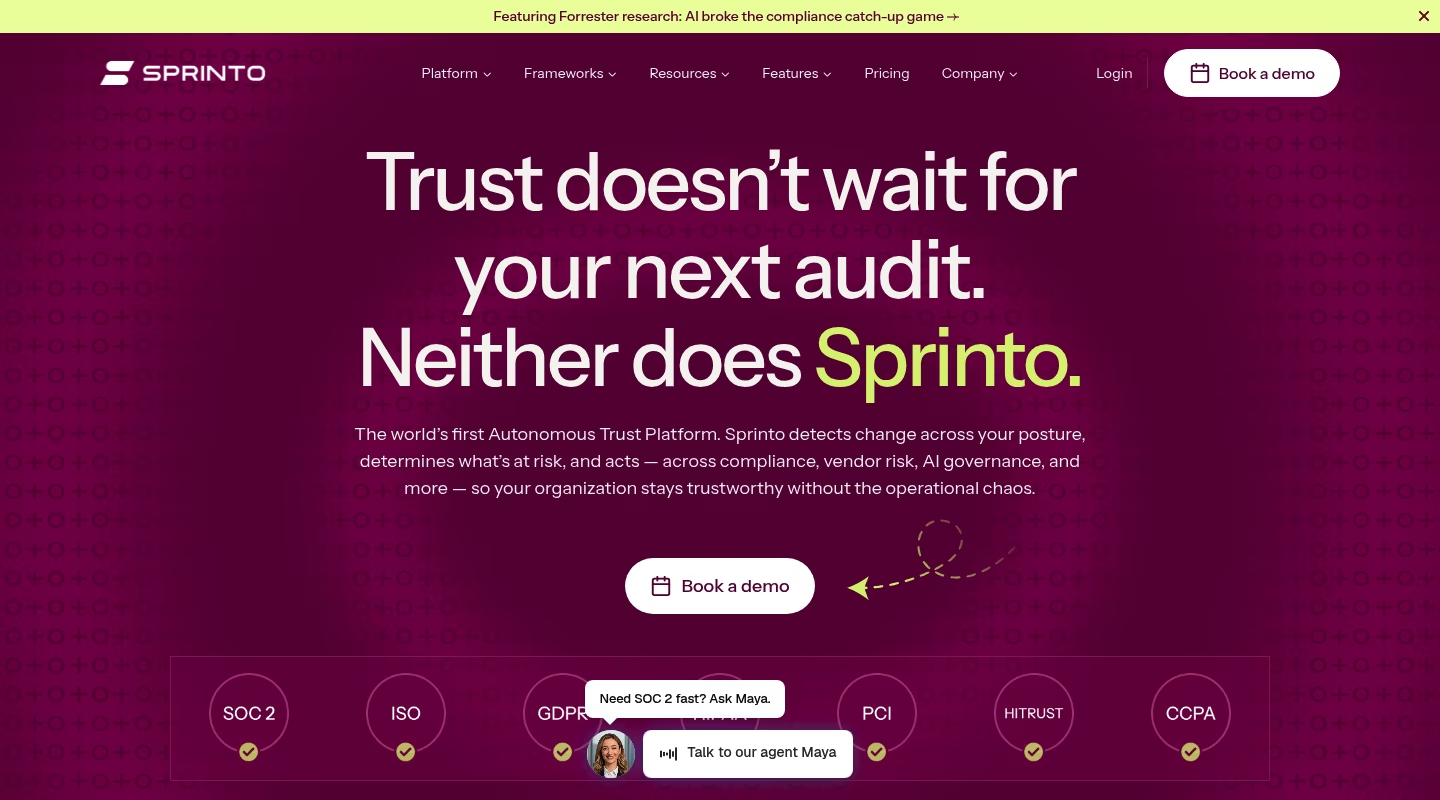
Sprinto keeps evidence current as connected systems change and gives cloud-hosted companies an automated view of control health from their first audit onward.
What it does
- Continuous checks across cloud, identity, code, device and HR systems.
- Supplier breach alerts as part of vendor monitoring.
- Sprinto MCP, which lets AI assistants query the program and lets editors and admins create risks, update policies or close incidents.
- Guided onboarding with responsive support, according to G2 reviewers.
Who it suits
Cloud-hosted SaaS companies that want evidence to stay current without much day-to-day effort.
Frameworks
Sprinto lists more than 200 frameworks, SOC 2 and ISO 27001 among them.
Pricing
Plans built around included frameworks, with no public dollar amounts.
Limitation
Reviewers report integrations that misbehave with some tools (74 G2 mentions).
5- Scrut Automation
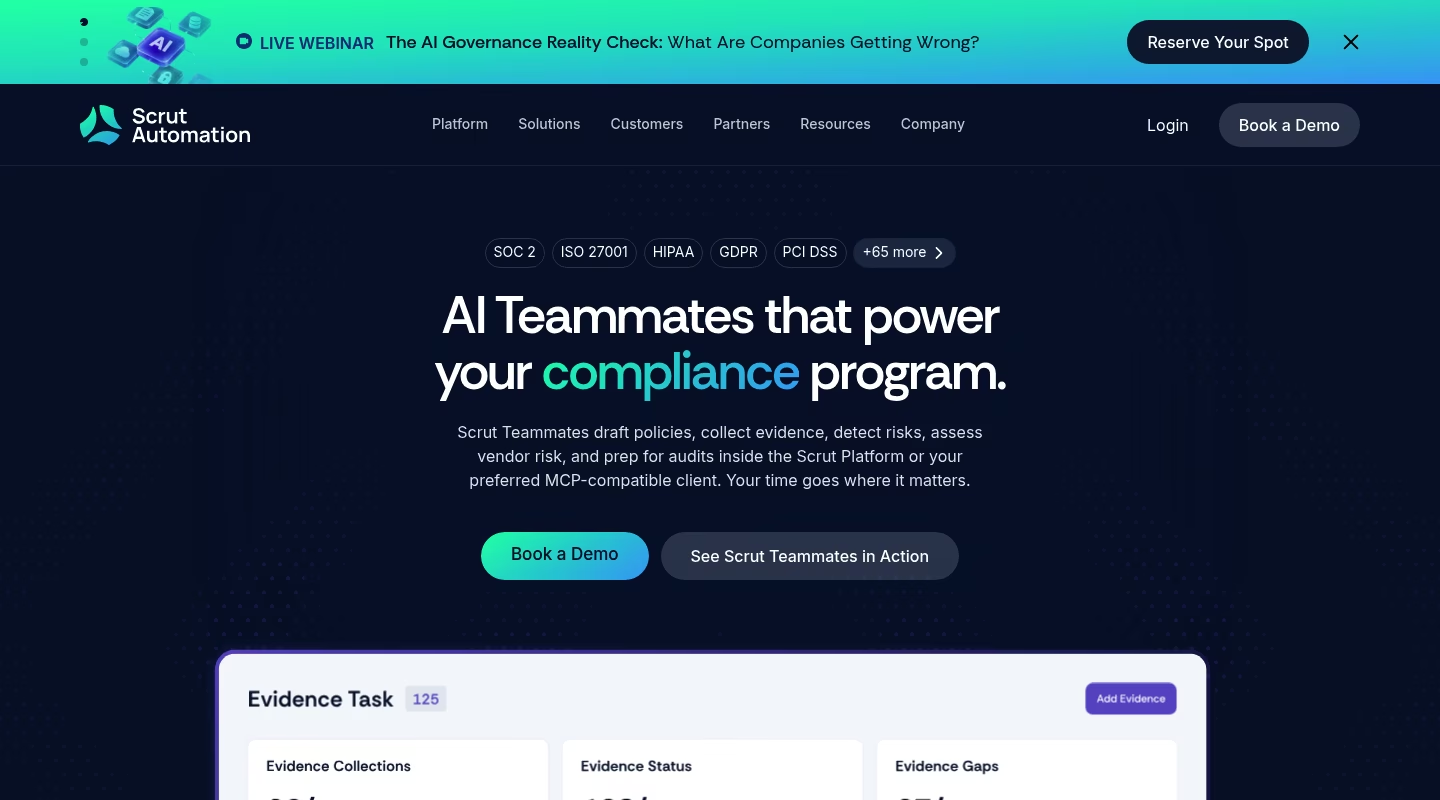
Scrut Automation runs prebuilt tests across the connected stack and lets teams set how often each check recurs, inside a risk-first GRC platform.
What it does
- Prebuilt tests with configurable schedules.
- Scrut Teammates, agentic AI that helps with risk and compliance tasks.
- Scrut MCP, which reads frameworks, controls and continuous test results and can file evidence without editing or deleting records.
- Device compliance checks and security training for employees.
Who it suits
Mid-market teams that want close vendor support and a risk register tied to live test results.
Frameworks
70+ frameworks mapped to one control set.
Pricing
Quote-based.
Limitation
Reviewers report bugs and broken workflows that interrupt tracking (52 G2 mentions), so test the workflows you depend on during a trial.
6- Strike Graph
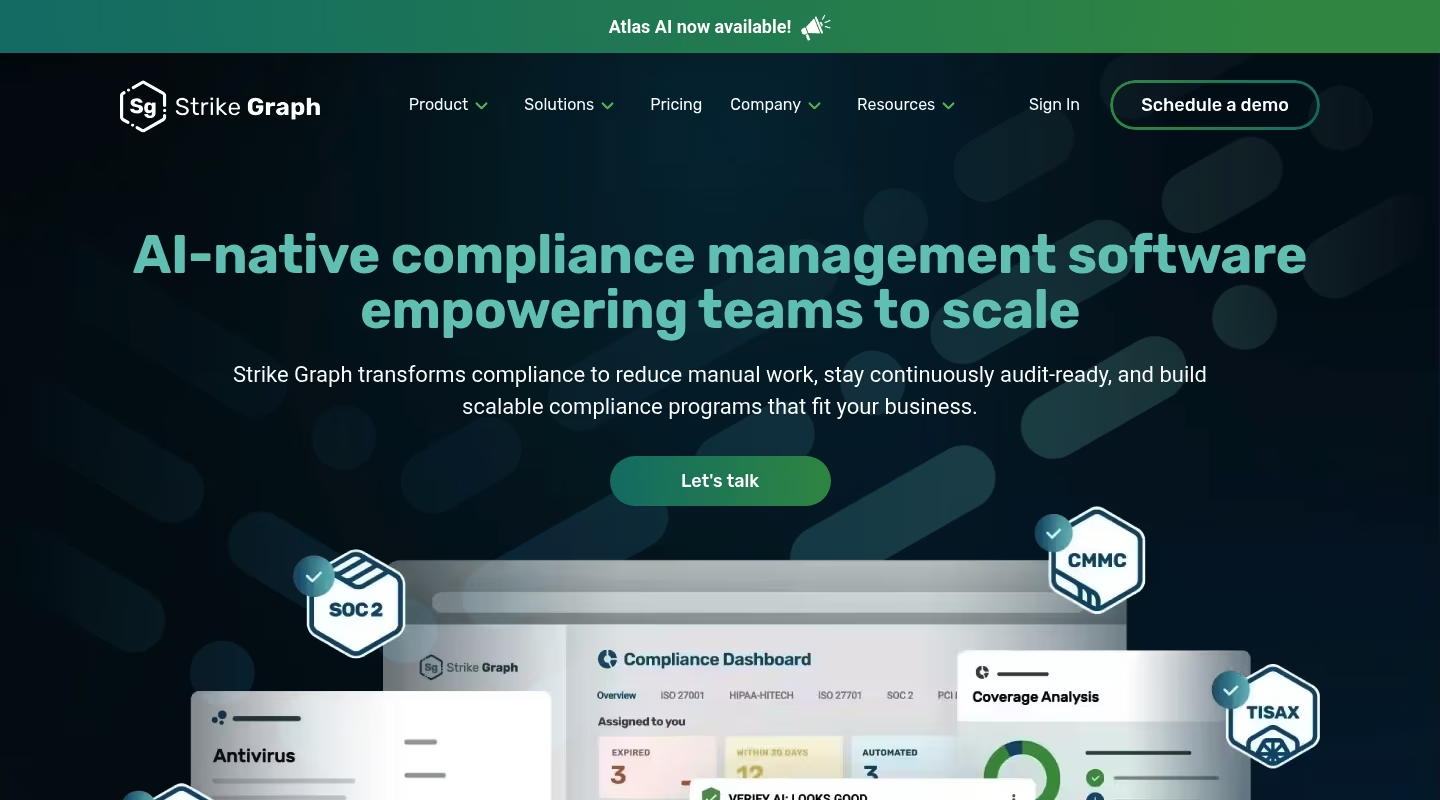
Strike Graph is an AI-native compliance platform that tests evidence against controls with Verify AI and pairs it with vulnerability scanning, plans of action and system security plans.
What it does
- Verify AI tests uploaded and collected evidence against each control.
- Vulnerability scanning and plans of action and milestones in the same platform.
- A read-only Security Assistant MCP server for Claude, ChatGPT and other MCP clients.
- Dashboards and reporting for audits and certifications.
Who it suits
Security teams that want monitoring and remediation planning for commercial and government-facing programs in one tool.
Frameworks
Commercial security frameworks plus the system security plan and plan-of-action records that government programs use.
Pricing
Quote-based; its help center also explains AI consumption pricing, so ask how the vendor bills AI use.
Limitation
Reviewers report a learning curve with evidence collection (20 G2 mentions) and too little guidance for newcomers (14 mentions).
7- Onspring
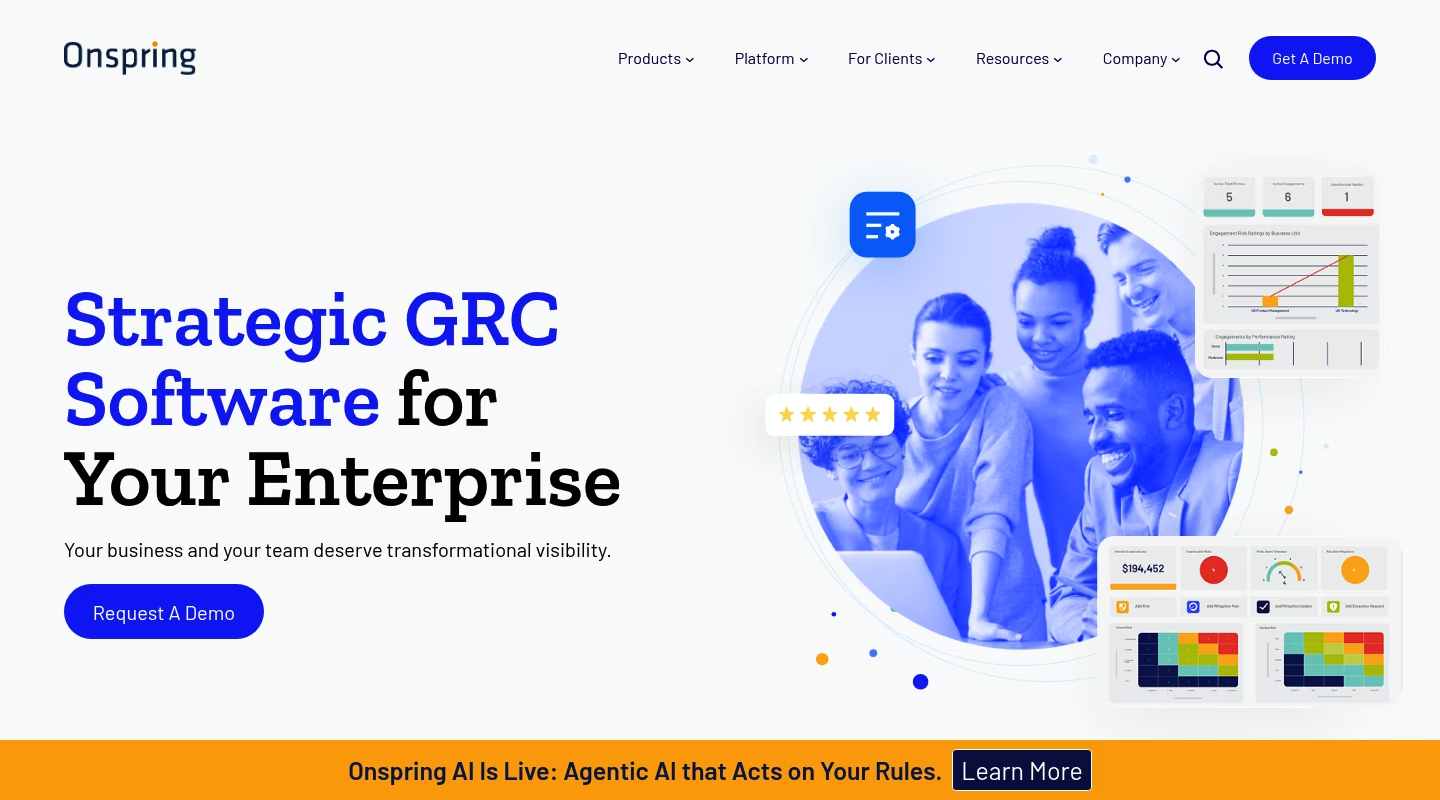
Onspring is a no-code GRC platform that customers configure to run their risk registers, policy exceptions and remediation tracking in one place.
What it does
- No-code configuration of workflows, reports and dashboards.
- Risk registers, policy exception tracking and remediation workflows, according to its customers’ G2 reviews.
- Automation options that teams set up to fit their own processes.
- Responsive and knowledgeable support, praised in 14 G2 reviews.
Who it suits
Enterprises that want to design their own monitoring and risk processes instead of adopting a prebuilt program.
Frameworks
Configured by the customer around its own obligations.
Pricing
Quote-based.
Limitation
Reviewers call the learning curve steep because of tricky configuration and formulas (10 G2 mentions).
8- LogicGate
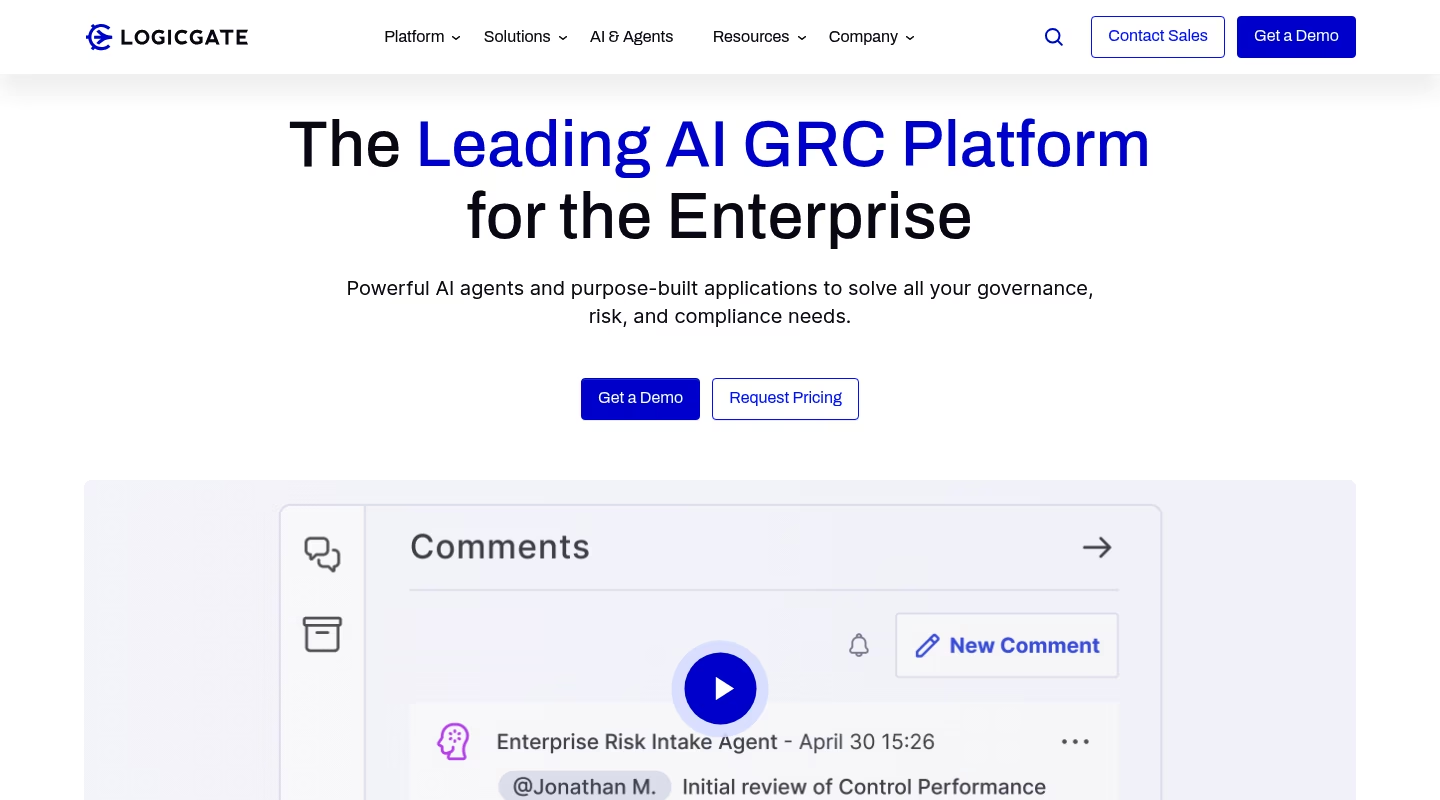
LogicGate sells Risk Cloud, a no-code GRC platform. Its Controls Compliance solution takes repetitive evidence tasks off control owners and layers AI control testing on top.
What it does
- Automated evidence tasks for control owners.
- AI control testing on top of evidence collection.
- Cross-mapping that links each control to dozens of frameworks.
- Regulatory Compliance Management, a separate product that follows rule changes.
Who it suits
GRC teams that like to design their own workflows and have the staff to do it.
Frameworks
Dozens of frameworks through cross-mapped controls.
Pricing
Quote-based.
Limitation
Reviewers find the initial setup hard without prior GRC experience (5 G2 mentions).
9- Optro (formerly AuditBoard)
Optro, the platform once called AuditBoard, adds ready-made IT control monitoring to an enterprise audit and risk suite.
What it does
- Prebuilt templates that watch common IT controls.
- AI support for mapping controls and spotting gaps.
- One set of controls and evidence reused across business units and auditable entities.
- Audit, risk and compliance modules on one platform.
Who it suits
Internal auditors and enterprise risk managers who run IT control checks as part of a bigger audit plan.
Frameworks
Enterprise frameworks across audit, risk and compliance, including SOX.
Pricing
Quote-based.
Limitation
Reviewers most often say analytics are hard to reach (71 G2 mentions), followed by limited customization (54 mentions).
10- Drata
Drata tests controls again on a set schedule and keeps every result as history for the auditor, with custom connections for homegrown and on-premise systems.
What it does
- Recurring automated tests with a full pass and fail history.
- Custom connections for systems outside its standard integrations.
- An MCP server that can read monitoring results and carry out 26 types of change, within each user’s permissions.
- The SafeBase trust center for sharing posture with buyers.
Who it suits
Engineering-led teams with an in-house owner for compliance.
Frameworks
Multiple frameworks, with each control mapped once and reused.
Pricing
Quote-based.
Limitation
Reviewers cite limited third-party integrations (43 G2 mentions) and complexity when moving from another tool (38 mentions).
11- Vanta
Vanta runs more than 1,400 automated tests every hour through its integrations, according to its own product pages, and cross-maps controls across 35+ frameworks.
What it does
- Hourly automated tests across cloud, identity and endpoint tools.
- Personnel monitoring for training, background checks and policy acceptance.
- The Vanta AI Agent and an MCP server in public preview since June 2025.
- A trust center and a network of partner audit firms.
Who it suits
Companies with an in-house security owner and a broad tool stack.
Frameworks
35+ frameworks, cross-mapped.
Pricing
Quote-based tiered plans.
Limitation
Integration problems that force manual work lead the G2 complaints (179 mentions), and many reviewers find the price hard to absorb.
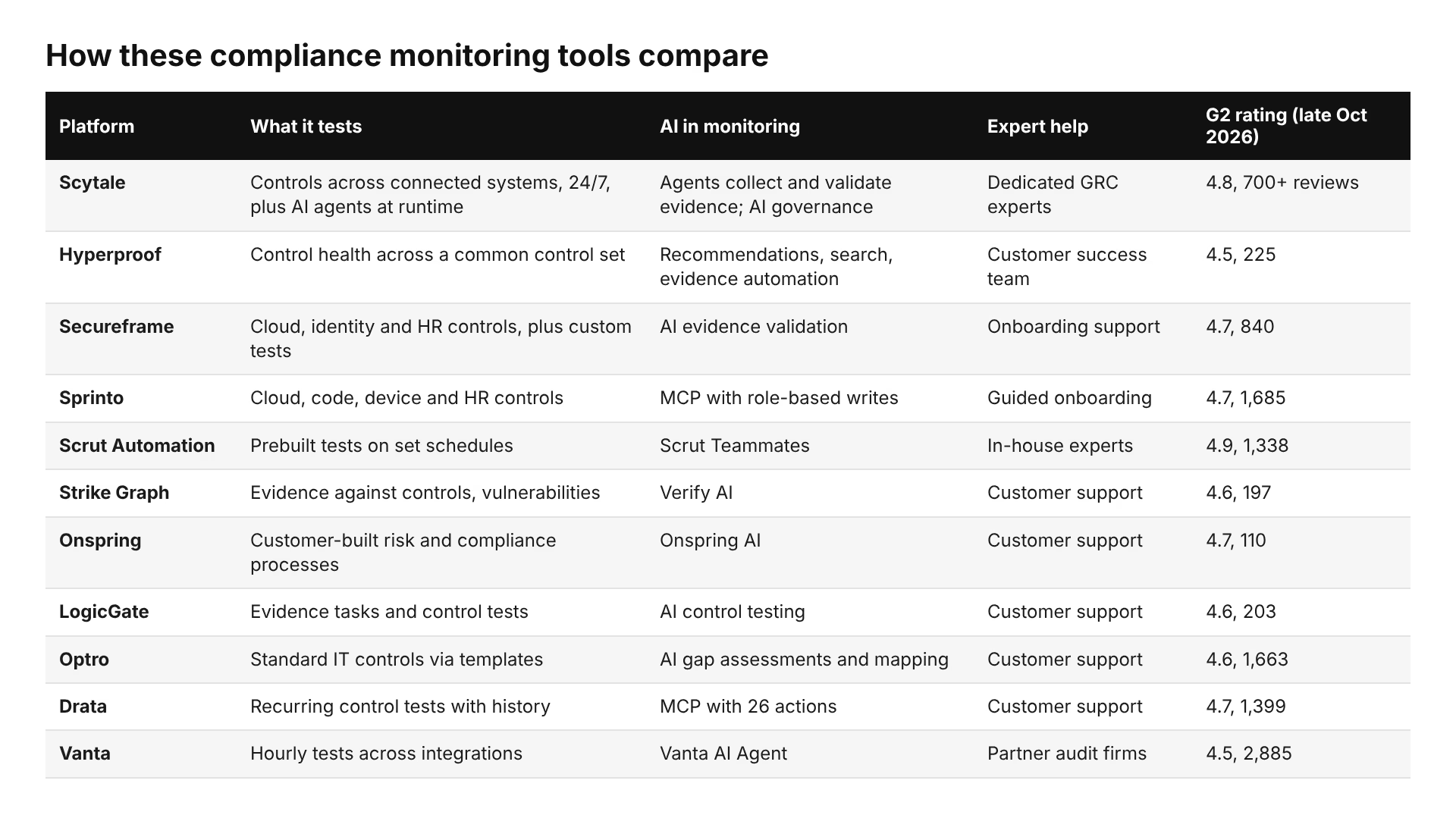
How do these compliance monitoring tools compare?
Which rules make continuous monitoring a requirement in 2027?
Several rules that apply now, or will by the end of 2027, expect companies to spot and report problems within days or hours. A quarterly review can’t meet those clocks. This map shows what each rule asks you to watch and the evidence a monitoring platform should keep.
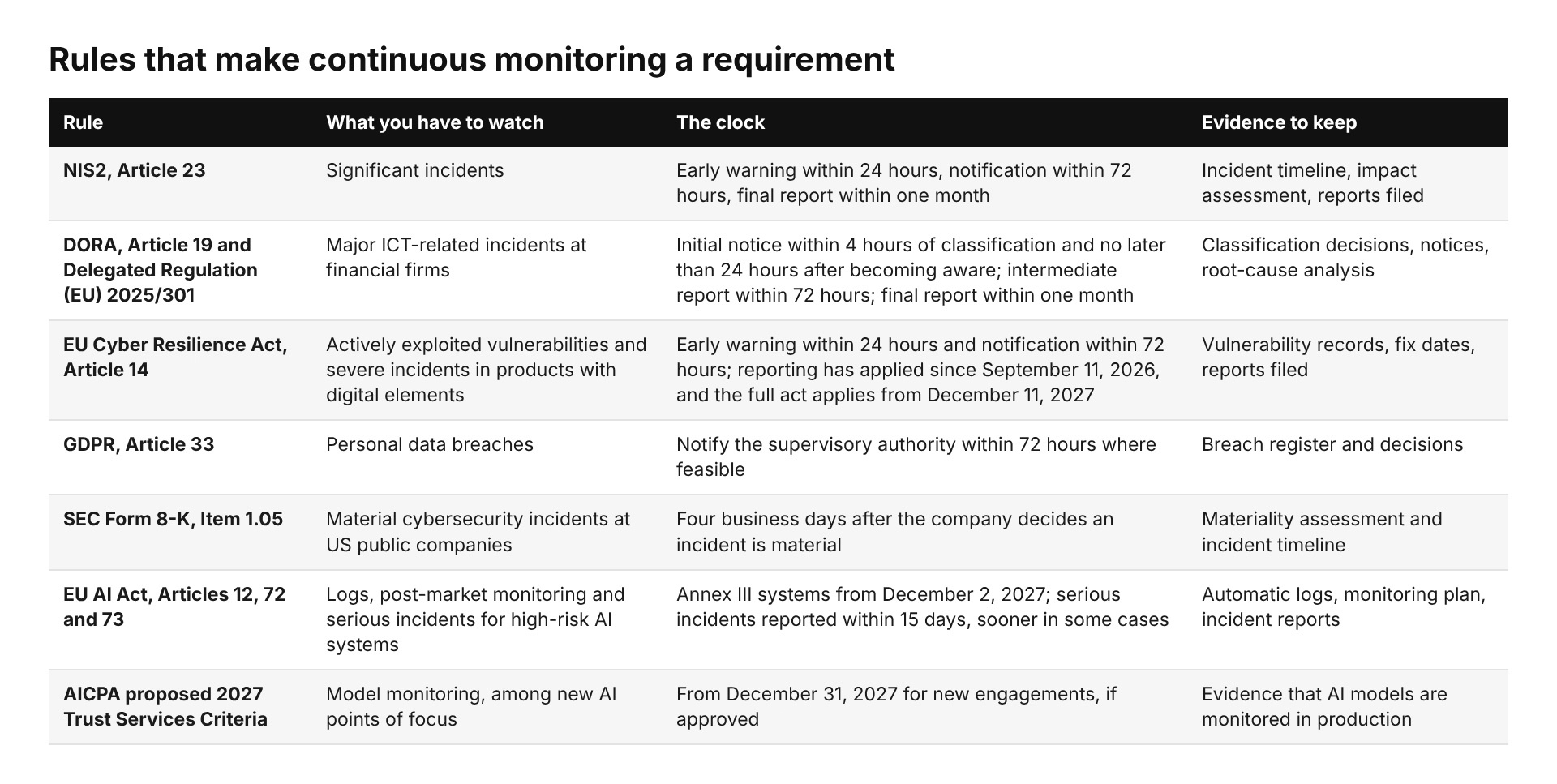
Sources: Directive (EU) 2022/2555; Regulation (EU) 2022/2554 and Delegated Regulation (EU) 2025/301; Regulation (EU) 2024/2847; Regulation (EU) 2016/679; SEC Form 8-K Item 1.05; Regulation (EU) 2024/1689 as amended by Regulation (EU) 2026/1744; AICPA exposure draft, October 2026.
The pattern across these rules is the same. Each one assumes you’ll know about a problem soon after it starts, and each one asks for a record showing when you knew. Continuous monitoring produces that record as a side effect.
How is AI changing compliance monitoring?
AI now works on both sides of monitoring. On the platform side, AI agents test controls, check evidence and draft fixes: Scytale’s AI GRC agents validate evidence and suggest remediation, Strike Graph’s Verify AI tests evidence against controls, and Scrut Teammates and Hyperproof AI help with risk and compliance tasks.
Most vendors in this list also run an MCP server, so a team can ask Claude or ChatGPT about control status instead of opening a dashboard.
On the other side, AI has become something companies have to monitor. Approving an AI system once doesn’t keep it safe, because models get updated and agents pick up new permissions over time. Scytale’s AI Governance module watches agents at runtime and flags risky activity to the owner, and the AICPA’s proposed 2027 criteria add model monitoring as a point of focus.
Gartner predicted in March 2026 that through 2027, manual AI compliance processes will expose 75% of regulated organizations to fines exceeding 5% of their global revenue. Auditors are tightening their side too: the IAASB proposed revised standards on audit evidence in August 2026, with stronger requirements for judging whether information is reliable. AI-generated evidence will get checked like any other, so pick a platform where a qualified person reviews what the AI produces.
How do you pick the right compliance monitoring platform?
- List the frameworks you carry now and the ones due by 2028, including any AI framework.
- List where your in-scope controls live: cloud accounts, identity provider, HR system, code repositories and endpoints.
- Ask each vendor to run live tests against those systems during the demo.
- Check who acts when a test fails. A named owner inside the platform helps; a dedicated GRC expert helps more when your team is small.
- Ask how the platform will monitor AI agents and models, and how it will handle the proposed 2027 criteria.
- Confirm the evidence trail: every pass and fail with a date, which is what auditors and regulators ask for.
What does compliance monitoring software cost?
All eleven vendors here price by quote, so the cost depends on scope. Price grows with the number of frameworks and the size of your stack, and it depends on whether expert support comes with the platform or as a separate engagement. Ask each vendor which applies, and price both routes.
Count the hours too. Every alert needs someone to fix it, and a self-serve platform leaves that work with your team. Set the internal time next to the subscription before you compare quotes.
What are the common mistakes when choosing a monitoring tool?
- Buying for cloud coverage alone. Identity and HR systems fail controls too, through stale accounts and missed training.
- Assuming every alert reaches the right person. Without owners, alerts pile up in a dashboard nobody opens.
- Treating AI as a black box. If nobody reviews the AI’s output, its mistakes become audit findings.
- Ignoring the reporting clocks. A tool that finds an incident but can’t show when you found it won’t help with NIS2 or DORA reporting.
- Adding another point tool. Each extra tool means another integration to maintain and another dashboard to check, so consolidate where you can.
Which compliance monitoring software should you choose?
The best compliance monitoring software keeps controls tested between audits and makes sure a person acts when a test fails, with every result on record. Enterprises with large audit and risk programs will find Optro, LogicGate or Onspring closer to how they already work.
Teams with an in-house owner can run Drata or Vanta themselves. If you carry several frameworks and want controls tested around the clock with a dedicated GRC expert behind every alert, start with Scytale’s AI GRC platform, which also watches the AI agents now running inside your own systems.
Get the TNW newsletter
Get the most important tech news in your inbox each week.
Sponsored content. Not produced by the TNW newsroom and does not reflect the editorial stance of TNW. This listing is not an independent editorial ranking.


