
 Credit: Simon Kadula on Unsplash
Capabilities below come from each vendor’s own pages and release notes as of November 2026. “Ask the vendor” marks anything those sources don’t spell out.
The dates machine builders are working back from
On January 20, 2027, Regulation (EU) 2023/1230, the Machinery Regulation (MR), replaces Machinery Directive 2006/42/EC for every machine you place on the EU market. From then on, a machine must identify the software it needs for safe operation and provide that list “at all times”. It must also collect evidence of any intervention in that software. It must also keep a tracing log of safety-software uploads switched on for five years. The 24-hour reporting clock in the Cyber Resilience Act (CRA) started sooner, on September 11, 2026.
- June 11, 2026 · The CRA’s notified-body chapter (Articles 35 to 51) applies.
- September 11, 2026 · CRA Article 14 reporting goes live, with a 24-hour early warning and a 72-hour notification.
- End of 2026 · The European Commission expects the first harmonized-standards list under the MR. None had appeared as of November 2026.
- January 20, 2027 · The MR applies to every new machine placed on the market.
- December 11, 2027 · The CRA applies in full, SBOM duty and CE marking included.
- August 2, 2028 · Delegated acts adding AI requirements to MR Annex III must apply by this date, under Regulation (EU) 2026/1744.
Work backward from a machine you plan to ship in February 2027. Its technical file must list the protective measures behind each safety requirement and the tests that verified them. You must also be able to supply the safety software’s source code or programming logic on a reasoned request from a national authority. Under Article 10 you keep that file for at least 10 years. For Annex III 1.1.9 and 1.2.1(f), the file has to describe the solution you applied, and because every one of these duties is record-keeping, the tool decision comes before January 20.
Six jobs that separate requirements management software for machine builders
The difference between these tools is how much evidence they produce on their own and how much your engineers assemble by hand, and six jobs show that split.
01 · Software-version evidence. Annex III puts software identification and the upload log on the machine itself. Your side of that is the engineering record: tested requirements and a baseline per release. Teams working to ISO 13849-1:2023 and IEC 62061 already keep that kind of record for safety functions. From 2027 the MR extends it to every safety-software version a shipped machine receives.
02 · Change impact before release. Under Article 3(16), an unplanned change “by physical or digital means” that adds a hazard or raises a risk counts as a substantial modification. You need to see which ISO 12100 risks and tests a firmware change touches, and who signed off.
03 · Component-to-product mapping. A CRA early warning, due within 24 hours, states the EU countries where you know the affected product is on the market, so you need records tying each software component to the releases that carry it. Teams already working to IEC 62443-4-1 for secure development have a head start on that record.
04 · PLM coexistence. BOMs and CAD stay in PLM, so requirements need links into the PLM system, whether Teamcenter, Windchill or Aras. Know which way each link runs.
05 · Reuse across machine families. Configure-to-order lines share most requirements, so look for approved requirements reused across configurations, plus a view of which variants a change affects.
06 · Supplier exchange. Drives and safety controllers come with their makers’ specs, and ReqIF moves those requirements both ways without retyping.
The comparison: eight tools against the 2027 evidence duties
Each regulatory row names the clause behind it.
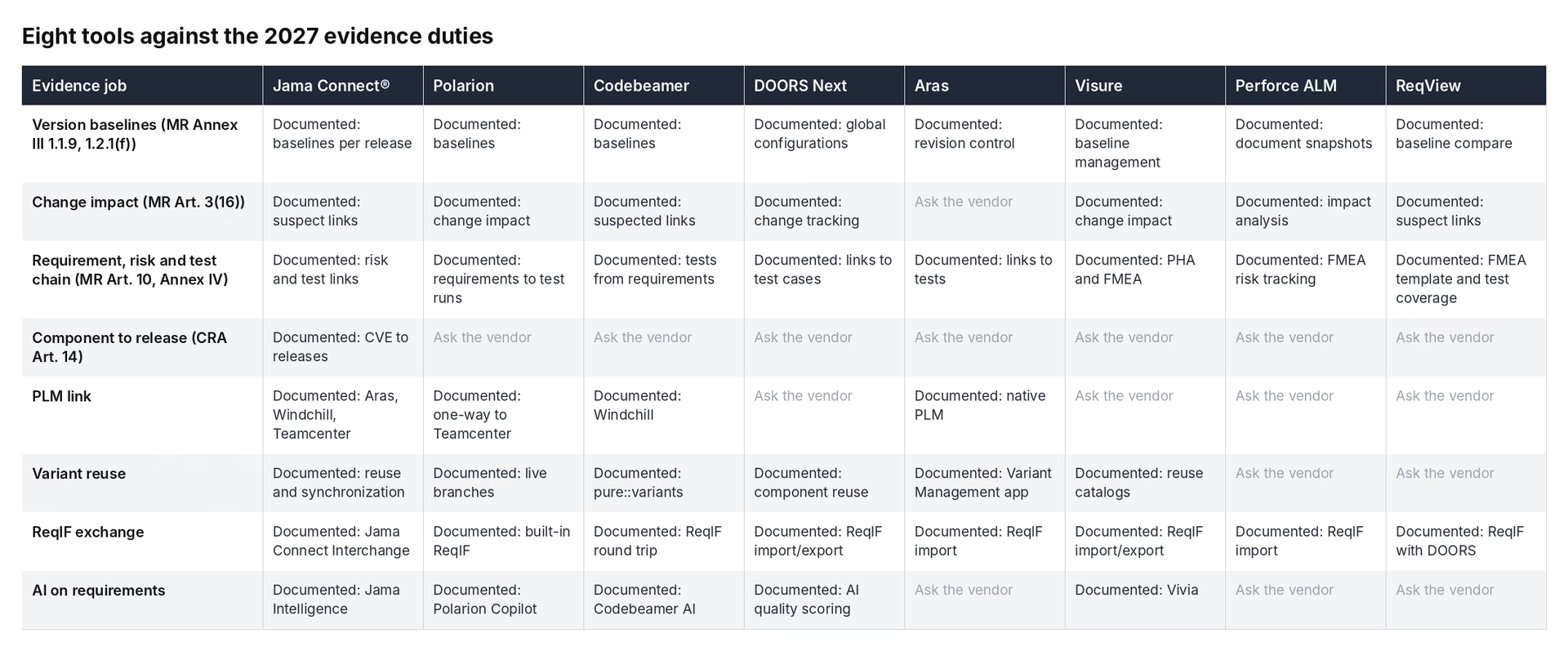
The eight tools, entry by entry
1) Jama Connect
Jama Connect®, which Jama Software® describes as a product context layer platform, gives mechanical, electrical, controls and software teams one governed record via its Industrial Machinery Development Solution and its Traceability Information Model (TIM). Live Traceability™ links a requirement written for an MR or CRA clause to its risk and test. Suspect links flag what a changed safety-PLC requirement touches before approval in Review Center.
PDF Import and Document Extraction takes a regulation PDF and turns its clauses into structured requirements; Relationship Discovery proposes links between selected items. Engineers confirm each proposal within their permissions and can ask the Assistant: “Summarize the selected safety-PLC requirements and flag any without a linked verification test.” Jama Intelligence stays focused and governed inside the workflow, while broader exploration can occur through complementary AI and MCP experiences. Jama Connect integrates with Teamcenter, Windchill and Aras; Jama Connect Interchange exchanges ReqIF files with suppliers.
Set up the TIM and the Review Center workflow in week one of the pilot.
2) Siemens Polarion
Siemens Polarion ALM is the application lifecycle management platform in the Siemens portfolio. Its Teamcenter Direct Integration, announced on Siemens’ blog in August 2025, sends approved requirements into Teamcenter PLM over what Siemens calls a “live, one-way link.” Siemens’ specifications fact sheet lists built-in ReqIF exchange, plus live branches and document reuse for handling specification variants. The May 2026 Polarion 2606 release notes describe a new Copilot API and custom LLM connectors, building on the Polarion Copilot features that arrived in the 2512 release.
In your pilot, push an engineering change from Teamcenter toward a linked requirement and see how the one-way design fits your change process.
3) PTC Codebeamer
In January 2026, PTC paired version 3.2 of the Codebeamer ALM platform with Codebeamer AI 1.0 and shipped pure::variants 7.2 for variant management alongside them. Codebeamer AI’s Requirements Assistant flags quality issues against INCOSE and ISTQB guidance, and its Test Case Assistant generates and optimizes test cases from requirements. PTC’s digital-thread integration connects Codebeamer to Windchill PLM, and PTC’s help center documents ReqIF export and import round trips with exchange partners.
Over a pilot, time how long your admin needs to wire up the Windchill link and one pure::variants model, since configuration effort is a recurring theme among its G2 reviewers.
4) IBM DOORS Next
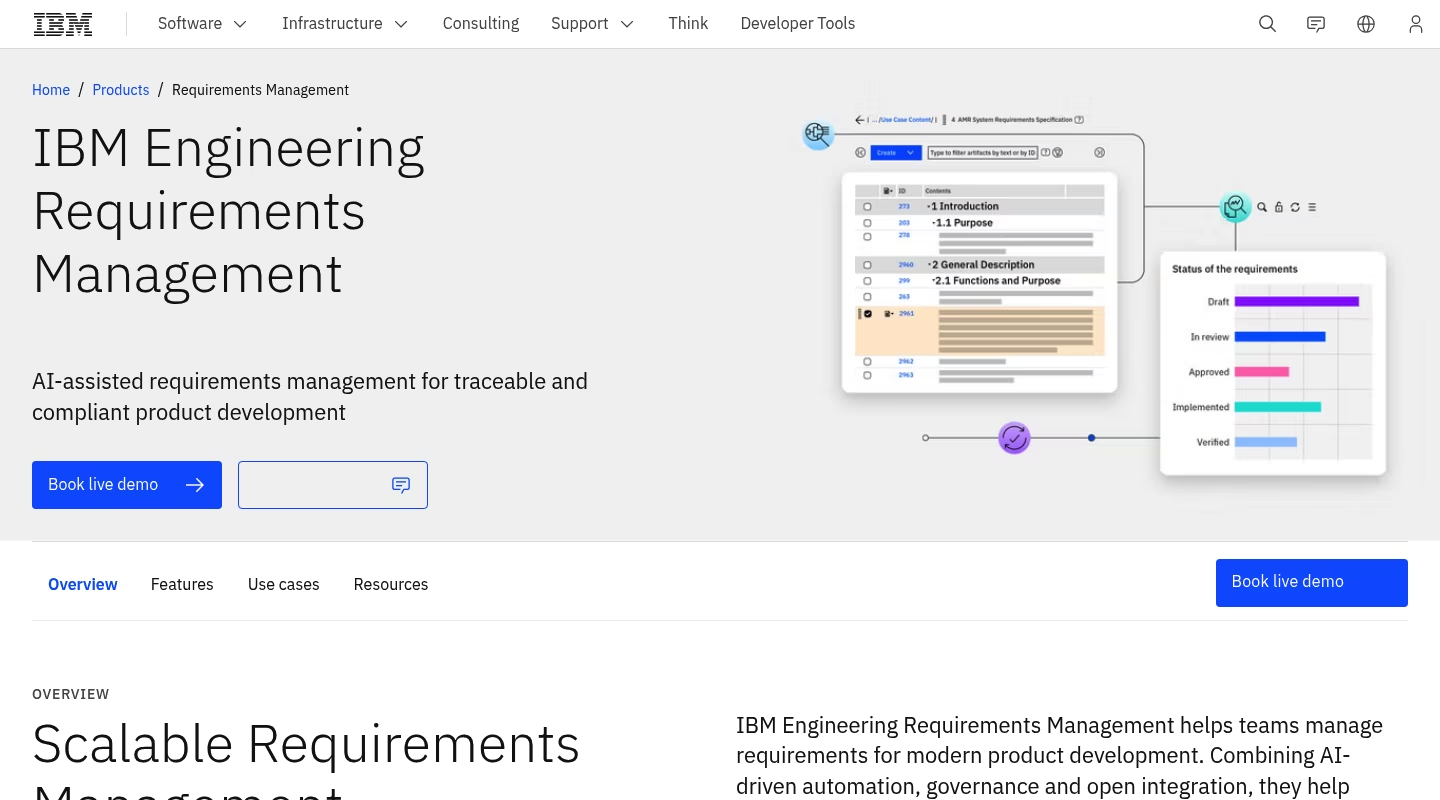
Inside IBM Engineering Lifecycle Management, the web-based IBM Engineering Requirements Management DOORS Next now carries IBM’s tagline “AI-assisted requirements management for traceable and compliant product development.” Its AI scores requirement quality and supports natural-language queries and summaries. For machine families, IBM points to global configurations and component reuse, with change tracking across parallel development streams, and IBM’s docs cover ReqIF import and export. G2 reviewers raise price and administration effort most often, and teams leaving classic DOORS for DOORS Next mention migration pain.
Before you sign, have your admin build one global configuration for a two-variant machine with shared safety requirements, then price the licenses your controls engineers and reviewers would need.
5) Aras Innovator Requirements Engineering
Aras describes its requirements engineering application as “managing requirements within a PLM platform,” part of a digital thread on the Aras industrial low-code platform. Requirements connect to system models and design details, and from there to simulations and tests, under what Aras calls formal revision control and configuration management. Aras demonstrates ReqIF import of requirements written in DOORS and Cameo, so teams with existing specs don’t have to start from scratch. Its separate Variant Management application, which Aras updated in a May 2023 release, handles variability across product representations.
Use the pilot to run one requirement change end to end in Aras, and time that loop against your current release process.
6) Visure Requirements ALM
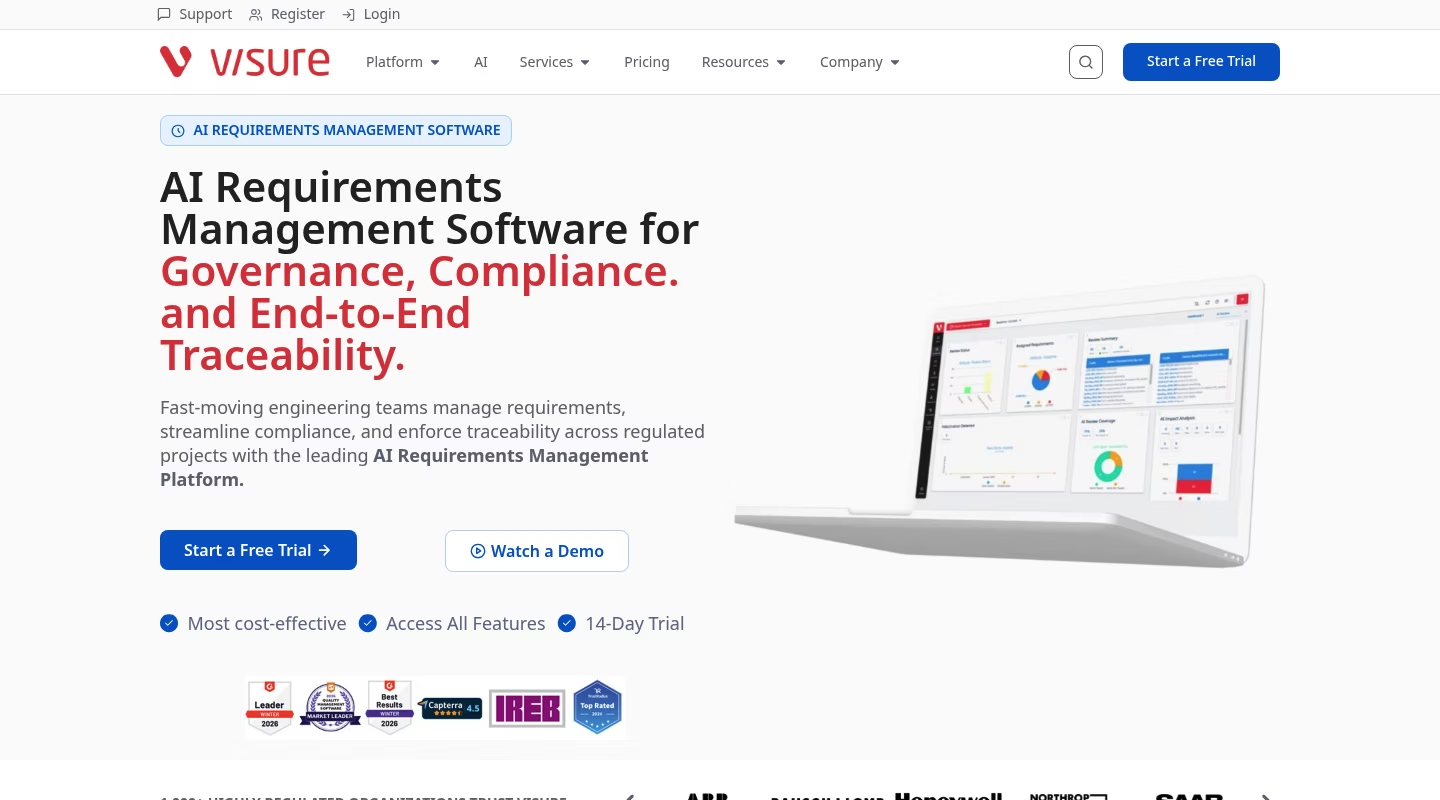
Visure Solutions runs an industrial-manufacturing page for Visure Requirements ALM that names IEC 60812 alongside ISO 9001 and describes a risk management profile built with PHA and FMEA. The same page describes upstream and downstream views to anticipate change impact, plus reusable requirements catalogs for product variants. Vivia, Visure’s AI assistant, sits beside quality analysis that runs while you write, and Visure offers on-premises licensing and ReqIF import and export. The G2 review base is tiny, though the few reviewers there say initial configuration takes work and that updates can need vendor help.
Run the pilot on your own FMEA and a real CRA component list, and track how much of the setup Visure’s services team ends up doing.
7) Perforce ALM
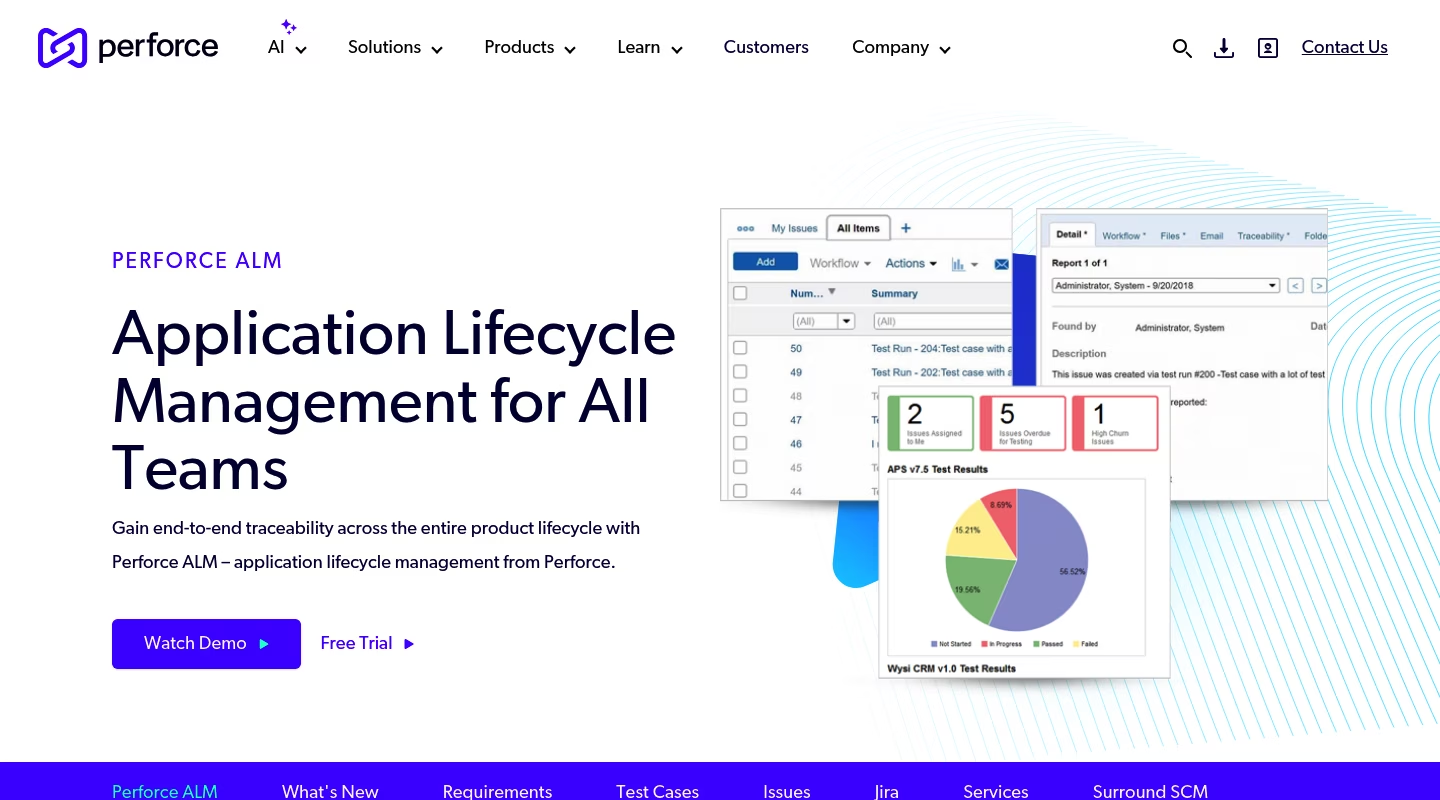
Perforce renamed Helix ALM to Perforce ALM in March 2025 and promises automatic end-to-end traceability with easy-to-configure workflows. Test case management traces each test back to its requirement, and built-in risk tracking covers FMEA and hazard analysis. Perforce also documents forward and backward impact analysis, so Perforce ALM shows the test cases and defects linked to a changed requirement. Reviewers on G2 bring up setup and integration effort, and some call the product expensive.
During a trial, link one hazard to its safety requirement and test, then change the requirement and check whether the impact view gives an approver enough to judge a substantial modification.
8) ReqView
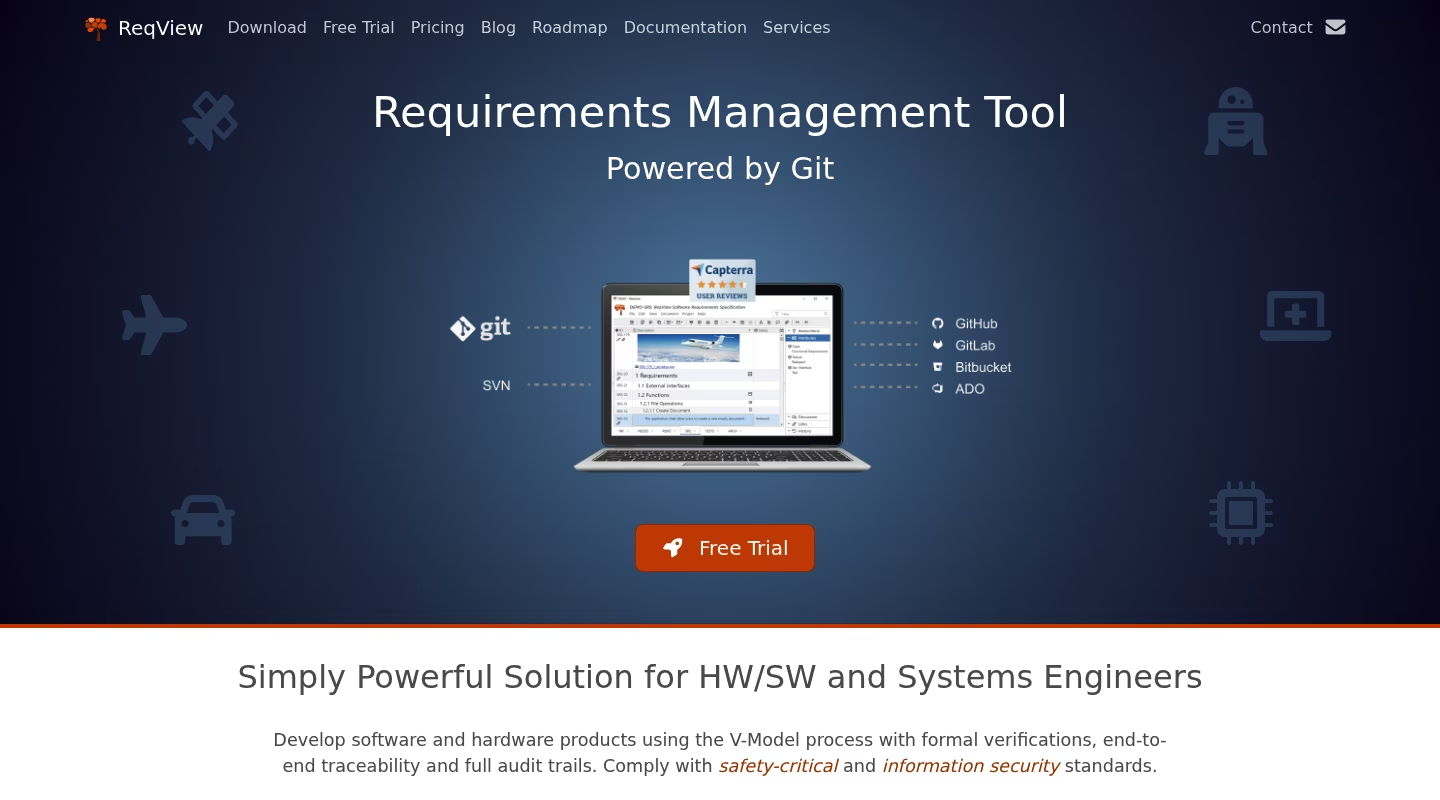
ReqView pitches itself as “requirements management software for regulated industries,” aimed at HW/SW and systems engineers who want to “track requirements in Git as your source code.” It exchanges ReqIF with IBM DOORS and connects to Jira, and its templates follow ISO/IEC/IEEE 29148:2018. Its change-management docs describe links that turn suspect when their target changes, plus comparison against a saved baseline, with Git or SVN keeping a second project history. ReqView has too few G2 reviews to show a pattern.
Test it by keeping one machine’s requirements in the same Git repository as its PLC code, then check that a reviewer outside the software team can read the history.
Which system keeps which piece of the evidence
Compliance evidence for one machine ends up in four kinds of software.
PLM owns the BOM and the engineering change orders, so it records what’s in the machine.
The requirements tool owns each requirement and its chain to risks and tests, so it records why each design choice exists and how you proved it.
CE-marking and safety-calculation tools do narrower jobs. IBF’s Safexpert calls itself “modular software for CE marking and risk assessment of machinery, plants and electrical equipment.” It supports EN ISO 12100 risk assessments and carries templates for declarations of conformity. SISTEMA, a free tool from Germany’s IFA, calculates the Performance Level a safety control achieves under ISO 13849-1.
SBOM tools produce the machine-readable software bill of materials that CRA Annex I asks for.
To file a CRA early warning, you need the SBOM tool to find the component and the requirements record to name the releases it touches.
The buyer checklist
Run each shortlisted tool through these with one real machine family loaded.
- Can it show an 18-month-old baseline and the safety-software requirements that release carried?
- Change one firmware requirement in the demo. Does it flag the affected risks and tests, and show who approved the change?
- Name a component. Can it list every machine release that contains it while you watch?
- Does the PLM link run one way or both, and does a change order in PLM propagate to the requirement it affects?
- Can it import a ReqIF file from your drive supplier and send the updated version back?
- Does it store a shared platform requirement once, with variants branching only where they differ?
- Point the AI at a real standards PDF. Can you see what it proposes and who confirms it?
- Can you export the whole record, links intact, in formats you could open in 10 years?
If you build in small batches or configure to order
The Commission’s Blue Guide treats placing on the market as a unit-by-unit event, which means a machine you configure in February 2027 falls under the Regulation even when its twin shipped under the Directive in December 2026.
At low volume, write platform requirements once and branch only what a configuration changes, since copying the full spec per order multiplies the history you’d defend. Link risks and tests from the first order. Spreadsheets and ticket trackers can store requirements, though without add-ons they don’t keep live links from a software component to the machines that carry it, a gap the first CRA early warning will expose.
What none of these can do
- None of them makes a machine compliant. Annex III 1.1.9 and 1.2.1(f) describe the machine itself, so software identification and the five-year log come from your controls platform.
- None of them replaces a notified body. Annex I Part A machinery goes to third-party assessment whatever tool produced the file.
- None of them can rebuild a decision nobody wrote down. Importing old files won’t add an impact review that never happened.
- None of them decides what counts as a substantial modification. Your engineers and compliance lead make that call. The tool keeps the record.
Choosing requirements management software for machine builders before January 2027
Start with the calendar. CRA reporting is already live, and the Machinery Regulation follows in January 2027. Pick a shortlist from the matrix, and treat every “Ask the vendor” cell as an item for the demo agenda. Run the checklist on a machine family you ship today before the Regulation applies. Judge each one by the evidence it leaves behind after an ordinary week of engineering, because that evidence is what a national authority can ask to see. Jama Connect makes a strong case, since the TIM in its Industrial Machinery Development Solution and its suspect links help build the engineering record the 2027 rules ask for while engineers do their normal work.
Common questions
When does the EU Machinery Regulation replace the Machinery Directive?
Regulation (EU) 2023/1230 applies from January 20, 2027. The June 2023 text said January 14, and a July 2023 corrigendum moved the date. Machines placed on the EU market before then must comply with Directive 2006/42/EC, and Article 52 lets those units stay available afterward. Every unit you place from January 20 onward must meet the Regulation, software clauses included.
Does a software update count as a substantial modification?
Sometimes. Article 3(16) covers a change “by physical or digital means” that the manufacturer didn’t foresee or plan. The change also has to create a new hazard or increase an existing risk. An update your risk assessment already covered doesn’t meet that test, while an unplanned change to a safety function might. Article 18 treats whoever makes a substantial modification as the manufacturer, so record the reasoning every time.
Does the Cyber Resilience Act apply to industrial machinery?
Yes, when the machine counts as a product with digital elements. The CRA’s Article 2 carves out sectors with their own rules, such as medical devices and vehicles, and machinery isn’t among them. Recital 53 confirms such machines fall under both laws’ essential requirements. It adds that CRA compliance can help with the MR’s corruption-protection clauses, so your engineers can build one risk-to-test chain and use it for both files.
Which Cyber Resilience Act obligations already apply?
The notified-body chapter has applied since June 11, 2026. Article 14 reporting followed on September 11, 2026 and covers products already on the market. You report exploited vulnerabilities and severe incidents through ENISA’s Single Reporting Platform, starting with an early warning within 24 hours. Jama Software’s Cyber Resilience Act guide treats that first step as a traceability question: which products contain the affected component, and where they’re sold.
How does the EU AI Act apply to AI-enabled machinery after the Digital Omnibus?
Regulation (EU) 2026/1744 entered into force on July 27, 2026. It moved machinery to Section B of the AI Act’s Annex I and pushed high-risk duties for Annex I systems to August 2, 2028. The AI requirements will arrive as delegated acts amending MR Annex III by that date. Safety components with self-evolving machine-learning behavior still need a notified body from January 20, 2027. Teams with Jama Intelligence can import each act through PDF Import and Document Extraction, then review each extracted requirement in Jama Connect.
Get the TNW newsletter
Get the most important tech news in your inbox each week.
Sponsored content. Not produced by the TNW newsroom and does not reflect the editorial stance of TNW. This listing is not an independent editorial ranking.


