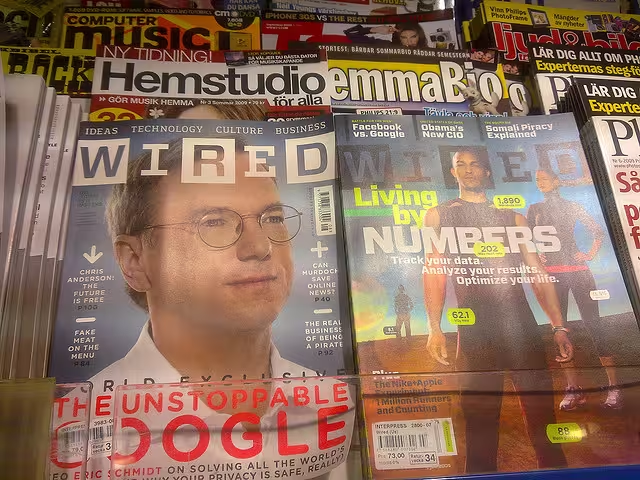
Today at CES, former Google CEO Eric Schmidt joined a CNET discussion about how his company is doing in every phase of its business.
It would be an understatement to say that Schmidt is bullish on Google’s plan for dominating the mobile market with Android, stating that the company is doing well with its plan to sell one billion units. During the discussion, he poked a bit at competitors Apple and Microsoft.
His major argument against Apple consisted of Google’s plan to build an ecosystem filled with happy developers. He wants these developers to “have a good time” with the Android platform. Apple’s developer ecosystem is notoriously filled with frustrating constraints that require app creators to follow strict guidelines or not make it onto the app store.
When it came to Microsoft, Schmidt said this:
Microsoft is trapped in an architectural problem they might not get through.
While it’s quite a damning statement, it appears that Microsoft is finding its way out of the woods in a few facets of its business. Obviously XBox is doing quite well, but Windows 8 looks promising and Windows Phone is getting positive attention as well.
Fragmentation of the Android market, due to so many handset providers, has been a hot topic. When asked about this, Schmidt fired back with:
You have to be careful with that word, fragmentation.
It appeared to be a touchy subject, but Schmidt pointed out that he prefers to label the choice of handsets as “differentiation”, meaning Android users have a choice of which handset they purchase, as opposed to Apple’s approach of one new device on the market at a time.
From what Eric Schmidt is telling us, it looks like Google is taking the popular holistic approach to attracting consumers. With Android, Google TV, Music, Google+, and search, the company is trying to surround consumers with technology that follows them around everywhere they go. This is the same approach that Samsung is taking with its Smart TVs and mobile devices, the latter of course running Google’s Android operating system.


I like that Android isn't fastened to a specific device, like it is the case with iOS and iPhones. In 2011, the number of Android smartphones rose to a record 194 percent. 2011 results for the mobile development world http://k-selezneva.blogspot.com/2012/01/2011-results-for-mobile-development.html
- spam
- offensive
- disagree
- off topic
LikeKaterina Selezneva
Shove your blog spam.
- spam
- offensive
- disagree
- off topic
LikeEric Schmidt is stupid. Fragmentation means that the user base have inconsistent Android versions, which impacts the apps being sold in the market.If I'm an app developer, and develop for the latest version of Android, how can I earn, when the rest of the users aren't updated yet.The only solution to Fragmentation is to develop apps for the Amazon Kindle Fire Android Market. Why? Amazon is always up to date with their Android versions. As a developer I can be confident my apps is accessible to all Kindle Fire customers. And when everyone finds Kindle Fire the solution to Fragmentation, other Android manufacturers will lag, and in the end, we only have Kindle Fire!
- spam
- offensive
- disagree
- off topic
LikeIt sounds like Google failed to establish a hardware reference platform and require adherence to it in the Android license. DUMB.
Windows runs on millions of disparate systems, but you can still update it on the day a new version is released. Users of Android, the "open" and "free" OS, are still waiting around for their service providers to dribble out updates months later (if they ever do). Why isn't the OS insulated from the phone by drivers? Unless an OS update has a new driver model, it should run on older phones.
Does Android lack hardware abstraction?
- spam
- offensive
- disagree
- off topic
LikeYes, Schmidt, consumer have more choices while selecting an Android phone, cool DIFFERENTIATION. But programmers need to do the work for that FRAGMENTATION, and that's not fun...that's worse than coding for just the coolest smartphone around (iPhone, of course).
Dear Android, please limit your manufacturers-partners to 1 or max 3 devices. No more.
Because with so many choices, iPhone is and will continue winning. Bad Differentiatior?
- spam
- offensive
- disagree
- off topic
LikeDifferentiation? If I purchase a device I expect it to run the latest firmware. The whole thing seems misleading to consumers.
Maybe Google should stop showcasing major versions of Android? I don't really see the point of showing off new features at the moment, other than teasing users.
- spam
- offensive
- disagree
- off topic
LikeJimmy Catizone-Loughran Since a phone's average life span is about 2 years I think having more hardware choices outweighs having the latest update; plus we've seen that even with Apple one doesn't get the latest features: e.g. Siri
- spam
- offensive
- disagree
- off topic
LikePeter BrownJimmy Catizone-Loughran Peter, I think you're confused about what Fragmentation means. Here's a graph that explains why it's a problem: http://www.bgr.com/2011/10/27/android-fragmentation-gets-visualized-infographic/But you know what, competitors of Android will be smiling because Schmidt is in denial about a problem that turns off developers from Android.______________________________See perezchapa's comment above that says it all:"Yes, Schmidt, consumer have more choices while selecting an Android phone, cool DIFFERENTIATION. But programmers need to do the work for that FRAGMENTATION, and that's not fun...that's worse than coding for just the coolest smartphone around (iPhone, of course).
Dear Android, please limit your manufacturers-partners to 1 or max 3 devices. No more.
Because with so many choices, iPhone is and will continue winning. Bad Differentiatior?"
- spam
- offensive
- disagree
- off topic
Like