We’re all eyes and ears about the new cool gadgets The Next Web team is checking out at CES, but this is one gadget that didn’t pop up in Las Vegas. Despite that fact, it still deserves some attention and recognition.
At a recent Google developers event in Tel Aviv, a proof of concept for a gadget that could change the way we communicate with the hearing impaired was demonstrated.
Three developers, Oleg Imanilov, Zvika Markfield, and Tomer Daniel, have come up with a glove that interprets sign language and turns it into text using a custom Android app.
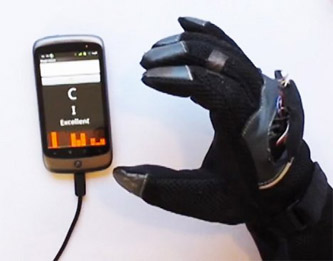
The glove, which is still in its very early stages, would let someone who knows sign language speak in their native language while allowing someone to read the text version of what they’re saying on an Android app that it’s hooked up to. It’s a brilliant idea and the demonstration makes it seem like this product could have a future:
While the device is still being refined, perhaps the team should start a Kickstarter project to get more funding. I imagine that many people who have hearing impaired family and friends would love to be able to use this for communication purposes.
The gesture-sensing project for good is currently dubbed the “Text Glove” and uses an accelerometer, finger sensors, a gyroscope, and Lilypad Arduino to do its magic.


If true would be very helpful for many....
- spam
- offensive
- disagree
- off topic
LikeThis work apparently starts from scratch (again), and doesn't build on prior work (e.g. David Jaffe's work of nearly 20 years ago at the Palo Alto Veteran's Administration Hospital, among others, http://www.baychi.org/calendar/19931109/).
What is the accomplishment here? Recognition of single handshapes (letter shapes) which are then interpreted into words (C-U-L as a play on "see you later" - a message very much colored by borrowing from English). It's a start, but it's not "recognition of sign language," where fine distinctions in movements and hand orientation (direction, rhythm, repetitions, plus point of contact between hands or hands and body) convey both gross and fine distinctions in meaning.
Meredith's comment about video captioning is most apt: it's rude to provide an explanation that excludes a primary audience for this work, deaf people. If there were someone deaf working on this project, some of these issues would have been addressed.
- spam
- offensive
- disagree
- off topic
LikeSeems like the phrase "sign language" is misused here -- if the manual alphabet ("fingerspelling") is all that is meant. Reading fingerspelling is an impressive accomplishment, of course, but keep in mind that deaf signers can type faster than they can fingerspell. If the glove can read signs for words (not just letters), and, even better, track spatial coordination between various signs, that will be a monumental accomplishment. Perhaps it does but the demonstration doesn't seem that way.
- spam
- offensive
- disagree
- off topic
Likefbechter I interpreted this as a really awesome, really cool starting point, with the eventual goal of being able to read more signs after more development. Which I think is so neat.
- spam
- offensive
- disagree
- off topic
LikeWould be nice to have this video captioned.
- spam
- offensive
- disagree
- off topic
Like