 Credit: Whoop
In short: WHOOP has raised $575 million in a Series G round that values the screenless health wearable company at $10.1 billion — nearly three times its 2021 valuation. Backed by sovereign wealth funds, leading medical institutions, and a roster of celebrity athletes, the Boston-based startup is positioning itself for an IPO. Its founder and CEO says the next private round will be its last.
WHOOP, the health wearable company whose screen-free tracker has become a fixture on the wrists of elite athletes and increasingly ordinary people, has raised $575 million in a Series G funding round at a valuation of $10.1 billion. The round, closed on 31 March 2026, nearly triples the company’s last publicly reported valuation of $3.6 billion from 2021 and sets up what founder and CEO Will Ahmed has described as an inevitable path to a public listing.
“It’s our expectation this is the last private round of financing that we’ll do,” Ahmed told Yahoo Finance. “Our next step is an IPO.”
An unusual investor roster
The round was led by Collaborative Fund and draws together an unusually broad coalition of backers. Institutional investors include Mubadala Investment Company and the Qatar Investment Authority, two of the world’s largest sovereign wealth funds, alongside Abbott, the medical devices group, Mayo Clinic, IVP, Foundry Group, Accomplice, Affinity Partners, 2PointZero Group, Glade Brook, B-Flexion, Macquarie Capital, Promus Ventures, and Bullhound Capital.
Among the individual investors are Cristiano Ronaldo, LeBron James, Rory McIlroy, Reggie Miller, and musician Niall Horan. The combination of sovereign capital, clinical institutions, and global sports names is deliberate: it signals that WHOOP no longer sees itself as a fitness gadget maker but as the infrastructure for a broader personal health platform.
“Our raise brings together the world’s most sophisticated investors, leading health institutions, and iconic global athletes behind the mission to unlock human performance and healthspan,” Ahmed said in the company’s official announcement. The inclusion of Abbott and Mayo Clinic in particular, organisations with deep roots in clinical diagnostics and preventive medicine, suggests that the line WHOOP is drawing between consumer wearable and medical-grade health tool is one it intends to make permanent.
From Harvard dorm to health platform
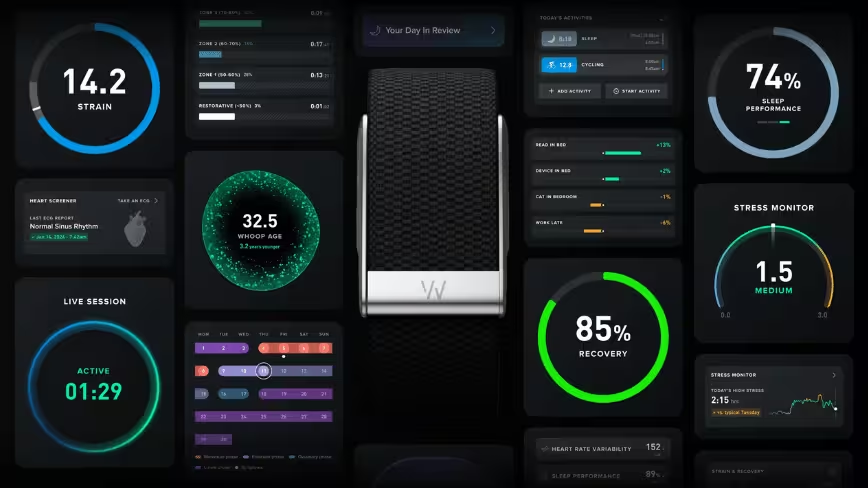
WHOOP was founded in 2012 by Ahmed, a Harvard student-athlete, together with John Capodilupo and Aurelian Nicolae, and was incubated at the Harvard Innovation Labs. The company’s core product has always been defined by what it lacks: unlike the Apple Watch, Fitbit, or Garmin’s devices, WHOOP has no screen, no step counter prominently displayed, and no notifications. Instead, it measures strain, recovery, and sleep continuously, feeding the data into an app that coaches users on the physiological cost of their choices.
That model has found a substantial audience. The company now counts more than 2.5 million members and exited 2025 with a bookings run rate of $1.1 billion, up 103% year on year. The business reached operating cash flow positive during 2025, a milestone that gave credibility to the triple-valuation jump this round implies.
Women represented 150% year-on-year growth in new WHOOP members as of early 2026, with female members engaging with WHOOP’s AI features approximately 30% more than male members, a demographic shift that has informed both product and marketing decisions.
Expanding into clinical territory
In May 2025, WHOOP launched WHOOP 5.0 and WHOOP MG, its first medical-grade device. The MG includes an FDA-cleared electrocardiogram, blood pressure insights, and a Healthspan feature that estimates what WHOOP calls a user’s Pace of Aging and generates a “WHOOP Age” distinct from their chronological one.
In September 2025, the company opened its Advanced Labs service to a 350,000-person waitlist after previewing it earlier in the year. Advanced Labs combines blood testing with continuous wearable data: members can schedule a curated panel of 65 biomarkers, powered by Quest Diagnostics across the United States, with results reviewed by a clinician and automatically synced to the WHOOP app. Pricing runs from $199 for a single test to $599 for four tests a year. In March 2026, WHOOP launched a dedicated women’s health panel covering 11 biomarkers relevant to cycle regulation and hormonal transitions.
The ambition is to create a continuous feedback loop: wearable data informs the interpretation of blood results, which in turn refine the daily coaching that WHOOP delivers through its app. Investor appetite for this kind of AI-assisted health data platform has been growing sharply, with specialised funds deploying capital into companies that sit at the intersection of diagnostics, continuous monitoring, and machine learning.
AI and talent as a dual bet
In March 2026, WHOOP announced a hiring surge of more than 600 roles globally as it scales its health platform. The timing is notable given broader debates in the tech industry about whether AI tooling reduces the need for headcount. Ahmed addressed this directly.
“Right now, companies are debating whether to hire more people or just invest in AI. We are doing both,” Ahmed said. “We are doubling down on exceptional talent and doubling down on world-class AI tools because the combination is what wins.”
The Series G proceeds will fund that dual expansion: growth in the United States alongside international expansion into Europe, the Gulf Cooperation Council, Latin America, and Asia. The global rollout of Advanced Labs is also expected to accelerate. Europe’s deep-tech ecosystem in particular has been grappling with questions about how to turn strong science into commercially scalable health products, territory WHOOP now intends to contest more aggressively.
The IPO horizon
Ahmed has been careful not to name a date, but the direction of travel is unmistakable. In November 2025, he said a listing was possible “over a horizon of two years.” This week, following the Series G close, he went further: the company is “doing a lot of the no-regrets work to be a public company” and expects this to be its final private round.
The timing would place WHOOP in a cohort of well-capitalised private technology companies considering listings as markets stabilise. Pre-IPO funding rounds have become a distinct category, used by companies to build the governance, reporting, and investor relations infrastructure that public markets require before crossing the threshold.
At $10.1 billion, WHOOP is now valued at roughly one quarter of Garmin, which has a market capitalisation of approximately $40 billion but competes across a far broader range of product categories. Whether public investors will credit WHOOP’s platform ambitions, particularly its bet that continuous biometric data combined with periodic blood testing can move wearables from self-quantification into preventive medicine, will determine what that gap looks like in the years ahead.
The largest funding rounds of 2026 have been concentrated in companies that can argue their product is not just an AI tool but an enduring infrastructure layer, a claim WHOOP is now making about personal health data. Ahmed’s answer to the question of what a $575 million round buys is simple: the platform that keeps people healthy, and the public market credibility to prove it. The AI-fuelled boom of 2025 produced no shortage of companies making similar arguments. WHOOP’s edge, if it has one, is a decade of member data, a clinical partner in Mayo Clinic, and a body-on subscription model that its rivals have so far struggled to match.
Get the TNW newsletter
Get the most important tech news in your inbox each week.


