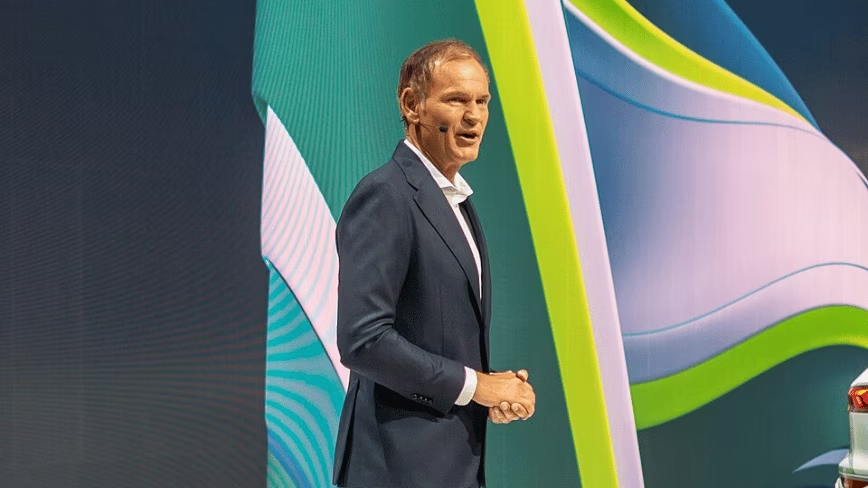

Volkswagen reportedly wants to cut 100,000 jobs, about 15% of its workforce, and close German plants. It would be the biggest overhaul in the carmaker’s history, and the unions are vowing to fight.
Europe’s car industry is shrinking, and its biggest name is leading the retreat. Volkswagen reportedly plans to cut around 100,000 jobs at its German plants, roughly 15% of its global workforce. If it happens, it would be the deepest overhaul in the company’s 89-year history.
The figure comes from the German business title Manager Magazin. It reported that chief executive Oliver Blume wants the cuts over the coming years to make Europe’s largest carmaker competitive again. Volkswagen would not confirm the specifics, citing internal, confidential documents.
The company did not deny the direction, though. “The entire Group, including its brands and subsidiaries, must undergo profound changes,” a spokesperson told CNBC. That is about as close to a confirmation of intent as a carmaker offers before the negotiations begin.
The scale is what makes this different. Volkswagen employs hundreds of thousands of people worldwide, and a 15% cut would fall mostly in Germany, its industrial heartland. The reductions would come over several years rather than all at once. Even so, a number like 100,000 reframes what a downturn at a national champion looks like.
Factories on the list
The report names specific sites. Volkswagen would reportedly stop production at Hanover, Zwickau and Emden, plus the Audi plant in Neckarsulm. For a company that has built cars in Germany for generations, closing plants at home is close to unthinkable. It is now on the table.
Zwickau stings most. Volkswagen recently converted the Saxony plant to build electric cars, six EV models across the VW, Audi and Cupra brands. It was meant to be the future. Instead it has suffered repeated production pauses, which the company blames on weak demand for EVs.
The EV bet that soured
This is the heart of the problem. Volkswagen bet heavily on electric, and the demand has not arrived fast enough. European EV sales have stalled, and the company has already trimmed output. The factories built for an electric boom now run below capacity.
The timing hurt. Germany scrapped its consumer EV subsidies at the end of 2023, and sales cooled just as Volkswagen finished retooling for electric. The company geared up for a surge that the policy then helped to stall. That mismatch is exactly what now shows up as idle plants and surplus staff.
Cheaper Chinese rivals have piled on the pressure. They sell electric cars in Europe at prices Volkswagen struggles to match. Add US tariffs under President Trump, and the maths gets worse. The cars cost more to build in Germany than many buyers will pay.
Blume’s pitch is blunt about cost. He argues the company’s plants and payroll were sized for a market that no longer exists. The goal, in his telling, is a leaner Volkswagen that can survive a decade of cheaper competition. The unions read the same numbers and reach a very different conclusion.
Volkswagen is not alone in the squeeze. Tesla and VW have spent years as the EV industry’s hottest frenemies, and both now face a market that is maturing and getting meaner. The era of easy electric growth is over for everyone.
A deal under strain
There is also a promise at risk here. Volkswagen had already mapped out 50,000 job cuts earlier this year, blaming Trump’s tariffs and falling Chinese sales. Its unions agreed to those losses in a late-2024 deal, on one condition. The company would not cut deeper or close plants before 2030.
This new plan blows through that. Doubling the cuts and shutting factories breaks the spirit, if not the letter, of the agreement. The unions reacted exactly as you would expect.
“If such plans were to be pushed forward, we would prevent them with all our might,” the IG Metall union and the General Works Council said in a joint statement. In Germany, where labour holds seats on the supervisory board, that is not an idle threat.
The politics push the stakes higher still. The state of Lower Saxony owns a large stake in Volkswagen and holds seats on its board. That gives regional politicians a direct say, and a strong reason to protect local jobs. A plan this big becomes a national argument, not just a corporate one.
Why it matters beyond VW
Volkswagen is a bellwether. It is Europe’s largest carmaker and one of its biggest private employers. When it sheds 100,000 jobs, the shock runs through suppliers, towns, and a whole industrial model built around the German car.
The wider industry is already cutting white-collar staff. Newer players are not safe either, with Rivian cutting roles as the US EV market shrinks. The pain is spreading across both legacy giants and upstarts.
Volkswagen’s own pivot tells the story. It has poured money into software and even taken a stake in Rivian to fix its tech. None of that changes the basic bind: too much factory capacity, too few buyers, and rivals who build for less.
The open question
For now, this is a report, not a signed plan, and the fight has barely started. Volkswagen has to negotiate with some of the most powerful unions in Europe. The 100,000 figure may be an opening position as much as a target.
The deeper question is whether Europe can keep building cars at the scale and cost it once did. Volkswagen spent 89 years proving it could. Whether it can do so for another decade, with far fewer workers, is the question this overhaul leaves open.
Get the TNW newsletter
Get the most important tech news in your inbox each week.


