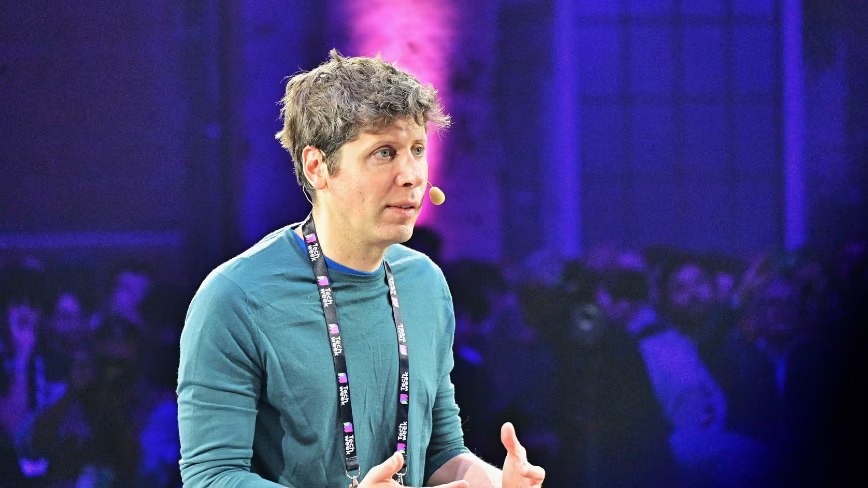
OpenAI chief executive Sam Altman speaks at Italian Tech Week 2024 in Turin
 Credit: Antonello Marangi / Shutterstock
The legal fight between Apple and OpenAI turned public and personal this week. OpenAI published a blog post titled “Apple is getting this wrong,” airing private messages and emails to rebut Apple’s trade-secrets lawsuit. On the same day, Apple escalated in court. Two former partners are now trading blows in the open.
Apple sued in July, accusing OpenAI of profiting from secrets carried out by former Apple staff. OpenAI’s post called the suit “careless, aggressive and oddly personal,” and denied the core claim. “We do not have, nor want, any of their trade secrets,” it wrote.
OpenAI’s receipts
OpenAI’s sharpest jab was about a mistake. Apple had said it contacted OpenAI in February and got no reply. OpenAI tells it differently.
It says Apple’s outside lawyer emailed its general counsel by accident, and claimed a phone call that never happened. The lawyer then admitted the message was meant for a different former Apple employee, surname Wang. OpenAI cast the mix-up as Apple “confusing two Asian last names,” and said it only surfaced when OpenAI flagged it.
The emails, which also appear in Apple’s own court filings, show the lawyer later apologising. Apple’s counsel had described itself as “resolving any issues,” OpenAI wrote. Then came roughly five months of silence before the lawsuit landed.
The bigger fight is over Chang Liu, a former iPhone engineer who left Apple in January. Apple says he tapped into confidential files after leaving. OpenAI published iMessages it says show the reverse. Apple employees, it says, asked Liu for help locating files after his last day.
The exchanges walk through airdrops and a still-signed-in iCloud account. In one, an Apple worker jokes about clicking “the sad button in workday” to log the departure.
OpenAI pins the blame on Apple’s own housekeeping. Departing staff keep “residual access,” it argued, because Apple fails to cut them off when they leave. Apple has also accused OpenAI’s chief hardware officer, Tang Tan, a 24-year Apple veteran, of soliciting secrets. OpenAI says Tan has always told his team not to touch rivals’ confidential information.
The receipts are a defence, not a verdict. The messages are OpenAI’s own selection, heavily redacted, and settle nothing on their own. But they hand the public a rare look inside a case both companies would normally fight behind closed doors.
Apple doubles down
Apple did not soften. On Monday it asked a federal judge for a preliminary injunction to bar OpenAI, Liu and Tan from using or disclosing its alleged secrets while the case runs. “If Apple’s trade secrets are used and spread throughout OpenAI, or get embedded in its products and operations, the damage cannot be undone,” its lawyers wrote.
It went further. Apple filed a second motion for expedited discovery and depositions. It also said its investigation had turned up 11 more former employees who may be involved. One allegedly met Liu before a colleague’s OpenAI interview and discussed unannounced products. Another, Apple says, took screenshots of confidential documents before interviewing there.
OpenAI called the injunction “based on false information and completely unnecessary,” and repeated that it wants none of Apple’s secrets. Apple did not respond to requests for comment.
What is actually at stake
Behind the filings is a partnership gone sour. OpenAI’s technology powers Apple Intelligence and Siri, and the two were close collaborators. The mood changed after OpenAI bought Jony Ive’s design studio io for $6.5bn and hired more than 400 former Apple staff to build its own devices. Apple, meanwhile, turned to Google to rebuild Siri.
Going public is the unusual part. Companies in active litigation rarely publish their evidence mid-case, and OpenAI’s post is a bid for the court of public opinion, not a legal filing. It changes nothing before the judge. What it does is let OpenAI tell its own story while Apple stays characteristically silent.
The clock is now set. OpenAI must file its formal response by 17 August, and the judge will hear the injunction on 1 October in a California federal court. Until then, two of the most valuable companies in technology are fighting in the open, with OpenAI’s hardware ambitions caught in the middle.
Get the TNW newsletter
Get the most important tech news in your inbox each week.
Also tagged with


