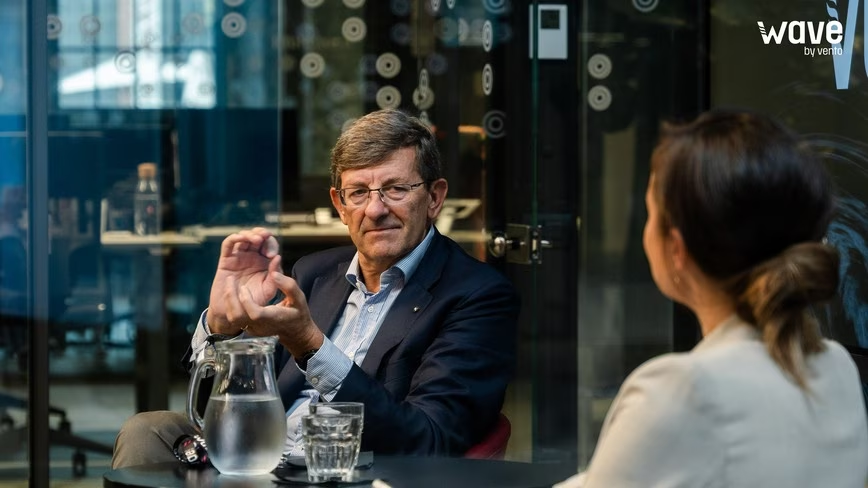
Vittorio Colao at a press Q&A at Wave by Vento in Turin, 9 October 2026

Europe has less than 2 gigawatts of AI computing capacity and needs more, former Vodafone chief executive Vittorio Colao said. He spoke at a closed-door press Q&A at Wave by Vento in Turin on Friday, the event’s last day.
“Europe missed the big digital wave. Fine, 20 years,” Colao said.
Europe should not miss the next one, he said.
Colao ran Vodafone from 2008 to 2018 and was Italy’s minister for technological innovation and digital transition in Mario Draghi’s government. Europe is starting to put money into computing, he said. The speed is not the right one, but the skills are there.
Simpler rules for young companies
The most important thing governments can do is make the first three to five years of a company’s life far simpler, Colao said, speaking in Italian. Italy, Germany and France are still places of administrative and labour-law complications, he said.
He gave the example of a digital health company he works for.
“Amazingly successful in France, good success in Germany, but already a different model. We’re going into the UK, another model. We came to Italy, another model,” he said.
He called what has come out of Europe’s “28th regime” for companies “un topolino”, a little mouse. No member state, Italy included, proposed adding labour, tax and administrative rules, he said, so it stopped at the simple part, registration.
He also wants public procurement opened to small companies, with a small share of contracts set aside for them. He is sceptical of governments acting as venture capitalists, he said. A state fund of funds is fine, and so is public money for strategic projects such as chips and energy. Those are industrial policy, not venture capital, he said.
A single capital market
Asked how Europe can keep companies from listing in the US, Colao said it needs a real single capital market, or savings and investment union, with depth. Euronext and the German and Swiss exchanges together have nothing compared with the American market, he said.
“We can write yet another report. But it’s time to start doing,” he said.
Each member state agrees in principle and then asks for something that slows the system down, he said. He is more optimistic about European investors’ appetite for risk than five years ago. Two things have to change: successful founders reinvesting their money, as in Sweden, and pension funds putting money into venture.
The first is already happening, he said, and the second needs some rule changes. On Wednesday, Bending Spoons’ Luca Ferrari told the same event that capital is no longer Europe’s big barrier.
What growth investors look for
The single thing he looks for in a founder is an obsession with customers and product, Colao said. A founder focused on customer quality from the first few million in sales is the best sign a company can scale to 500 million, he said. He also wants clean, detailed revenue figures.
AI risk and cyber defence
On AI, Colao said there is some risk, partly because development ran as a race without the safeguards a more traditional company would have added. Because AI works at global scale, the safeguards need rules everyone respects, he said.
Cyber defence needs much closer cooperation, because reaction time matters, he said. He described the UK’s National Cyber Security Centre as ahead of others. Europe did the right thing in creating its cyber security authorities, but they need more resources, he said.
Europe is also too self-critical, he said. In July, the EU opened bidding for AI ‘gigafactories’ to add computing capacity. On Thursday, Dealroom’s chief executive told Wave that Europe’s first trillion-dollar startup may already exist.
Get the TNW newsletter
Get the most important tech news in your inbox each week.


