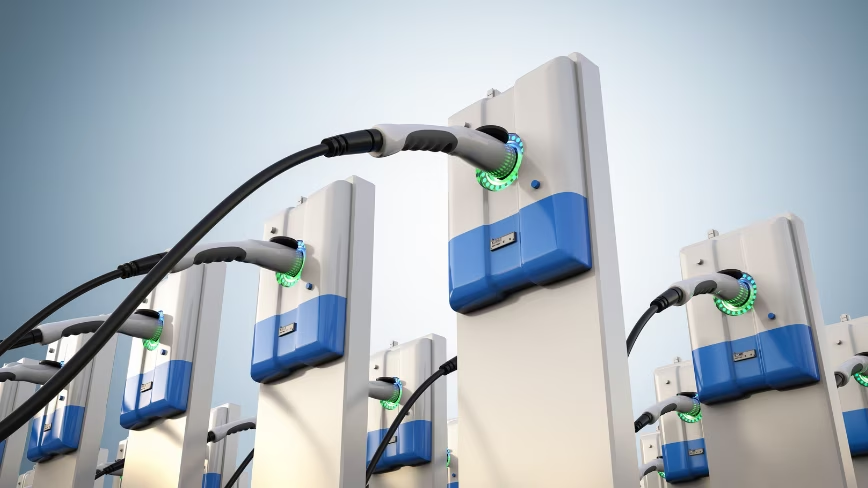
EV Charger
 Credit: Canva
California has opened a $28M round paying up to $100,000 per public DC fast-charging port, covering as much as 100% of eligible costs. The top rate goes only to ports above 275kW, even though charger makers’ own data shows plug count raises usage far more than power does.
California has opened a $28M round of incentives for public DC fast chargers, paying up to $100,000 for a single charging port. The money can cover up to 100% of eligible costs.
The window opened on 7 October and closes on 14 January, as InsideEVs reported. Awards are first-come, first-served, with disadvantaged, low-income and tribal sites moved to the front of the queue.
The rate depends on power. Ports delivering 150kW to 274.99kW get $55,000, while anything above 275kW gets $100,000. That is nearly double for raw output, which is not what a Finnish charger maker found.
Kempower’s analysis of its own network put utilisation at about 3% on 100kW sites and just over 5% on 400kW ones. Two plugs to eight lifted it from 2% to almost 10%.
Kempower sells distributed-power chargers, so the paper argues for its own architecture. The figures come from its analytics platform rather than an independent audit.
Europe regulated instead of paying. The Alternative Fuels Infrastructure Regulation obliges member states to put a recharging pool every 60km in each direction along the trans-European core road network.
Those pools must deliver 400kW with one 150kW point, rising to 600kW and two such points by the end of 2027. A single BYD flash connector carries more than twice that.
The two approaches fail differently. Brussels sets a floor and leaves operators to find the money, while California supplies the money and lets applicants choose the locations.
One California rule favours European hardware. Funded sites must have at least 50% CCS connectors, the standard Europe settled on, at a point when North America is converging on Tesla’s plug instead.
The firm best placed to supply the top tier is Italian. Alpitronic, founded in Bolzano in 2009, held about 30% of European DC fast charging in 2024, and its Hypercharger range clears 275kW.
Plug count is the cheaper lever either way. Tesla’s newest Superchargers pack eight stalls into one delivered unit, two of which fit on a single truck.
California has narrowed what qualifies. Charging hubs, hotels and business districts are no longer eligible, and only projects with permits issued and a final utility design will be considered.
The premium is also temporary. A third window running from February to May 2027 caps every port at $55,000, whatever its output, so the $100,000 rate expires with this round.
Get the TNW newsletter
Get the most important tech news in your inbox each week.


