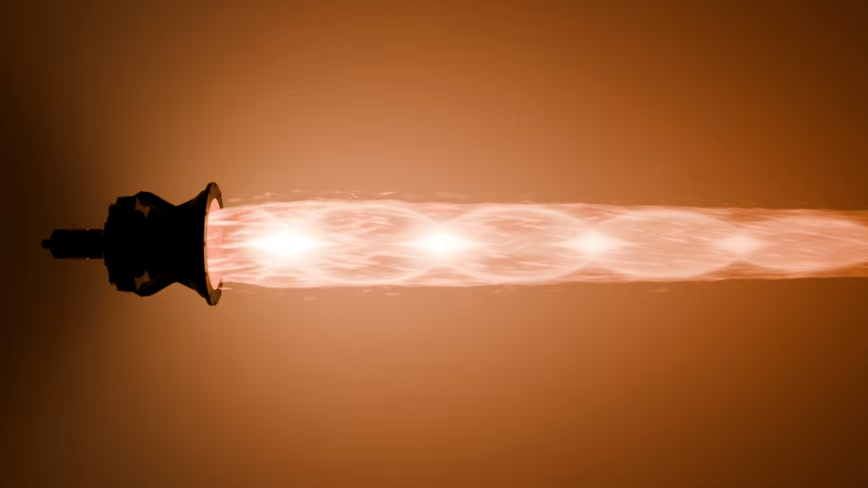
 Credit: Venus Aerospace
A Texas startup has raised $91m to build a rocket engine most of the industry once wrote off as too hard. Venus Aerospace announced a $91m Series B to develop its Rotating Detonation Rocket Engine, or RDRE. Mercury Fund led the round.
The backers read like a defence roll-call. Lockheed Martin Ventures joined, alongside MESH, PEAK6, Draper Associates, Starboard Star Venture Capital, Green Sands Equity and others. The money will fund testing and vehicle designs built with specific customers. It is a fraction of the sums flowing to Europe’s space giants, but pointed.
A different kind of rocket
Most rockets burn fuel in a round chamber. An RDRE instead sends a continuous supersonic wave of combustion spinning around a ring. In theory it wastes less propellant. In practice the physics proved brutal, and the idea sat on the shelf for decades.
Better 3D printing and simulation changed that. The first working test came in 2020 at the University of Central Florida. NASA ran a ground demo in 2022, and Japan’s JAXA fired one in space in 2021. Venus went further last May, when its RDRE became the first to launch a rocket into flight.
From passenger jets to weapons
Venus started with a softer dream. Founders Sassie and Andrew Duggleby, a husband-and-wife team, set up the firm in 2020 to build clean hypersonic jets for passengers. The May flight changed the pitch. “The world looked at us and said, ‘oh my gosh, you have a working RDRE, would you sell us one?'” chief executive Sassie Duggleby told TechCrunch.
Now the company points at defence. It wants to replace the solid motors inside many missiles with its own thruster, and to build high-speed space vehicles for the military. Chief technology officer Andrew Duggleby said the engine “combines efficiency, throttling, reusability and manufacturability in a way that customers need for real defense and space missions.”
Why it matters
The hard part now is endurance. Across 600 tests, Venus has fired its engine for 32 seconds at most. Its customers will want six to 15 minutes. A Texas Space Commission grant is funding a bigger test stand to close that gap. If the firm gets there, a 70-year-old idea finally becomes a product, and a small startup lands in the middle of the defence-tech boom.
Get the TNW newsletter
Get the most important tech news in your inbox each week.


