 Credit: Google
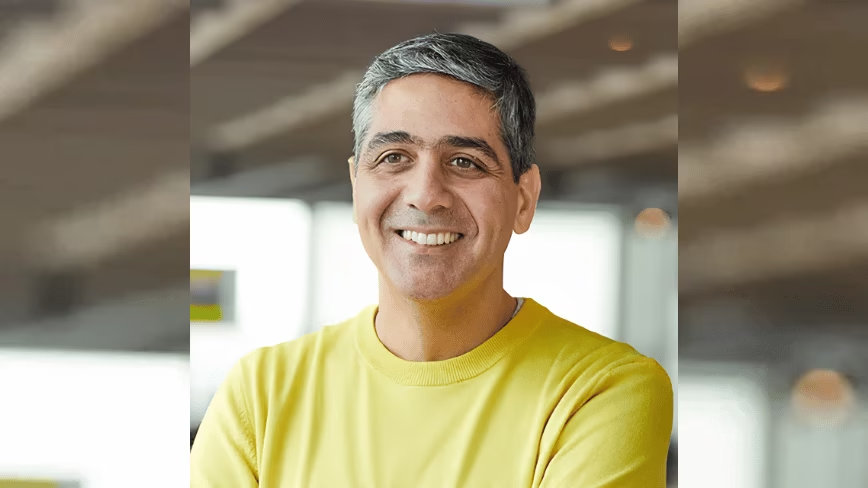
The headlines went to the man who left. The more telling name is the one who stayed. Koray Kavukcuoglu, Google DeepMind’s technology chief, now runs the lab day to day and reports straight to chief executive Sundar Pichai. He inherits what Hassabis is giving up: control of Gemini, and with it Google’s standing in the AI race.
Last week Google said Hassabis, DeepMind’s founder and a Nobel laureate, would step back from running the lab to become its chair and Alphabet’s chief scientist. That was the announcement. The shift beneath it is geographic. Google is pulling its AI leadership out of London and concentrating it in California.
The engineer who now holds Gemini
Kavukcuoglu is not an outsider. He has spent 13 years at DeepMind, started its deep learning team, and led the work behind WaveNet and DQN. Turkish-born, he studied under Yann LeCun at New York University. LeCun calls him a great engineer who built rare research-management skills on the way up.
He moved to Mountain View in the past year, and oversight of Gemini moved with him. He is now the only one of Gemini’s co-leads still at Google. He also loses his old reporting line to Hassabis and answers to Pichai alone. In Google’s bureaucracy, that is the real promotion. Some now tip him to succeed Pichai one day.
Why Hassabis really went
Two stories explain the exit, and they do not quite agree.
The first is Google’s, and Hassabis’s own. He had been drifting from the day-to-day for a year, Semafor reported, handing consumer AI and Gemini to Kavukcuoglu. He never loved being a tech executive. His passion is the science: AGI, and curing disease through Isomorphic Labs, the drug-discovery company he still runs. On this telling, he chose to go.
The second is sharper. After a 2024 image-generation fiasco, Hassabis demanded more control and won it, consolidating power in London while sitting 5,000 miles from headquarters.
People close to DeepMind suspect a falling-out at the top, and that the chess champion was outmanoeuvred by Kavukcuoglu, Bloomberg’s Parmy Olson wrote. Google has not addressed that reading, and it remains informed speculation.
Both can be partly true. Either way, the map redrew. The strategy Hassabis had gathered in London now sits in California.
What Kavukcuoglu has to fix
The job is execution, not invention. Google invented the transformer that underpins modern AI, yet rivals shipped it first. Its most powerful Gemini has slipped past a June target and trails on coding, the task eating most of the industry’s compute.
OpenAI and Anthropic keep poaching its people, from Noam Shazeer to Nobel co-winner John Jumper.
The money raises the stakes. Google has guided to capital spending of up to $205bn this year, and its free cash flow turned negative for the first time since its 2004 listing. Investors read the reshuffle as a warning and marked Alphabet down about 4%.
Google’s own numbers cut the other way. The Gemini app is past 950 million monthly users, and Pichai insists his is the only company with the full AI stack. The talent and the compute are real. What Google has lacked is speed. Kavukcuoglu, quietly, is the man now asked to supply it.
Get the TNW newsletter
Get the most important tech news in your inbox each week.
Also tagged with


