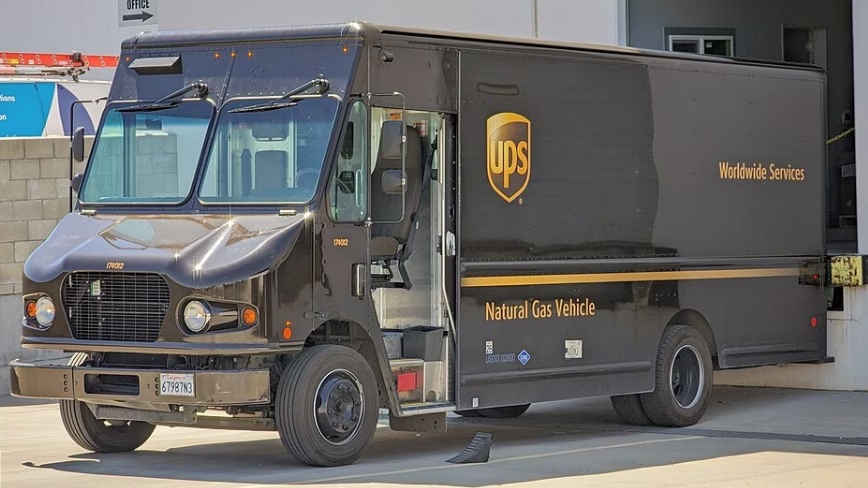
UPS Truck at the Betts Company loading dock in Fresno, California
 Credit: DoulosBen
UPS has told CNBC it is investing more than $2bn across its international, healthcare and supply chain businesses, spending that began in 2024 and runs to 2028. The same company cut about 48,000 roles last year and said in January it would cut 30,000 more.
UPS has put a figure on something it had been doing quietly. The company says it is investing more than $2bn across its international, healthcare and supply chain businesses, spending that started in 2024, runs to 2028 and had never been quantified publicly.
The number arrives in unusual company. UPS cut around 48,000 roles during 2025 and said in January that it would remove another 30,000 operational positions this year.
The buildings went too. It closed 93 facilities in 2025 and planned two dozen more in the first half of 2026.
One customer explains most of it. UPS is deliberately halving its Amazon volume over 18 months, roughly a million packages a day, targeting about $3bn in savings from the withdrawal.
So $2bn is not really expansion. It is money leaving a domestic parcel network and arriving in specialised freight, brokerage and temperature-controlled logistics.
Chief executive Carol Tomé has given the mechanism plainly. Cost per piece in automated buildings runs 28% below conventional ones, which is the same logic driving Europe’s warehouse robots.
The projects are spread wide. A hub in the Philippines this year, an Ontario facility next year, an air hub at Hong Kong International in 2028, and a Taiwan logistics centre where automation has taken a day out of total supply chain time.
Europe appears as a node rather than a destination. UPS has opened an Amsterdam facility combining freight, brokerage and cold chain, and now flies Paris to Hong Kong five times a week.
Healthcare is where the margin sits. The company recently put $48mn into 27 temperature-controlled facilities, aimed partly at moving temperature-sensitive drugs including GLP-1 medicines.
Europe’s own giant is running the same play. DHL is cutting 8,000 German postal jobs to save about €1bn by 2027, while building out health logistics, as Decathlon doubles output with robots across seven European sites.
The pattern underneath is the story. Two of the largest logistics companies in the world are shrinking the networks that carry consumer parcels and rebuilding around refrigerated pharmaceuticals and automation.
Get the TNW newsletter
Get the most important tech news in your inbox each week.


