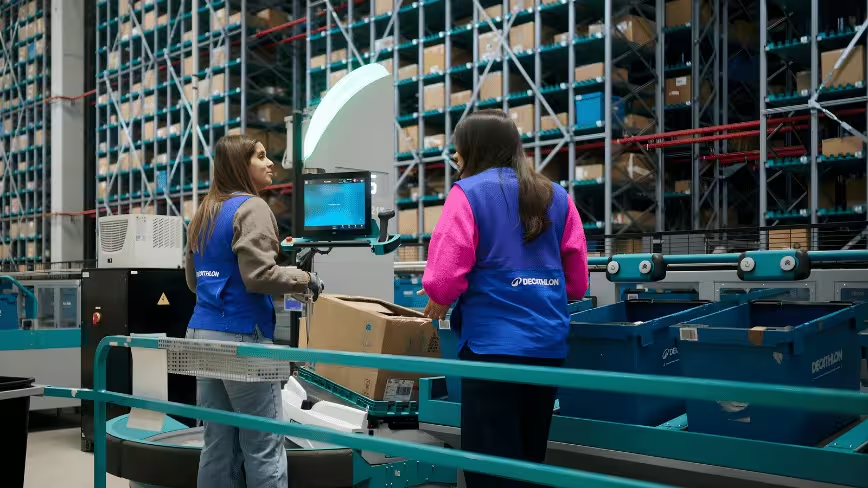

The world’s largest sporting goods retailer has turned seven of its European warehouses over to robots, and the early results suggest the machines are earning their keep. Decathlon announced on Tuesday that its partnership with Exotec, a French warehouse robotics company, has delivered what it calls significant productivity gains across sites in France, the United Kingdom, Portugal, Italy, and Germany.
The numbers are hard to argue with. At its warehouse in Setúbal, Portugal, Decathlon said the facility now prepares 114,000 orders per day, double the 57,000 it managed before automation. A French warehouse nearly doubled the number of stores it can replenish, from 37 to 73. At the Northampton site in England, pickers who once walked more than 10 kilometres a day now cover less than one. Workplace incidents related to order picking at that same site have halved, dropping from one in every 5,000 to one in 10,000.
These are not the humanoid robots that dominate headlines. Exotec’s flagship product, called Skypod, is a fleet of wheeled machines roughly the shape and size of a large Roomba. Each one carries storage bins on its back and can climb proprietary shelving racks to heights of about 14 metres, retrieving and delivering hundreds of thousands of items per day. A typical Decathlon installation runs between 150 and 200 Skypods, supported by automatic depalletisers, carton-opening machines, RFID tunnels, and palletisers. The whole system is coordinated by Deepsky, Exotec’s warehouse execution software.
The footprint argument
Romain Moulin, Exotec’s cofounder and chief executive, said the core advantage is not speed alone but density. In a conventional warehouse, shelves are stacked to roughly two metres to accommodate human pickers. That forces companies to seek ever-larger facilities as order volumes grow. The average warehouse footprint is about 18,000 square metres, Moulin said. With Skypods able to climb vertically, Exotec claims it can reduce that to around 6,000 square metres without sacrificing capacity, because the same volume of goods occupies a fraction of the floor space.
The implication is that retailers can either operate in smaller, cheaper buildings or dedicate the freed space to other operations. For Decathlon, which runs more than 1,800 stores and employs 101,000 people globally, the appeal is obvious: a standardised warehouse design that can be replicated quickly across markets. Moulin claimed Exotec can stand up a new automated warehouse every four months.
What happens to the workers
The question that shadows every warehouse automation story is what happens to the people who used to do the picking. Exotec’s own figures offer a partial answer. At one site, 50 employees were designated pickers before Skypods were installed. Afterward, that number dropped to 12, with the remaining workers reassigned to tasks such as returns processing and repairs.
Moulin framed this as an improvement in working conditions rather than a reduction in headcount. Pickers no longer walk 10 kilometres per shift. The injury rate has fallen. And the throughput of the facilities has increased, meaning companies need the reassigned workers to handle the greater volume of goods flowing through the system.
That narrative is convenient, but it also reflects a genuine structural problem. Labour shortages in warehouse logistics are acute and worsening across Europe, Japan, and the United States. Moulin said every customer he speaks to, regardless of geography, reports difficulty recruiting pickers. The warehouse robotics market, valued at roughly $8.75 billion in 2026, is growing at more than 18 per cent annually, driven in large part by this shortage.
Why not humanoids
The article’s most revealing detail may be what Exotec is not building. While companies from BMW to Amazon are experimenting with bipedal humanoid robots for factory and warehouse work, Moulin was dismissive of the approach for his use case. Using a humanoid to push a cart 10 kilometres a day, he argued, simply recreates the problem that automation is supposed to solve. Exotec instead uses purpose-built machines optimised for a single task and layers AI on top for routing, scheduling, and inventory management.
It is a distinctly European approach to industrial robotics: pragmatic, specialised, and uninterested in spectacle. Exotec, founded in 2015, reached unicorn status in 2022 after raising $335 million at a $2 billion valuation, with backing from Goldman Sachs. Its annual revenue has since grown to approximately €300 million, with the Skypod system deployed at more than 200 customer sites worldwide, including Uniqlo, Carrefour, Gap, and Geodis.
The Decathlon deployment, branded as the Skyfleet programme, is its most ambitious multi-site rollout to date. Whether it becomes a template for how European retail manages its supply chains will depend on whether the productivity figures hold as the system scales. For the 38 former pickers at that one site who are now doing something else, the answer may already be clear enough.
Get the TNW newsletter
Get the most important tech news in your inbox each week.


