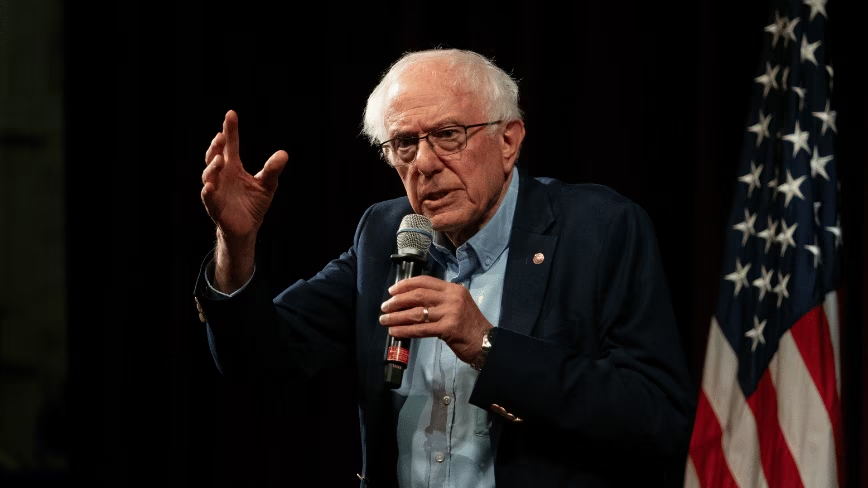
Senator Bernie Sanders speaking at Stanford University in February 2026.

Senator Bernie Sanders and Representative Greg Casar have introduced a bill to permanently ban artificial superintelligence in the US. The Ban Artificial Superintelligence Act would also pause work on the most advanced AI. And it would create a Department of Artificial Intelligence.
The two lawmakers introduced the bill on Wednesday. They gave it first to the Associated Press, whose Joey Cappelletti reported it. Sanders is an independent from Vermont. Casar, a Texas Democrat, chairs the Congressional Progressive Caucus.
“When you are racing towards a cliff, you don’t just ease up on the gas pedal. You hit the brakes. When the future of humanity is at stake, we cannot let a handful of Big Tech CEOs write their own rules,” Sanders said in a statement.
What the superintelligence ban covers
The bill text bans building or deploying artificial superintelligence. It defines that in two ways. One is a system that beats human cognitive performance in most domains or tasks. The other is a system able to plan and carry out the destruction or disempowerment of humanity.
The bill would also pause work on advanced AI systems. The section-by-section summary defines these as systems trained on 10^25 or more operations. The pause would start at once. It would end when the new department is fully staffed and has set clear rules.
After that, any company that builds or sells advanced AI would need a charter from the department. The summary lists a system’s ability to change its own functions as a warning sign to watch for. Semafor’s Nicholas Wu reported that the bill bans “recursive self-improvement”.
Prison terms and a “corporate death penalty”
People who break the ban or the pause could face up to 20 years in prison. The bill’s one-pager compares that with the penalties for unlawfully building nuclear weapons.
Companies would face what the one-pager calls the corporate death penalty. A company that breaks the rules would lose its charter. It would also hand its intellectual property and assets to the federal government. The bill protects employees who report superintelligence risks to the department.
Abroad, the US would seek international agreements and export controls on AI computing. The aim is to stop superintelligence being built anywhere.
“Our bill bans the development of artificial superintelligence and pushes for international agreements so that no one, anywhere, builds AI too powerful for humans to control,” Casar said.
Support from inside the labs
Several employees at AI companies backed the bill in a statement shared with the AP. One is Juan Felipe Cerón Uribe, a researcher on OpenAI’s Safety Systems team. He said superintelligence “could either go extremely right or extremely wrong”.
“A ban on superintelligence development would be a positive change for the foreseeable future,” said Swante Scholz, a Google DeepMind software engineer speaking for himself.
Sanders told the AP that avoiding the most dangerous AI would require cooperation between the US and China, as nuclear arms control did in the Cold War. Last week he called for an AI slowdown alongside Steve Bannon. Earlier this month he hosted a Senate briefing on AI risk.
“It doesn’t take a genius to say, ‘slow it down’,” Sanders told the AP.
The odds in Congress
The bill faces long odds in the Republican-controlled Congress, the AP reported. Three other AI bills are already waiting there with no date for a vote.
President Donald Trump has pushed the other way. On Tuesday he told the UN that the US would now call AI “super intelligence”. He said the US would encourage the technology, not rein it in. A US slowdown while China keeps going is one of the main arguments against broad limits, the AP reported.
“I think Trump has very little understanding of what this issue is about,” Sanders told the AP. “I think he’s mainly concerned about the economic implications of a slowdown.”
Sanders told reporters on Wednesday that Congress must act as soon as it returns, Semafor reported. He also wants 2028 presidential candidates to take up the issue now.
Get the TNW newsletter
Get the most important tech news in your inbox each week.


