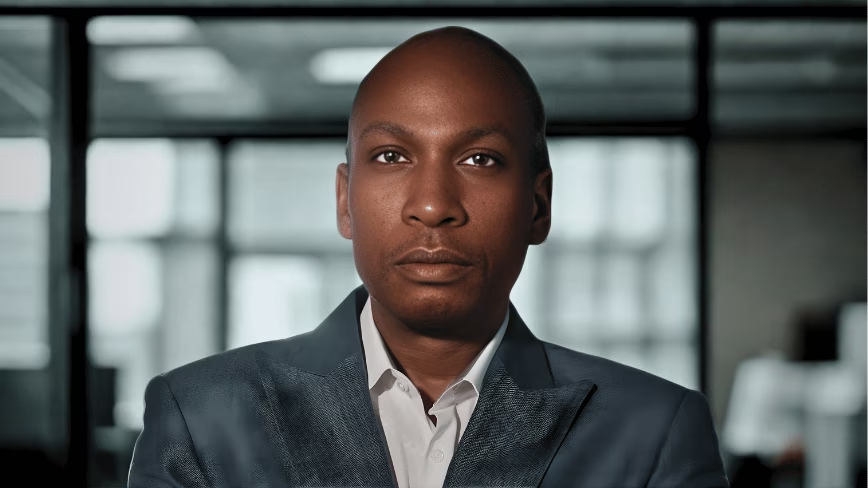
The global cost of cybercrime surpasses billions of dollars annually, with phishing/spoofing, personal data breaches, and extortion accounting for a significant share of losses. According to Cordell Robinson, CEO of Brownstone Consulting Firm, the scale of financial damage urges the need for a reality check. “Personal protection is no longer optional, and it cannot be outsourced,” he says.
With the rapid adoption of emerging technologies in 2026, Robinson posits that individuals have to be responsible for safeguarding themselves from new vulnerabilities in the cybercrime space.
In his opinion, this risk has been dramatically amplified by social media. “Social media can be very contagious and addictive,” he explains. “And now, we are voluntarily giving away our private information because of it.” In his view, platforms designed for connection are increasingly functioning as rich intelligence sources for criminals.
“Personal information like names, birthdays, family details, travel habits, and purchasing milestones is becoming publicly accessible,” Robinson notes. “How can we be sure that this information can’t be used nefariously when it’s in the wrong hands?”
Research shows that over 60% of data breaches involve some form of human element, including interaction with malware, social actions that might lead to phishing, and credential abuse. Robinson notes that individuals may assume that danger only exists when sensitive information appears in a bio or a profile description.
That assumption, he warns, is flawed. “People think, ‘Who’s going to scroll through years of posts?” he says. “But they don’t have to. Now, AI tools can collect and analyze a decade of content in seconds.” This belief is validated by the data showing that 1 in 6 data breaches now involve attackers using AI-generated phishing or deepfake scams.
Robinson is quick to point out that artificial intelligence has changed the economics of cybercrime. He believes that tasks that once required time and persistence now only require intent. Images posted without a visible address could still be geolocated.
“If a house has ever been sold online before, there are photos out there already. AI will find it without a number,” he says. According to him, even attempts to obscure details, such as covering a school name or house number in an image, offer little protection. AI cross-referencing closes those gaps efficiently.
Influencer culture, Robinson believes, is perhaps one of the biggest contributors to fostering a false sense of safety. High-profile creators and public figures may routinely share insider information on their wealth, locations, and lifestyle content with little visible consequences.
As the general public may perceive this display to be safe, Robinson urges people to recognize the distinction. He says, “Influencers and brands are businesses. They have cyber teams, physical security, account managers, and risk protocols. They don’t live the same reality as the everyday individual.”
He highlights that what audiences see online may often be staged or geographically distorted from real life. Vehicles, homes, routines, and lifestyles shown on screen may not reflect actual circumstances. “For private people, mimicking such behaviors can introduce exposures without that protection influencers have,” he says, emphasizing that the larger issue lies in misapplied imitation. “Visibility without infrastructure creates vulnerability,” he adds.
This vulnerability may be exacerbated by oversharing, which often extends beyond posts and images. Robinson points to viral quizzes and surveys that ask seemingly harmless questions. “It could be simple things like favorite color, birthdates, schools attended, first jobs,” he says. “But those can often be password recovery questions. Once that information is public, it can be legally collected and used.” While many people blame platforms for data misuse, Robinson notes that users often supply the data willingly.
Another overlooked risk lies in historical content. He believes that many users have become more cautious in recent years, yet rarely revisit what they shared in their 20s or early 30s. Robinson advises intentional digital curation. “If you don’t manage your digital footprint, someone else will,” he says. “Old posts still carry context, patterns, and identifiers that can be exploited. Curate your digital footprint so that you can control it.”
Privacy settings also provide limited assurance. Content restricted to “friends” can still be shared, screenshotted, or redistributed without consent. Once information leaves the original account, control is effectively lost. “Think before you post,” Robinson says. “You don’t know the personal ramifications it can have on your safety, finances, or identity.”
Robinson’s foresight is not arbitrary, but is informed by his years of experience. Since founding Brownstone Consulting Firm in 2010, Robinson has spent his professional life helping enterprises mitigate cyber risk. He sees a stark imbalance, as organizations invest heavily in protection, while individuals rely on hope and platform defaults. As he says, “Most people don’t have a security professional in their corner. That means they have to adopt the mindset themselves.”
The solution, in his view, lies in awareness and intentional behavior. Social media can remain informative and engaging when treated as a public space rather than a private diary. As exposure continues to carry measurable financial and physical consequences, Robinson finds it imperative for personal security to begin with personal responsibility.
“Social platforms may evolve, and threats will continue to adapt,” he notes. “What must remain constant is the discipline to protect oneself, because no one else is doing it for you.”
Get the TNW newsletter
Get the most important tech news in your inbox each week.


