TL;DR
Robert Polacek of RoseBernard Studio argues AI works best when it’s invisible, handling mundane tasks behind the scenes so designers can focus on creative work. He says smaller, agile studios are better positioned to adopt new tools quickly and that younger talent already expects AI as standard practice.
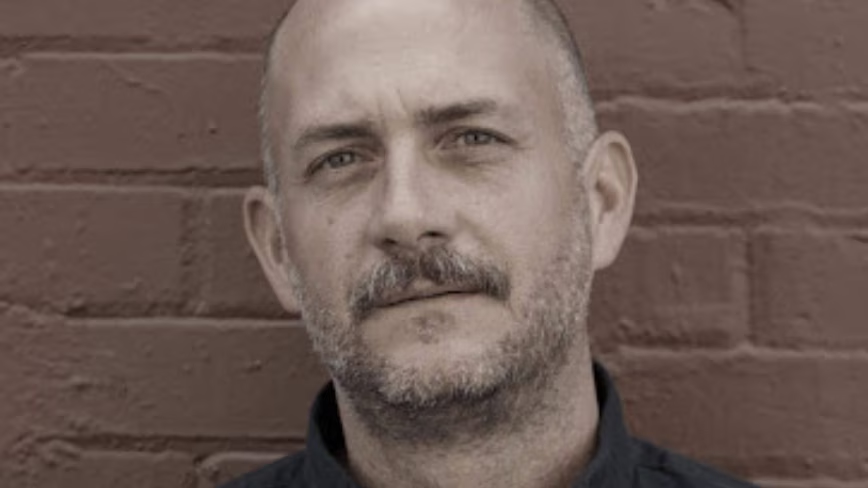
Artificial intelligence has held an indomitable presence within conversations surrounding architecture, design, and other creative industries. Though Robert Polacek, co-founder and creative director of RoseBernard Studio, believes the most important discussions have left the bandwagon of replacement and uncertainty. Instead, his focus pivots to how technology can expand creative capacity and create stronger opportunities for collaboration across the industry.
Polacek views AI as an efficiency tool that enables creatives to spend more time developing ideas and strengthening conceptual work inside studio environments. Recent studies corroborate his sentiment, as 84% of architects are reported to be optimistic about AI use for automating manual tasks.
He explains, “As much as we are creatives, building physical spaces for people to be in, there’s so much technology we can leverage to help us get there sooner. AI can help us have more creative time and hone our skill sets at the same time.”
Recent experiences during Milan Design Week reinforced many of those beliefs for him. While exploring exhibitions alongside fellow creatives, Polacek noticed that AI wasn’t overtly visible within the work being presented. Instead, he observed that its influence appeared integrated subtly throughout architecture, installations, renderings, written material, and creative production methods.
“We realized AI was everywhere, but it wasn’t out in the forefront,” he notes. “It was behind the scenes, doing what it needed to do to create the art that we were seeing. That’s exactly what we’re preaching. AI doesn’t have to announce itself; it can work for us, but behind the curtains.”
Polacek sees that tactful usage as a matter of importance for creative industries currently navigating rapid technological change. According to him, studios that approach AI purely as a shortcut toward cost reduction risk weakening the human qualities that give creative work meaning and emotional presence.
At the same time, he believes firms that resist technological evolution entirely place themselves at a significant disadvantage operationally and creatively. “We want to create less friction, so we’re constantly aware of keeping up. That’s what you need to do to remain aligned with the technological evolution,” he explains.
Inside RoseBernard Studio, Polacek believes adaptability has become a part of the firm’s work culture. He highlights how team meetings focus on evaluating emerging software, testing new systems, and determining whether tools can improve workflow, collaboration, and creative development.
Polacek says, “We meet every two weeks as a team and look at the software we’re working on and the ones coming out. We ask ourselves, ‘Should we change?’ And if it meets our needs, we do, because we’re nimble enough to do that.”
He believes agility gives smaller studios a meaningful advantage in the current dynamic moment. Large firms, he notes, often face enormous implementation challenges each time new technologies emerge, particularly when multiple offices, departments, and legacy systems are involved. “By the time everyone gets trained and adjusted, something new comes along, and everything changes again,” he says.
Conversations following a recent presentation RoseBernard Studio delivered reinforced those observations. During the presentation, Polacek recalls how members of the RoseBernard team demonstrated different applications of AI within their own workflows, ranging from conceptual development and rendering production to research and strategic thinking. After the session, Polacek recalls that younger designers approached the team with a consistent concern: many firms still restrict or prohibit the use of AI entirely, a practice he deliberately rejects.
According to him, younger creatives increasingly expect technology to function as part of everyday professional practice. He believes those expectations will continue influencing how future studios are formed, staffed, and operated. “I’m hiring people right out of school because they know the latest technology,” he says. “They use it outside of work for jewelry design, art making, dance, and all kinds of creative work.”
Efficiency, Polacek notes, has allowed the studio to remain lean while expanding creative output. He emphasizes that AI has not replaced jobs inside the firm. Instead, he believes the technology has allowed the studio to operate more effectively with existing teams. “AI has made mundane tasks, once handled by the younger generation, unnecessary. That means you no longer need 20 years of experience to make an impact; you need a willingness to learn and the creativity to make a difference.”
Polacek also insists that accessibility to advanced creative tools can create new pathways for younger entrepreneurs and boutique firms entering the industry. According to him, software advancements can now allow smaller teams to accomplish work that may have once required expansive departments. He says, “It is easier now to get a streamlined workflow on your own. If you’re creative enough and business savvy, there’s more opportunity there.”
Still, he doesn’t view that shift through a competitive lens. He sees it as an opportunity for collaboration between smaller studios with complementary strengths and perspectives. “Put three small firms together and all of a sudden you have an amazing team,” he says.
Technology, according to Polacek, continues to reshape the relationship between digital systems and physical creative practice. Having worked across analog and digital eras, he notes that the current moment requires greater adaptability and continuous learning. “AI can’t harm you unless you stop learning. That’s when you could become disposable,” he adds.
Polacek’s perspective ultimately frames AI as the infrastructure supporting creativity. Through that lens, he believes the future of design practice will belong to studios capable of balancing technological fluency with human imagination and collaborative thinking.