TL;DR
Google announced Universal Cart at I/O 2026, an AI-powered shopping hub that lets users add products from Search, Gemini, YouTube, and Gmail into a single persistent cart with deal tracking and compatibility checks. It also updated its Agent Payments Protocol (AP2) to let AI agents make purchases autonomously, and is expanding its Universal Commerce Protocol to new countries and verticals.
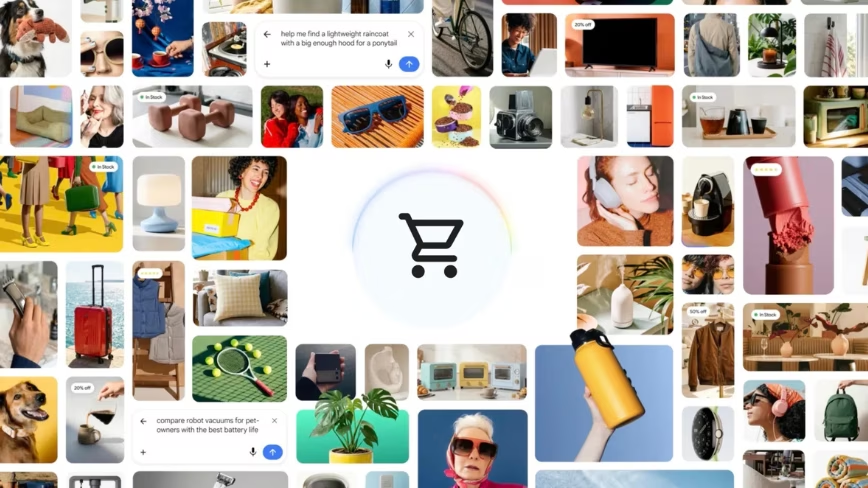
Google has unveiled Universal Cart, an AI-powered shopping hub announced at I/O 2026 that lets users add products from across its ecosystem, Search, Gemini, YouTube, and Gmail, into a single persistent cart. The feature, rolling out in the US today, represents the company’s most ambitious bid yet to become the default middleman in online commerce.
Universal Cart is not just a place to stash products. Powered by Gemini, it actively monitors price drops, surfaces price history, sends back-in-stock alerts, and even runs AI compatibility checks. Google’s demo highlighted a scenario where a user building a custom PC could add components from multiple retailers and receive automatic warnings if, say, a processor was incompatible with a selected motherboard, along with suggested alternatives.
The feature is built on Google Wallet’s existing infrastructure for rewards and loyalty points, and it integrates with the Universal Commerce Protocol (UCP), an open standard Google released in January 2026. UCP creates a common language for AI-driven commerce, enabling checkout directly through Google or a seamless handoff to a merchant’s own site. A March 2026 update added cart management, real-time catalogue queries, and identity linking so shoppers can retain loyalty benefits when buying through Google’s surfaces. Launch partners include Nike, Sephora, Target, Ulta Beauty, Walmart, Wayfair, and Shopify merchants such as Fenty and Steve Madden.
The timing matters. China’s tech giants have already deployed AI shopping agents at scale, with Alibaba’s Qwen assistant reaching 300 million monthly active users on Taobao. Amazon recently embedded Alexa directly into its search bar, merging its Rufus chatbot and Alexa+ assistant into a unified shopping experience. Google is clearly racing to keep pace in what McKinsey estimates could be a $5 trillion agentic commerce market by 2030. The stakes are enormous: whoever controls the default AI shopping layer stands to influence where billions of consumer dollars flow.
Alongside Universal Cart, Google updated its Agent Payments Protocol (AP2), an open framework first announced in September 2025 with more than 60 partners including PayPal, Mastercard, and American Express. AP2 allows AI agents to make payments on a user’s behalf within pre-set limits, using cryptographically signed digital contracts called “Mandates” that create a tamper-proof audit trail for every transaction. The protocol’s latest v0.2.0 release, shipped in April 2026, introduced “Human Not Present” payments, letting agents autonomously purchase items like limited-release tickets the moment they go on sale. Google has donated AP2 to the FIDO Alliance, signalling its intent to make the protocol an industry-wide standard rather than a proprietary tool.
The broader push into agentic commerce extends beyond the US. UCP-powered checkout is expanding to Canada and Australia, with the UK planned for later. Google also intends to bring the protocol to additional verticals, including hotel bookings and local food delivery, and to YouTube in the US.
Universal Cart will reach the Gemini app this summer, with YouTube and Gmail integrations to follow. For consumers, the pitch is convenience: one cart, persistent deal tracking, and AI that shops proactively on your behalf. For Google, the calculus is more strategic. By positioning itself as the orchestration layer between shoppers, merchants, and payment providers, it can capture data and influence across every step of the purchase funnel.
Whether retailers view this as a welcome distribution channel or a threat to their direct customer relationships will likely depend on how much traffic Google sends their way, and at what cost. Some retailers are already reporting traffic declines of up to 30% as consumers shift from traditional search to AI agent queries. Google’s Universal Cart could accelerate that trend or, if its open protocols gain adoption, help merchants meet customers wherever they are.