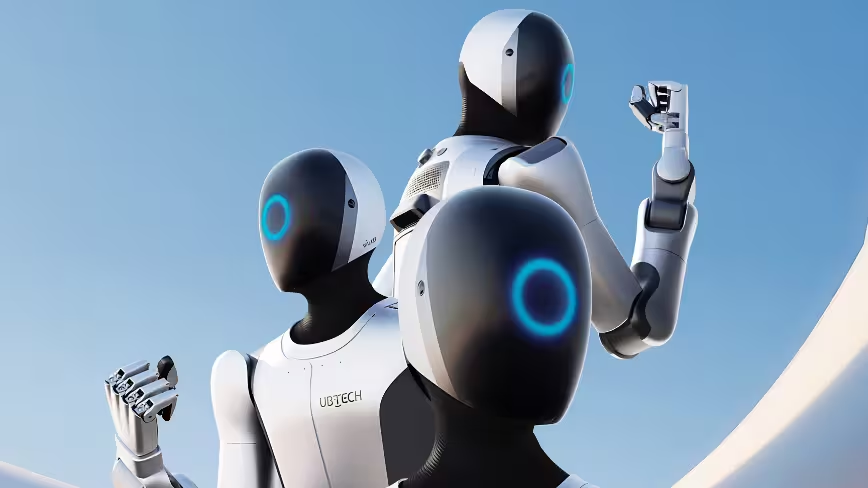
UBTech’s salary range for Chief Scientist of Embodied Intelligence runs from $2.2M to $18M. The Shenzhen company’s humanoid robot revenue grew twenty-fold last year. Bloomberg calls the offer unusual even by Chinese standards.
Chinese humanoid robotics company UBTech has posted a global recruitment notice for a Chief Scientist of Embodied Intelligence, offering an annual salary ranging from 15 million to 124 million yuan, equivalent to $2.2 million to $18 million.
The role, which the company’s WeChat post describes as setting UBTech’s full technology roadmap and being ‘the helmsman of UBTECH’s technical path,’ was confirmed to China’s Global Times.
Bloomberg described the package as unusual even by Chinese standards, noting that China’s AI industry has historically avoided the mega compensation packages commonplace in Silicon Valley.
UBTech was founded in 2012 and is headquartered in Shenzhen. It became the world’s first publicly listed humanoid robot maker, trading in Hong Kong. Its primary product is the Walker S2, a 5-foot-9 humanoid designed to operate autonomously in factories.
Earlier this year, UBTech struck a deal with Airbus to test Walker S2 units on aircraft manufacturing production lines. In its annual results released on 31 March, the company reported 2025 revenue of 2.01 billion yuan, up 53.3% year-on-year.
Revenue from humanoid products and services specifically reached 820.6 million yuan, representing 41% of total revenue, a twenty-fold increase from the previous year when that segment generated just 35.6 million yuan and accounted for less than 3% of revenue.
The Chief Scientist role will lead research in vision-language-action models, robotics foundation models, and manipulation and dexterity capabilities, with the stated goal of accelerating large-scale deployment across manufacturing, commercial services, and what UBTech describes as ‘family companionship.’
The package is structured as a combination of cash, benefits, and equity. The job posting, which states UBTech does not care about passports, age, or gender, and asks only ‘Can you define the future?’, is part of a broader hiring push that also includes reinforcement learning algorithm engineers, hardware engineers, and EtherCAT master system developers.
The offer lands at a moment when China’s humanoid robot industry is receiving explicit government support. Premier Li Qiang has included robotics in the government work report for two consecutive years, and Chinese companies accounted for nearly 90% of global humanoid robot shipments in 2025, according to research firm Omdia.
UBTech sold 1,079 full-size humanoid robots last year, generating 820 million yuan. Tesla, meanwhile, posted a notice in late March seeking more than 80 specialists for its Optimus humanoid programme. The AI talent war that began in large language models is moving rapidly into embodied intelligence.
Get the TNW newsletter
Get the most important tech news in your inbox each week.


