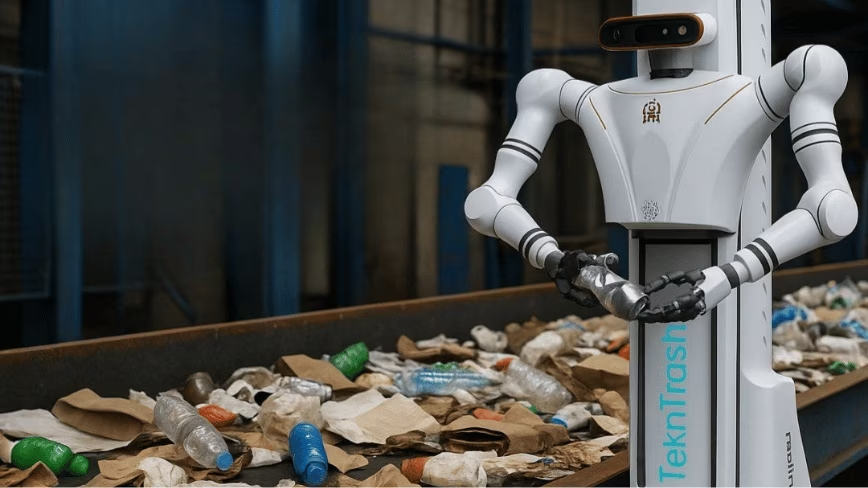
ALPHA (Automated Litter Processing Humanoid Assistant)
 Credit: TeknTrash
Morgan Stanley has doubled its forecast for China humanoid robot shipments again, to 50,000 this year. The bank says the machines are moving from stage demos to real factories, shops and restaurants.
China’s robots are leaving the showroom and reaching the shop floor. Morgan Stanley has doubled its forecast for China humanoid robot shipments for the second time this year, CNBC reported. The bank now expects 50,000 units to ship in 2026.
The jump is steep. The bank started the year predicting 14,000 units. It doubled that to 28,000 in January, and has now nearly doubled it again. The reason, it says, is speed. The shift from demonstration to commercial use has come faster than expected.
The numbers behind the call
Morgan Stanley puts China’s humanoid market at $2bn this year, rising to $15bn by 2030. It sees annual shipments reaching 446,000 units by then, up from an earlier estimate of 262,000, SCMP reported. Those figures count only external sales, not prototypes or robots a maker uses in-house.
“Commercial verification, policy support, and supply-chain feedback point to faster humanoid adoption in China,” said Sheng Zhong, an equity analyst at the bank. In short, the orders are real, the state is helping, and the parts are flowing.
Zoom out and the global picture is bigger still. Morgan Stanley expects the worldwide humanoid market to grow from about $3bn in 2025 to $28bn by 2030. Only around 13,000 humanoids shipped globally last year, on one industry count, so the bank is betting on a near-vertical climb.
From dancing robots to the night shift
The deployments are getting practical. Chinese makers are racing to scale production and putting humanoids into factories, convenience stores and restaurants, not just trade-show stages. A growing list of firms, including the EV maker Xpeng, plan mass production by the end of the year.
Morgan Stanley’s own supply-chain checks pointed the same way. Its analysts cited factories, logistics sites, unmanned shops and interactive services as the early proving grounds. The story has moved from spectacle to shift work.
Outsiders see the same momentum. “If you go to any Chinese factory right now, there’s more automation and robotics deployed than anywhere else in the world,” said Joe Ngai, McKinsey’s Greater China chairman. He called humanoids a possible “next big frontier” for investors.
The ambitions stretch beyond the back office. BYD wants humanoids on its showroom floors to help sell cars within a year or two, its second-in-command told Business Insider. The pitch is no longer purely industrial. It is starting to reach the customer.
Beijing’s heavy hand
The state is a big part of the story. Beijing has made “embodied AI,” the term for intelligence inside a physical machine, a priority for the next five years. It has told local governments to hand startups cheap land and office space, and pushed banks to lend on easy terms.
That support shows in the league table. Chinese firms shipped more than 80% of the world’s humanoids last year and took the top five spots by volume, Business Insider reported, citing Omdia. Names like Unitree led the way. America’s Figure AI came seventh and Tesla ninth. Tesla does not plan public Optimus sales until the end of 2027.
Where the money goes
For investors, the bank’s tip is a parts supplier, not a robot maker. Morgan Stanley named Shanghai-listed Leaderdrive a major winner and lifted its 12-month target to 464 yuan ($68) from 269 yuan. The firm sells precision components to humanoid builders such as Ubtech and Galbot, and could hold 40% of the global market this year.
It is the classic picks-and-shovels bet. When dozens of robot brands fight it out, the suppliers of joints, gears and hands often win either way. Leaderdrive could keep about a quarter of that market over the longer term, the bank reckons.
The same logic is pulling robotics firms toward public markets fast. A wave of listings is following the money, with firms like Seer Intelligent now trading in Hong Kong. Seer earns 18% of its sales abroad, across more than 65 countries, a rare sign of reach beyond China. The two biggest makers, Unitree and AgiBot, are lining up listings that could value them together at around $13bn.
The headwind
One thing could slow it all: politics. Geopolitical tension and trade friction are the biggest risk, Chinese robot executives say. Washington has grown alarmed at China’s AI progress, and at the prospect of the world depending on Chinese machines.
That makes overseas expansion harder. Chinese firms are spreading across markets and stressing local compliance to reduce the danger of a single-country shock. The robots may be ready before the politics are.
Analysts frame it as more than a hardware race. If Washington chases capability benchmarks alone, one argued this week, it may lead on invention but lose on where and how AI gets used. China is selling deployment, not just demos.
The case for caution
The forecast itself is a warning. A number that doubles twice in six months can move the other way just as fast. Momentum is not the same as durable demand.
The math invites scepticism, too. More than 150 firms are chasing a home market that delivered only about 14,000 robots last year. Most will not survive. A shake-out looks likely, and the winners will be those that actually solve commercial deployment, not those with the best stage show.
There are softer signals as well. One recent read of the market found 150 firms chasing buyers who are mostly unimpressed, with only a minority satisfied by the robots on offer. Most deployments still sit in controlled factories, where the work is predictable. Homes and busy streets remain hard.
Still, the direction is hard to miss. China has decided humanoids are a national project, and the money, the policy and the supply chain are lining up behind that bet. Whether 50,000 ship this year or not, the country is building the machines, and the market, faster than anyone else. The open question is who ends up buying them.
Get the TNW newsletter
Get the most important tech news in your inbox each week.


