TL;DR
Cox Automotive projects Toyota will narrow its US sales gap with GM to 83,255 vehicles through June as hybrids surge and EV sales fall over 23 percent.
A new Cox Automotive forecast projects the narrowest sales gap between the two automakers since Toyota briefly took the crown in 2021, driven by surging hybrid demand and a steep EV decline
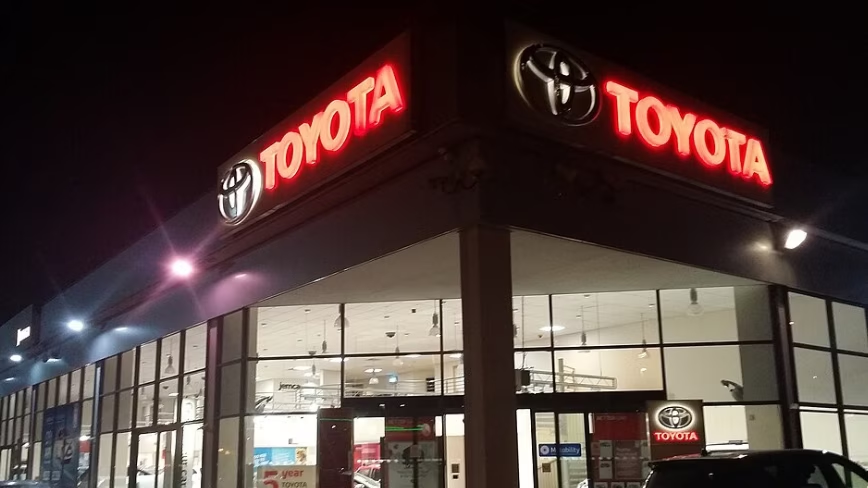
Toyota
 Credit: David Howard
Cox Automotive projects Toyota will narrow its US sales gap with GM to 83,255 vehicles through June as hybrids surge and EV sales fall over 23 percent.
Toyota is gaining on General Motors in the race for America’s sales crown, and the gap is now the narrowest it has been in half a decade. A new forecast from Cox Automotive, released on Wednesday, projects Toyota will sell approximately 1,250,000 vehicles in the United States through the first half of the year, up nearly one percent from a year ago, while GM is expected to fall more than seven percent to roughly 1,330,000.
The projected difference of 83,255 vehicles marks the closest the two automakers have been since Toyota topped GM in annual US sales for the first time in 2021, a result driven partly by semiconductor shortages that hit GM harder during the pandemic. Other than that year, GM has held the title of America’s top-selling automaker continuously since 1931.
“At these rates, and what we’re seeing right now in the selling rates, GM may be looking over their shoulder here when we get to the year’s end, that Toyota could potentially overtake them,” Charlie Chesbrough, senior economist at Cox Automotive, said during a media event. Chesbrough added that he is not yet forecasting Toyota to finish the year on top, but called the trends “concerning for General Motors.”
The divergence comes down to powertrain strategy. Toyota has spent decades building its hybrid lineup and has continued to expand it, rolling out new models across its brands while also introducing battery-electric vehicles. GM took the opposite bet, investing heavily in a full EV portfolio for Cadillac and expanding electric options across Chevrolet, GMC, and Buick while dismissing hybrids as transitional technology, leaving the Corvette E-Ray as its sole hybrid.
That bet is not paying off in 2026. Cox forecasts that EV sales will fall more than 23 percent through the first half of the year, a decline driven by the expiration of the $7,500 federal tax credit last September and 25 percent import tariffs that have made many electric models uneconomic. Hybrid sales, meanwhile, are projected to rise about 10 percent over the same period.
“The story is hybrids are having their moment,” said Stephanie Valdez Streaty, Cox director of industry insights. The broader US new vehicle market is expected to decline three percent through June compared with a year ago, including a drop of about half a percent during the second quarter alone.
GM is not the only automaker under pressure. Cox projects the steepest second-quarter sales declines for Tesla, Ford, and GM, while Honda, Volkswagen, and Stellantis are expected to post gains. The pattern is consistent: automakers with strong hybrid or domestically built lineups are holding up, while those that leaned into EVs without a hybrid fallback are losing ground.
GM’s position is particularly exposed because it lacks the hybrid bridge that competitors are using to weather the EV slowdown. Honda cancelled its entire 0 Series EV lineup earlier this year and pivoted back to hybrids, which set an all-time sales record in February. Toyota never needed to pivot because it never left hybrids in the first place, while GM CEO Mary Barra said in January that the company is still working on a hybrid and plug-in hybrid strategy with no production timeline announced.
The question is whether Toyota can sustain the momentum through the second half of the year. When Toyota chairman Akio Toyoda learned the company had overtaken GM in 2021, he said he did a “happy dance,” but executives cautioned that the win was unlikely to be repeated. The broader US auto market is being reshaped by tariffs and trade policy that favour domestically built vehicles, and both companies manufacture extensively in the United States.
What has changed since 2021 is consumer sentiment toward powertrains, with the hybrid market growing because buyers want electrification without the range anxiety, charging gaps, and higher prices that still accompany battery-electric vehicles. Toyota built its entire product strategy around that preference, while GM bet that buyers would skip hybrids entirely and go straight to EVs. The sales data suggests Toyota read the market correctly.
Get the most important tech news in your inbox each week.


