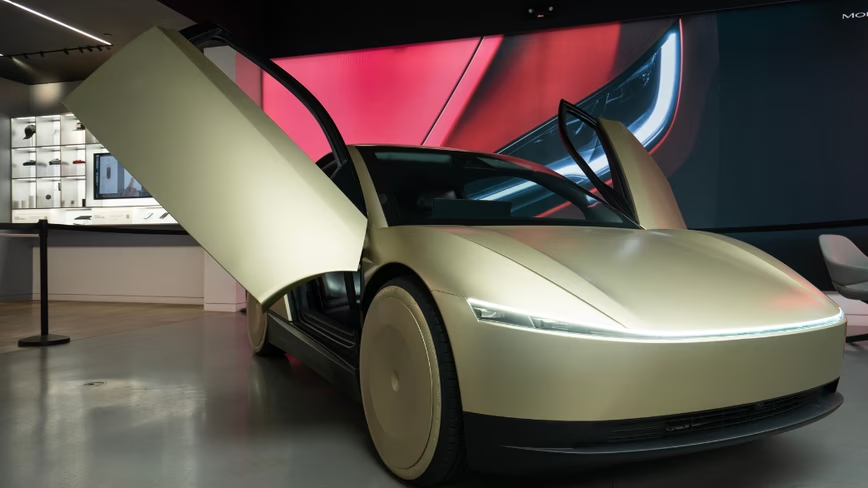
The Cybercab, a two-passenger battery-electric self-driving car under development by Tesla, on display at a Tesla showroom in Bellevue, Washington.
 Credit: Tada Images via Shutterstock.com
Elon Musk said Tesla’s robotaxis are still working on spotting animals that blend into the road at night, describing the problem as grey kittens on grey tarmac, as Austin’s hours moved to 11pm from 10pm. The EU’s Technical Committee on Motor Vehicles votes on bloc-wide approval of the same camera-only sensor suite on 6 October.
Elon Musk says Tesla’s robotaxis still cannot reliably see pets on the road at night. Austin’s service now runs an hour longer, until 11pm. The European Union votes on Tesla’s driver assistance software on Tuesday.
“Literally trying to avoid grey kittens on grey tarmac in the dark,” Musk said on Friday, as Electrek reported. The main thing Tesla is trying to solve is not running over pets when they are hard to see at night, he said.
Austin’s closing time moved from 10pm to 11pm. The service opened in June 2025 running from 6am to midnight, so the window is shorter now than it was at launch.
Cameras need light and contrast to separate an object from the road. Lidar and radar do not.
Musk called lidar a fool’s errand in 2019, a seductive local maximum in 2022, and said last August that lidar and radar reduce safety through sensor contention. New Jersey has a bill that would require two sensing modalities beyond cameras.
Waymo’s sixth-generation cars carry 13 cameras, four lidars and six radars. Its roughly 4,000 driverless vehicles run around the clock.
Tesla dropped radar in 2021 and ultrasonic sensors in 2022, and has never shipped lidar. Our tracking in August found the Austin cars running without safety monitors, on a fleet down to about 17.
Europe is deciding about those same cameras this week.
The Technical Committee on Motor Vehicles votes on bloc-wide approval of FSD Supervised on 6 October, needing 55% of member states representing 65% of the population. Six countries have cleared it already, through mutual recognition of the Dutch approval.
That software is Level 2 and the driver stays liable, so it is not the system driving itself in Austin. The cameras are the same.
Two Model 3s stopped dead in American traffic lanes last October and were hit from behind, in two fatal crashes. Both happened in the dark, at about 9.25pm and just after 3am.
Tesla redacted the crash narratives and the software versions as confidential business information, so which system was running has not been established.
The Dutch regulator approved FSD Supervised in April, after 18 months and 1.6 million kilometres of European road data. Tesla had given Swedish and Dutch regulators safety figures that researchers called misleading.
Get the TNW newsletter
Get the most important tech news in your inbox each week.
Also tagged with


