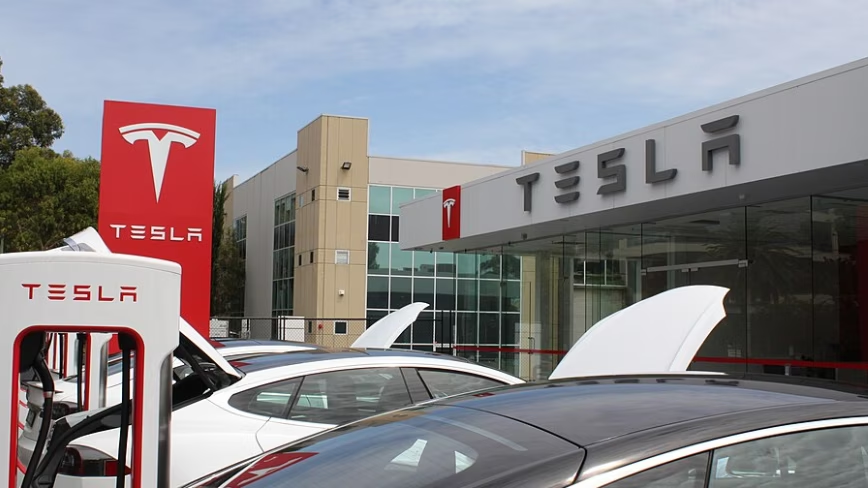
Tesla store with cars and charging stations
 Credit: Jeremy from Sydney, Australia
Electrek has matched two fatal US freeway crashes to redacted Tesla reports showing a driver assistance system verified as engaged with the car stopped at 0mph in a live lane. The Netherlands approved FSD Supervised in April under UN Regulation 171, sealed the reasoning as commercial secrets, and an EU-wide vote is expected in October.
Two Teslas came to a complete stop in live freeway lanes. Both were struck from behind, both drivers died, and both had a driver assistance system verified as engaged, Electrek reported.
One was in Florida. A 2020 Model 3 stopped in the centre eastbound lane of I-4 in Seminole County at about 9.25pm on 6 October 2025, and a semi clipped it into a second semi, killing the 43-year-old driver.
The other was in Arizona. A 2020 Model 3 stopped on the eastbound Loop 202 in Mesa just after 3am on 31 October 2025 and was struck across the whole rear by a Ford F-350, a second report found.
Tesla’s filings to the US regulator say the same thing twice. Engagement status verified engaged, pre-crash movement stopped, speed 0mph.
Everything that would explain it is blacked out. The crash narrative, the software version and the field recording whether the road was inside the approved operating area were all withheld as confidential business information, at a regulator where owners have separately complained that the car took control.
So nobody outside Tesla can say which system was running. Autopilot and Full Self-Driving are indistinguishable in these documents.
That is now a European question rather than an American one. The Netherlands approved FSD Supervised on 10 April under UN Regulation 171, after 18 months of assessment and 1.6 million kilometres of European road data.
The approval is provisional for at least 36 months. Germany, France and Italy were expected to grant national recognition within weeks.
It made the country the first in Europe to certify the system. The RDW was explicit that the car is not self-driving and the driver remains responsible.
The escalation matters here. If a driver ignores the attention warnings, FSD disengages and hands back control, and continued non-response triggers a controlled stop.
A controlled stop is a stationary car in a live lane. Whether that is what happened in Florida and Arizona cannot be established, and the Dutch regulator sealed the reasoning behind its own approval as commercial secrets after Tesla asked for that guarantee.
An EU-wide vote is expected in October. It needs member states representing 55% of the bloc’s countries and 65% of its population.
Tesla has already settled a fatal Full Self-Driving case rather than litigate it. Europe will vote on evidence almost nobody outside the RDW has been allowed to read.
Get the TNW newsletter
Get the most important tech news in your inbox each week.
Also tagged with


