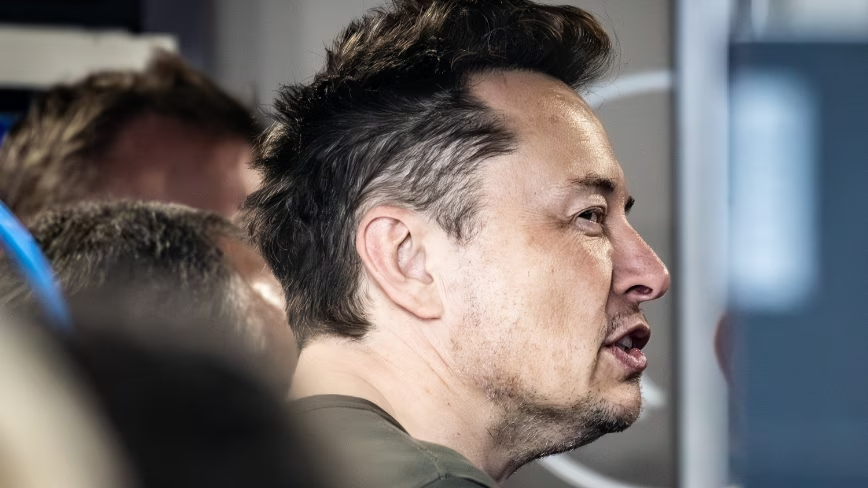
Elon Musk, CEO Tesla in Miami, Florida, May 2023 at the F1 World Championship.
 Credit: Cristiano Barni/Shutterstock
Tesla shares fell around 6% after a Cybercab update that landed badly and after NHTSA opened an investigation into how the company certified a vehicle with no steering wheel, pedals or mirrors. Amazon’s Zoox petitioned for an exemption and was approved in July; Tesla self-certified and did not petition. The complication is that NHTSA is already proposing to remove the brake pedal requirement for automated-only vehicles.
Tesla shares fell around 6% on Friday after a Cybercab update that landed badly, and after the National Highway Traffic Safety Administration opened an investigation into how the company certified the vehicle, as CNBC reported. The regulator is examining the process and technical data Tesla used to demonstrate compliance with federal motor vehicle safety standards for up to 1,000 Cybercabs.
The car has no steering wheel, no brake or accelerator pedal and no mirrors. NHTSA has said Tesla did not petition for an exemption from the standards those omissions engage.
The comparison that frames it
Amazon’s Zoox took the other route. It petitioned NHTSA and received approval in July for limited commercial deployment of its own steering-wheel-free robotaxi.
Same regulatory question, two answers. One company asked and was granted a narrow permission; the other declared itself compliant and is now being asked to show its working.
This is worth stating carefully, because self-certification is the normal mechanism under the federal standards, where manufacturers certify their own compliance rather than seeking type approval. Tesla has not invented a shortcut, and the contested question is whether that mechanism stretches to a vehicle missing controls the standards specify.
Why the faster route is attractive
Look at what asking has produced for Tesla elsewhere. Tesla asked Las Vegas for 5,000 robotaxis and Nevada granted 10.
A permission regime that returns ten vehicles against a request for five thousand is not a route to a fleet. Self-certification for up to 1,000 cars is a different order of magnitude, which is precisely why the certification basis matters.
Zoox’s approval was also for limited deployment. Neither of the permitted routes currently scales at the speed Tesla’s robotaxi plans assume.
The rule is moving underneath the argument
Here is the part that complicates any simple reading. NHTSA has proposed removing the federal requirement for brake pedals in vehicles designed exclusively for automated driving, a change expected to be adopted later this year.
If that lands, one of the main barriers to a vehicle like the Cybercab disappears. Tesla may therefore be accused of moving ahead of a rule change rather than against a settled rule.
That is a meaningfully different charge, and it will shape the outcome. Regulators tend to treat front-running a pending amendment less harshly than defying a stable requirement, though the investigation is live and no finding has been made.
The event itself
The product news was thinner than the regulatory news. Tesla held the Cybercab event in Austin on Thursday, invite only and not streamed, and Elon Musk did not appear.
The vehicle is a two-seat bronze robotaxi with butterfly doors, and users of the Tesla Robotaxi app can now hail one inside a geofenced area of Austin. The rollout began with staff rides before folding into the existing Austin service.
An unstreamed, founder-free launch is an unusual choice for a company that has historically made these moments theatrical. Investors appear to have read the absence as information.
This was not unforeseen
The regulator had already signalled interest. NHTSA said it was evaluating the Cybercab rollout before this week’s formal investigation, so the escalation follows a stated concern rather than arriving from nowhere.
Tesla’s Austin fleet has been running without safety drivers for some time, so the novelty here is the vehicle rather than the autonomy. TechCrunch reported the investigation as a response to the deployment rather than to any crash.
What changed is visibility. A Model Y without a driver attracts less scrutiny than a purpose-built car with no controls at all.
The pattern across two continents
Compare this week in London. Uber and Wayve launched with a licensed safety driver in every car, because they used private hire licensing rather than Britain’s new automated passenger permit scheme.
Two operators, two jurisdictions, the same underlying decision. The legal route chosen determines what the product looks like, more than the state of the software does.
Wayve took the slower-looking route and got cars on the road with a human in the seat. Tesla took the faster one and got a vehicle with no controls and a federal investigation.
What to watch
The investigation’s scope is the number to track. It covers the certification process and technical data for up to 1,000 vehicles, which is a fleet-level question rather than a defect inquiry into a single failure.
Watch the brake pedal rulemaking alongside it. If the amendment is adopted while the probe is open, Tesla’s position improves considerably without anything about the car changing.
And watch whether Tesla petitions retrospectively. Filing for the exemption it did not seek would resolve the immediate question, at the cost of conceding that the exemption was needed.
Get the TNW newsletter
Get the most important tech news in your inbox each week.
Also tagged with


