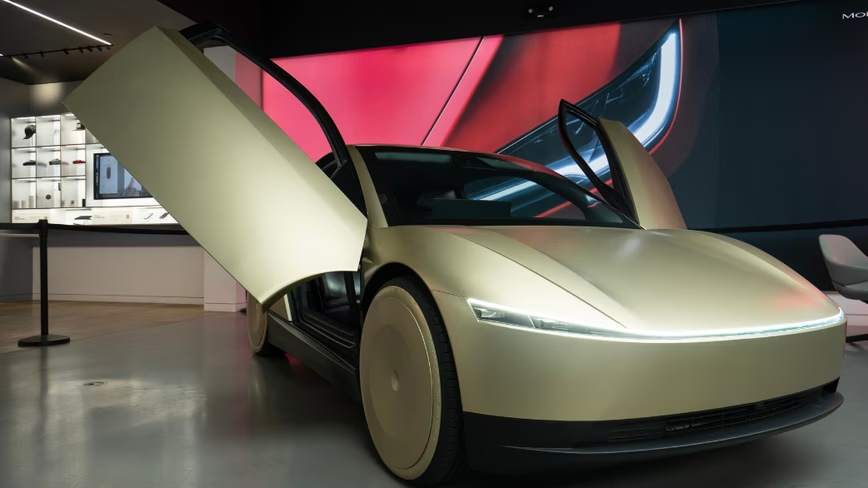
The Cybercab, a two-passenger battery-electric self-driving car under development by Tesla, on display at a Tesla showroom in Bellevue, Washington.
 Credit: Tada Images via Shutterstock.com
Tesla is preparing to put its Cybercab, the purpose-built two-seat robotaxi with no steering wheel and no pedals, onto public roads in Austin as soon as this month, according to The Information.
There is, as ever with a Tesla launch date, a catch attached to the milestone: the first people to ride in it will not be the public, but Tesla’s own employees.
The plan, as reported, is to begin by offering staff rides on public roads and then fold the Cybercabs into the company’s existing Austin robotaxi service a few days later.
The internal target is said to be the end of August, though those familiar with the effort caution that the timeline could still slip.
It is broadly the same cautious playbook Tesla followed before opening its first commercial robotaxi hub in the city last year, and it is a sensible one. It is also a long way from the driverless future Elon Musk has been selling since roughly 2016.
By way of preparation, Tesla has reportedly been running test drives around its Austin campus since July, ferrying employees along private routes, and last week it held training sessions with local fire, rescue, and police departments so first responders understand how the cars behave in an emergency. Public-road testing of the production version began back in June.
Production is the part that sounds most impressive and reveals the most. Tesla has been building Cybercabs at Gigafactory Texas since February, and by July more than 100 of them had been spotted sitting in factory lots.
In other words, the company is mass-producing a vehicle it cannot yet legally sell to anyone or let a customer drive, because it has neither the controls nor, in most places, the permission.
That is a striking bet on software that still has to prove itself, and it means the launch is being timed to the readiness of the driving system rather than the factory, which has plainly been ready for a while.
And that is where the gap between the announcement and the reality opens up. Tesla says its robotaxis have now covered around 380,000 driverless miles across its hubs, a number Musk cited approvingly. Waymo, the competitor Tesla rarely names, passed 220 million rider-only driverless miles some time ago.
Tesla’s unsupervised Austin fleet, meanwhile, is reported to have shrunk to roughly 17 cars, down from about 25 in the spring, and its robotaxis still only work inside carefully mapped geofences in a handful of cities, from Austin to a clutch of Florida markets, with human safety monitors never far from the story.
This is a service scaling slowly and deliberately, whatever the launch language suggests, and the Cybercab does not change that arithmetic so much as give it a sleeker shell.
None of which makes the Cybercab a failure. A car with no steering wheel is a genuinely bolder proposition than a retrofitted Model Y, and regulators are gradually warming to the format, as Amazon’s Zoox showed when it won the first US approval to charge for rides in a wheel-free robotaxi.
But there is a reason the first riders are on the payroll. Employee trials are low-risk, easy to control, and impossible to embarrass the company with, and they let Tesla announce a launch without quite delivering the driverless public service it has promised for the best part of a decade.
We have been here before, of course. The Cybercab was unveiled to great fanfare in 2024, and Tesla’s robotaxi story has a habit of producing carefully staged moments that look like arrival and turn out to be rehearsal.
A staff shuttle in one city is real progress. It is just not the same thing as a robotaxi you can hail, and it would be wise to keep the two firmly apart until Tesla itself stops blurring them.
Get the TNW newsletter
Get the most important tech news in your inbox each week.
Also tagged with


