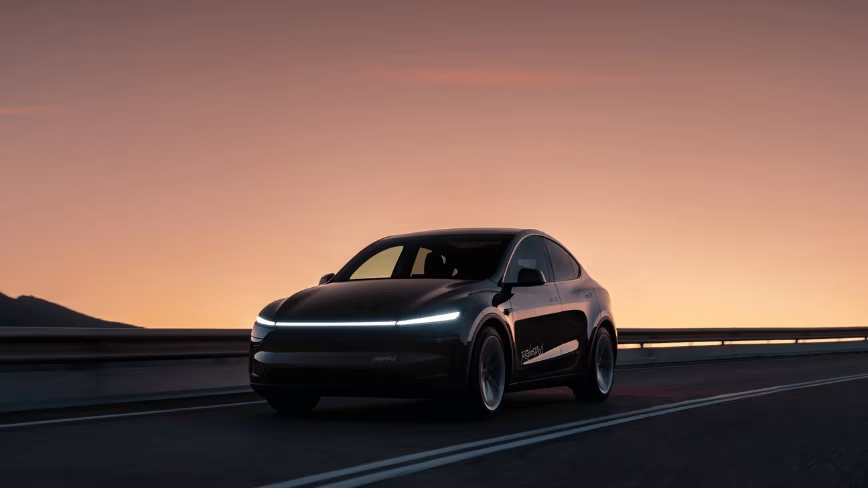
 Credit: Tesla
Tesla is building Supercharger stations dedicated to its robotaxi fleet, which currently uses public sites where operators plug the cars in by hand. Europe was where Tesla first opened the network to other brands, and its charging rules count only publicly accessible capacity.
Tesla is building Supercharger stations dedicated to its robotaxi fleet, InsideEVs reported. The driverless cars currently use public sites, where an operator plugs them in at night.
“They’re plugged in manually, but that’s just for now,” said Max de Zegher, who runs Tesla’s North American charging unit. He did not say how the cars would connect themselves. Tesla dispatches the cabs to chargers using the same trip planner that powers navigation in its other cars.
Tesla has not delivered the robotic charging arm it showed a decade ago.
The Cybercab may not need one. Tesla said in 2024 that the two-door car would support only wireless charging, demonstrated at up to 25kW against a 48kWh battery.
The dedicated sites will go where demand is high and land is cheap. At public stations, Tesla says cars carrying passengers have charging priority. Back-to-back sessions are the aim, to keep site utilisation high.
Europe is where this network first opened up, which is what makes the direction of travel worth noting.
Tesla ran its first pilot for other brands in the Netherlands in November 2021, opening ten stations to any driver with the app.
Europe then wrote openness into the rules. The alternative fuels regulation sets its targets in kilowatts of publicly accessible capacity, at least 1.3kW for every registered battery-electric car.
TNW has written before about how the regulation counts kilowatts, not plugs. New stations above 50kW have also needed card payment since April 2024, so a driver can arrive and pay without an account.
A station reserved for one company’s robotaxis is not publicly accessible, so it would count towards none of that.
Inductive pads raise the same question from the other side, because the targets and the payment rules are written around points a driver can plug into.
None of this binds Tesla yet, because it has no robotaxi service in Europe. Its supervised driver assistance has cleared six member states through mutual recognition.
The Technical Committee on Motor Vehicles votes on bloc-wide approval on 6 October. Whichever way it goes, the charging a robotaxi fleet needs sits outside the rules Europe wrote to keep charging open.
Get the TNW newsletter
Get the most important tech news in your inbox each week.
Also tagged with


