BMW i7 gen6
 Credit: BMW
Summary:BMW revealed the facelifted 2027 i7 simultaneously at Grand Central Terminal and Auto China with Gen6 cylindrical cells from Rimac, rare-earth-free motors with SiC inverters, and 250 kW charging. The i7 60 xDrive targets 350-plus miles EPA and 728 km WLTP; the i7 50 reaches 611 km and the M70 targets 686 km. BMW dropped Level 3 autonomous driving entirely, replacing it with the cheaper Level 2 Symbiotic Drive system, and overhauled the interior with Panoramic Vision, an 8K Theatre Screen, and Operating System X.
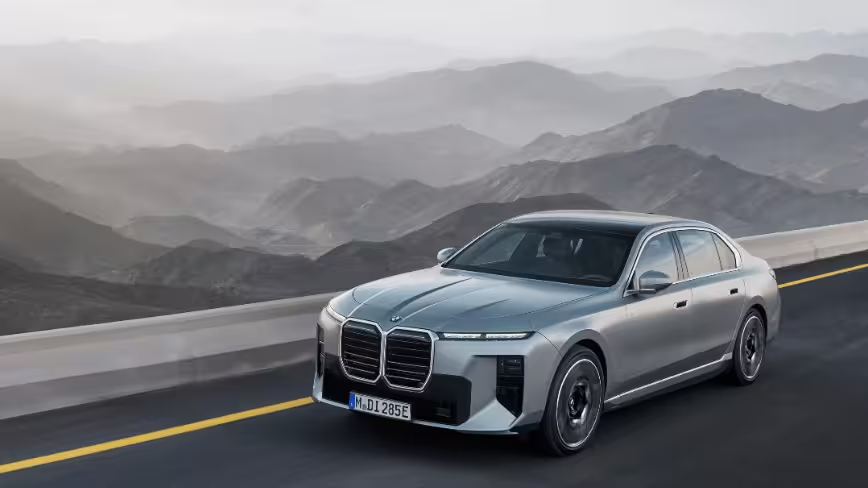
BMW revealed the facelifted 2027 i7 simultaneously at Grand Central Terminal in New York and Auto China in Beijing on Tuesday, calling it “one of the brand’s most significant reveals in a generation.” The substance behind the rhetoric is a battery developed with Rimac Technology that uses BMW’s sixth-generation cylindrical cells for the first time outside the dedicated Neue Klasse platform, and a charging architecture that reaches 250 kilowatts, up from 195. The i7 60 xDrive now carries 112.5 kilowatt-hours of usable capacity, up from 101.7, and BMW estimates a preliminary EPA range of more than 350 miles, with up to 728 kilometres on the WLTP cycle. The entry-level i7 50 xDrive reaches 611 kilometres WLTP, and the performance-focused i7 M70 xDrive targets 686 kilometres. A ten-minute stop at a compatible DC fast charger adds up to 146 miles of WLTP range. Charging from 10% to 80% takes 28 minutes.
The numbers matter because the i7 has been the weakest link in BMW’s electric argument. A car that starts north of $120,000 and could not match the range of a Tesla Model S at a third of the price invited the obvious question. The Gen6 battery and Rimac partnership are BMW’s answer, and they arrive at a moment when European EV makers are gaining ground against Tesla, whose registrations fell nearly 60% year on year in Germany in early 2025.
The Rimac battery
The technical story is the battery. BMW’s Gen6 cells use the 4695 cylindrical format, 46 millimetres in diameter and 95 millimetres tall, replacing the Gen5 prismatic cells in the outgoing i7. The cylindrical cells deliver roughly 20% higher volumetric energy density, which is how BMW increased usable capacity by more than 10% without changing the external dimensions of the battery pack. The existing floor structure of the G70 7 Series did not need to be modified, a constraint that would have been prohibitively expensive for a mid-cycle update.
Rimac Technology, the Croatian company better known for the Nevera hypercar, built two full production lines and an end-to-end supply chain at its campus near Zagreb, described by BMW as one of the largest industrial construction projects of its kind in Europe, to manufacture the battery packs, which are then shipped to BMW’s plant in Dingolfing for final assembly. The partnership represents a new role for Rimac as a battery systems supplier to a major OEM, a business model distinct from its hypercar and autonomous taxi ventures. BMW says the Gen6 cells reduce the battery supply chain’s CO2-equivalent footprint by 33% compared to Gen5, with cells produced entirely using renewable energy and incorporating recycled lithium, cobalt, and nickel. The wheels on certain i7 variants use 70% recycled aluminium.
The electric motors themselves have changed as fundamentally as the battery. The i7 now uses excited synchronous motors whose rotors no longer require rare earth magnets, with the magnetic field generated instead by windings fed with direct current. Silicon carbide inverters are integrated into the motor housing, and BMW claims a 20% efficiency gain across the entire powertrain, aided by optimised wheel bearings that improve overall vehicle efficiency by up to 7%. The i7 achieves a drag coefficient of 0.24, competitive with the segment leaders. These are not the kinds of improvements that make headlines, but they are the kind that make the difference between 300 miles of real-world range and 350.
This is the first deployment of Gen6 cylindrical cells outside the Neue Klasse architecture, which is significant because it means BMW is bridging its current and next-generation platforms with the same cell chemistry. The Neue Klasse iX3, arriving this summer with up to 400 miles of range and 400-kilowatt ultra-fast charging on an 800-volt architecture, uses the same Gen6 cells in a purpose-built pack. The i7 facelift proves the cells can be retrofitted into an existing platform, which opens the possibility that other current-generation BMW EVs could receive similar upgrades.
What the money buys
The i7 50 xDrive is a new entry-level electric variant with 449 horsepower, 487 pound-feet of torque, a 0-60 time of roughly 5.3 seconds, and a starting price of $107,550. The i7 60 xDrive produces 536 horsepower and 549 pound-feet, reaches 60 in approximately 4.6 seconds, and starts at $126,250. The ICE lineup includes the 740 with a turbocharged 3.0-litre inline-six producing 394 horsepower on a Miller cycle, starting at $101,350 in rear-wheel drive, and the 750e xDrive plug-in hybrid combining 308 horsepower from the same engine with a 194-horsepower electric motor for a combined 483 horsepower, arriving in the first quarter of 2027. A V8-powered M Performance variant is confirmed for later that year. All electric variants carry a native NACS charging port as standard in North America. Production of the launch models begins in July at Dingolfing.
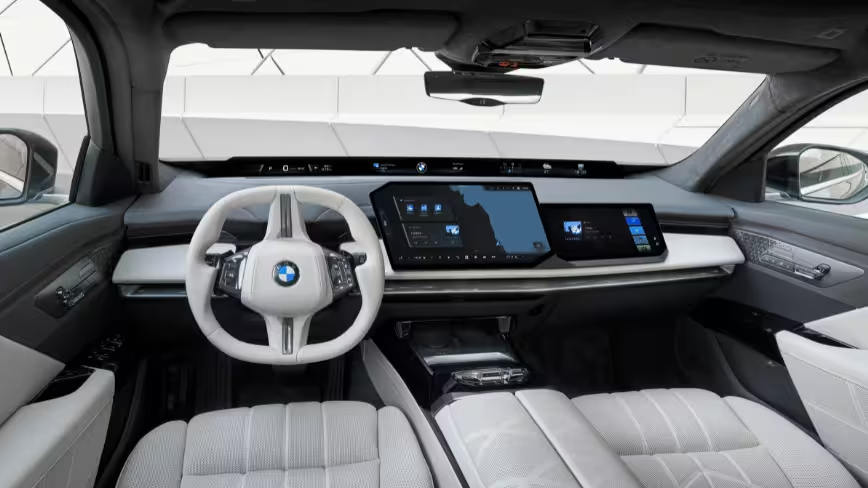
The interior has been overhauled more dramatically than the exterior. BMW replaced the traditional instrument cluster and iDrive rotary controller with the Panoramic Vision system from the Neue Klasse range: a full-width projection from A-pillar to A-pillar on a black printed surface in the lower windshield, with the most critical driving information displayed above the steering wheel. An optional 3D head-up display sits above the Panoramic Vision for navigation and automated driving data. A 17.9-inch centre infotainment screen and a 14.6-inch front passenger display in a free-cut rhombus design, a first for BMW, complete the cabin. The system runs BMW’s Operating System X. The rear seat gets a 31.3-inch Theatre Screen with 8K resolution and a 32:9 aspect ratio, streaming via Amazon Fire TV over 5G with 128 gigabytes of offline storage. Rear passengers control content, climate, and seating through 5.5-inch touchscreens in each door. The available Bowers and Wilkins Diamond 4D audio system runs to 1,965 watts across 35 speakers.
The exterior adopts the illuminated Kidney Iconic Glow grille surround, minimalist crystal headlights with vertically stacked daytime running light signatures, and a full-width rear light bar. Twenty-two-inch wheels are available on the 7 Series for the first time, and a digital rearview mirror is also a first for the model.
The autonomous driving retreat
The most notable subtraction is Level 3 autonomous driving. The outgoing 7 Series offered Personal Pilot L3, which allowed hands-free, eyes-off driving on motorways in certain conditions at a price of roughly $7,000. BMW has dropped it entirely, replacing it with Symbiotic Drive, a Level 2 system derived from the Neue Klasse iX3. Symbiotic Drive offers hands-free motorway driving up to 130 kilometres per hour, address-to-address urban navigation, and automatic lane changes confirmed by eye movement rather than a physical input. It costs approximately $1,700, less than a quarter of the Level 3 system it replaces. BMW said demand for Level 3 was not at a profitable level.
The retreat is instructive. BMW invested heavily in the regulatory approvals and sensor suites required for Level 3, only to find that customers were unwilling to pay the premium. The replacement system does less in a narrow legal sense, the driver remains responsible at all times, but does more in practical terms: it works in urban environments, handles lane changes with a glance, and includes what BMW calls “symbiotic braking,” backed by 24 patents, which lets the driver gently brake to increase following distance without deactivating the system. The gap between what regulators define as autonomous and what drivers experience as effortless continues to narrow from the Level 2 side rather than the Level 3 side.
The competition is not standing still
The i7 60 xDrive’s preliminary 350-plus miles would be a meaningful improvement but still trails the global EV sales landscape’s benchmarks. The Tesla Model S offers 410 miles of EPA range at roughly $75,000. The Lucid Air Grand Touring reaches 512 miles. Mercedes-Benz is preparing a 2027 EQS update with an 800-volt architecture, 926 kilometres of WLTP range, 350-kilowatt charging, and steer-by-wire, a package that would leapfrog the i7 on every electrical metric. From below, Chinese EVs are challenging European automakers with luxury features at a fraction of the price.
BMW’s argument is not that the i7 leads on any single specification. It is that the combination of a familiar luxury sedan, a meaningfully upgraded battery from a credible technology partner, competitive charging speeds, and a native connection to the largest fast-charging network in North America makes it the least compromised electric option in its segment. The 250-kilowatt charging rate is faster than the current EQS at 200 kilowatts, though Mercedes will surpass it with the 2027 update. The 28-minute 10-to-80 time is competitive with the segment. The NACS port removes the last friction point for American buyers who worried about charger access.
The bridge strategy
The i7 facelift is a bridge product, and BMW is not pretending otherwise. The Neue Klasse platform is the company’s future: an 800-volt architecture with Gen6 cells in a purpose-built pack, ultra-fast charging, and a centralised computing system designed from the ground up. The iX3 has accumulated more than 50,000 orders in Europe before deliveries have begun. The Neue Klasse i3 is due later this year with up to 900 kilometres of WLTP range in some configurations. BMW plans to roll Neue Klasse technologies across 40 new models and updates by 2027.
The i7’s job is to hold the line until that transition is complete. BMW sold 442,072 fully electric vehicles in 2025, up 8.3% year on year, with European EV growth at 28.2%. First-quarter 2026 deliveries fell to 87,458 units, a decline of roughly 20% from the prior year, though European EV orders rose 40%. The numbers reflect the awkward timing of a product cycle: buyers waiting for Neue Klasse, current models ageing, and a European market where Tesla’s sales have declined sharply enough to create opportunities but not so sharply that BMW has captured them all.
The Gen6 battery in the i7 is BMW’s way of saying that the wait for Neue Klasse does not mean the wait for better technology. The cells are the same. The chemistry is the same. The manufacturing partner is building the packs at scale. What the i7 cannot offer is the 800-volt architecture, the 400-kilowatt charging, or the purpose-built efficiency of a platform designed around the battery rather than adapted to accommodate it. That distinction is the difference between a bridge and a destination. The challenges of entering the EV market have claimed even well-resourced partnerships. BMW’s bet is that bridging two generations of technology is harder than it looks, and that doing it credibly, with Rimac-built batteries, rare-earth-free motors, and an interior borrowed from the future platform, buys the time needed to get there.
Get the TNW newsletter
Get the most important tech news in your inbox each week.


