The San Francisco startup, founded by an ex-Uber ATG and Waabi engineer, is taking a different approach to autonomous freight than Aurora or Kodiak: no driver’s cab, no hub handoffs, and an autonomy stack built on vision-language-action models rather than rule-based systems.
Humble, a San Francisco-based autonomous freight startup, has emerged from stealth with a $24 million seed round and a fully electric, cabless freight vehicle called the Humble Hauler.
The round was led by Eclipse, the Palo Alto-based venture firm that has made physical AI its central investment thesis, with participation from Energy Impact Partners.
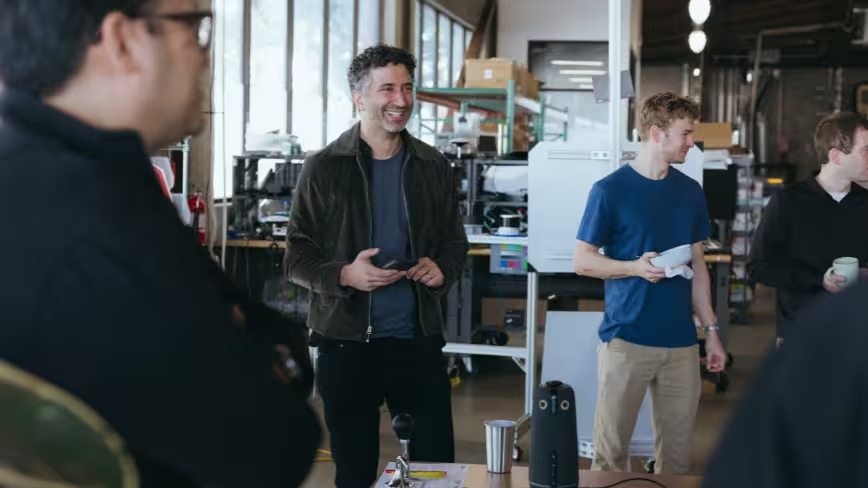
The company was founded by Eyal Cohen, whose two-decade career in autonomous vehicles spans Apple, Uber ATG, Waabi, and Spark AI, a startup he co-founded that was acquired by John Deere in 2023.
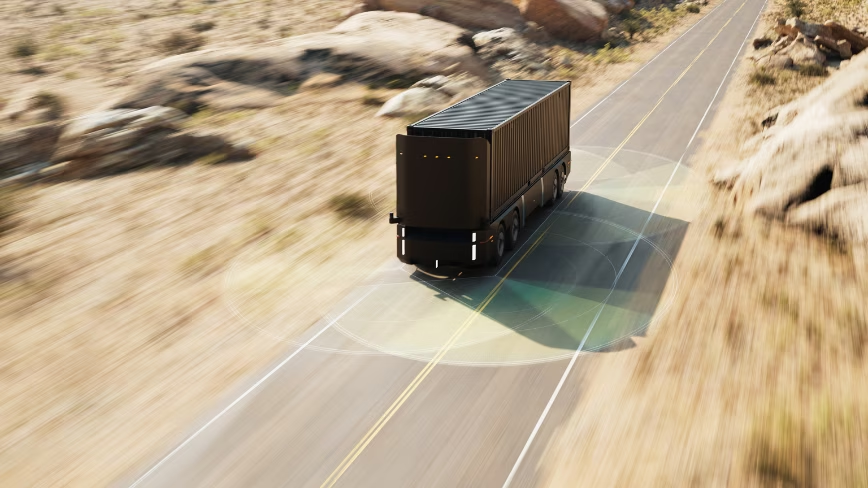
The Hauler is designed around a deliberate absence: there is no driver’s cab. Cohen told Fortune, which reported the launch exclusively, that conventional trucks were never conceived with autonomy in mind, their architecture reflects a world built around human operators.
Removing the cab allows 360-degree sensor coverage across cameras, LiDAR, and radar, frees payload capacity, and enables a fundamentally different vehicle geometry.
The Hauler is built for 40-foot and 53-foot shipping containers, the standard dimensions of intermodal freight, and operates dock-to-dock, delivering directly to the destination and unloading rather than dropping a trailer at a handoff point.
That dock-to-dock model is where Humble’s commercial proposition diverges most visibly from the rest of the autonomous trucking market.
Aurora, whose driverless truck network now spans the Sun Belt, operates a hub-to-hub model in which autonomous trucks hand off to human drivers at drop yards near city limits. Kodiak’s commercial operations are built around fixed launch-and-landing zones.
Both approaches simplify the autonomy problem by constraining the operating domain. Humble’s bet is that going all the way to the customer is ultimately what logistics operators need, and that the Hauler’s architecture, combined with an autonomy stack built on vision-language-action models rather than conventional rule-based systems, can get there sooner than approaches constrained by cab-forward truck geometry.
The investor most directly associated with the Humble thesis is Jiten Behl, a partner at Eclipse who joined the firm in early 2024 after serving as chief strategy officer and chief growth officer at Rivian, where he helped close Amazon’s order for 100,000 electric delivery vans and led more than $10 billion in financing including Rivian’s IPO.
He frames the commercial case in terms logistics operators cannot easily ignore: “When you go to them and say there is a possibility of 30 to 50% more efficiency in your business, you’re obligated to take it to your management team.”
On the capital required to reach scale, Behl is notably restrained for a sector that has consumed billions: “This is not going to take a billion dollars. It’s going to take an order of magnitude less than that.”
The market context supports both the ambition and the caution. US truck freight is a $906 billion industry. The autonomous freight segment is estimated at $575.7 million in 2026 and projected to reach $3.25 billion by 2035.
Federal tailwinds are arriving in parallel: the Self Drive Act of 2026, formally introduced in February, proposes a unified federal framework for autonomous trucking, and Cohen was meeting with the National Highway Traffic Safety Administration in Washington as recently as last week. Humble has been engaged with NHTSA since early in its development.
What Humble is not yet disclosing is its commercial timeline, specific pilot partners, or target geographies for initial operations. The seed round will fund development of the Hauler and deployment of a pilot programme.
Whether it can translate architectural differentiation and a credible founding team into operational proof before the window closes, Aurora is already reporting more than 250,000 driverless miles with zero at-fault collisions, and plans to have 200 autonomous trucks operating by year end, is the question the $24 million is meant to start answering.
Get the TNW newsletter
Get the most important tech news in your inbox each week.


