TL;DR
A Tesla Model 3 on Autopilot crashed into a Texas home, killing a 76-year-old woman. NHTSA is launching a special crash investigation.
The crash in Katy, Texas adds another fatality to the growing list of Autopilot-linked incidents as NHTSA simultaneously pushes to loosen safety rules for automated vehicles under the Trump administration
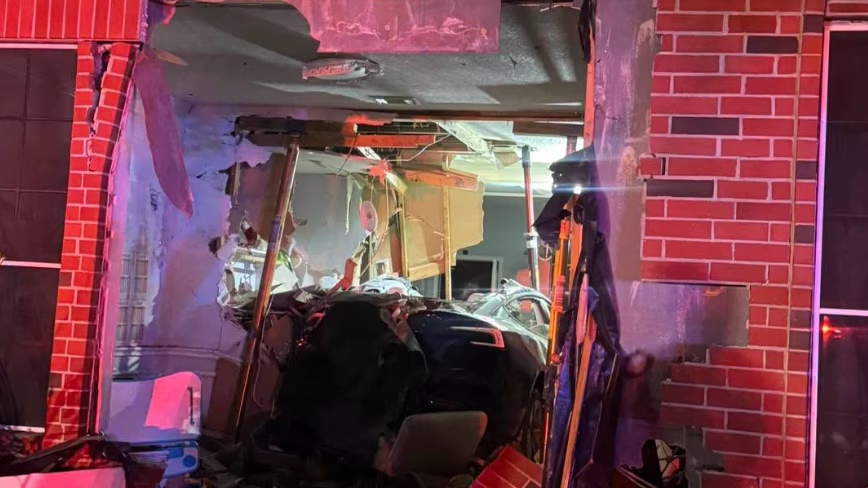
Crash
 Credit: The Office of Constable Terry Allbritton / Facebookl
A Tesla Model 3 on Autopilot crashed into a Texas home, killing a 76-year-old woman. NHTSA is launching a special crash investigation.
A 76-year-old Texas woman died on Friday after a Tesla Model 3 driver told police he was using the car’s Autopilot feature when he lost control and crashed into her family’s home at high speed. The Harris County Sheriff’s Office confirmed that Michael Butler said an automated driving assistance system was engaged at the time of the crash in Katy, a suburb west of Houston. Police said Butler “failed to drive in a single lane, left the roadway, and struck the residence” but confirmed he was not intoxicated and is cooperating with the investigation.
Martha Avila was standing in the front room of the house, where she lived with her daughter, son-in-law, and three young grandchildren. No one else was injured. Her daughter, Jennifer Barbour, told local outlet KHOU that Avila was in good health and on no medications when she died suddenly from her injuries, adding that she had expected her mother to live to 100.
The National Highway Traffic Safety Administration told Ars Technica it is launching a special crash investigation. The crash falls within the scope of NHTSA’s existing engineering analysis into more than three million Tesla vehicles equipped with Full Self-Driving software, which the agency escalated in March 2026 after documenting incidents where vehicles crossed into opposing lanes, ran red lights, and struck pedestrians.
The same agency certified the Tesla Model Y as the first vehicle to pass its new driver-assistance safety tests just weeks earlier, creating a situation where NHTSA is simultaneously celebrating and investigating the same company’s technology. Investigators have not yet confirmed whether Autopilot was actually engaged at the time of the crash, as the claim comes solely from the driver.
A doorbell camera video shared by The New York Times shows the Tesla plowing through the brick home’s front wall. A neighbour who witnessed the collision estimated the car was travelling at 60 to 70 miles per hour through the residential area, according to local news outlet Click2Houston.
The fatality arrives as Tesla pushes the Trump administration to relax safety rules for automated vehicles. The company has filed comments supporting two proposed NHTSA rule changes: one that would allow automated vehicle makers to remove transmission shift position displays, and another that would eliminate the requirement for windshield wipers and defogging controls on vehicles equipped with automated driving systems. Tesla argued in its regulatory filings that cameras make human-facing controls unnecessary because the automated system does not rely on windshield visibility to operate.
Advocates for Highway and Auto Safety has opposed both proposals, warning that passengers still need to see their surroundings to safely enter and exit vehicles, particularly in emergencies. The group called Tesla’s Autopilot “unproven” and emphasised that even a single fatality like Avila’s has a “horrific ripple effect forever changing the lives of children, parents, friends, and communities.”
Tesla’s marketing of Autopilot has drawn criticism for sending mixed signals about the system’s capabilities. The owner’s manual instructs drivers to keep their hands on the wheel and remain attentive, but as recently as May, Tesla’s official X account posted an ad showing drivers with their hands off the wheel. Tesla’s Austin robotaxi service has reported 14 crashes across roughly 800,000 miles of operation, a rate approximately four times worse than the human average that Tesla itself cites on its safety page.
The broader regulatory picture favours Tesla. NHTSA Administrator Jonathan Morrison confirmed in a January speech that 2026 would be a “big” year for autonomous vehicle rulemaking, criticising the Biden administration for focusing too heavily on enforcement. He said the Trump administration’s priority is removing what it calls unnecessary regulatory barriers and enabling commercial deployment of autonomous vehicles without steering wheels or brake pedals.
In 2023, Tesla recalled more than two million vehicles after regulators found the company had not deployed Autopilot in a way that required drivers to remain attentive. Elon Musk’s Department of Government Efficiency subsequently cut staff at NHTSA with expertise in evaluating autonomous vehicle safety, with the agency’s self-driving division disproportionately affected. A new NHTSA probe into Tesla’s FSD opened in October 2025 after alarming reports of the system running red lights and crossing into oncoming lanes, and Tesla twice delayed responding to federal data requests.
For Avila’s family, the policy debate is secondary. Barbour said she does not know whether the driver or the car is to blame, adding that she has never seen a vehicle move that fast through a neighbourhood.
Get the most important tech news in your inbox each week.


