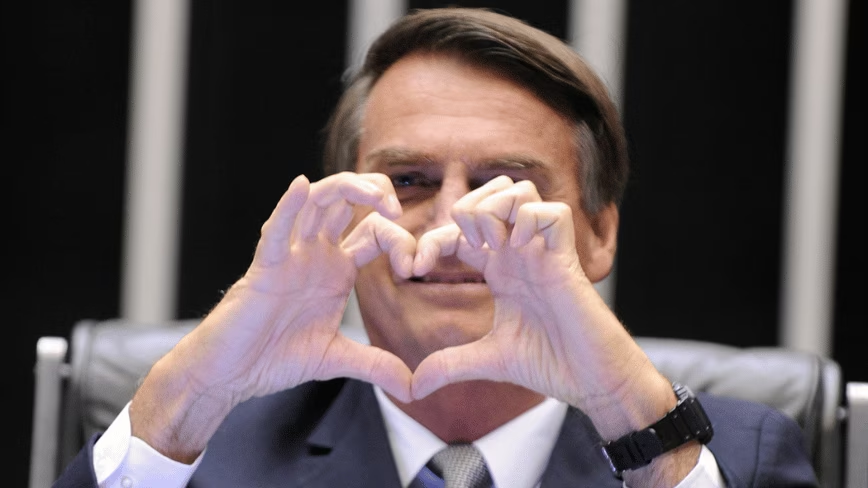
 Credit: Gabriela Korossy / Câmara dos Deputados
Brazil ordered Jair Bolsonaro to stay silent. Last weekend, a giant AI version of him addressed a campaign rally anyway.
At the launch of his son Flávio’s presidential bid in São Paulo on Saturday, a video avatar of the jailed former president loomed over the crowd. The clever part was the confession. “What you see here is not me,” it said. “This is a simulation of my image and my voice using artificial intelligence.”
Then it campaigned. “As everyone here knows, I am imprisoned and silenced by an unjust and arbitrary decision,” the avatar said, before asking the crowd to back Flávio, “blood of my blood.” Bloomberg timed the clip at 46 seconds, and both Reuters and AFP reported the appearance.
Why this is not a normal deepfake
The debate over AI in elections has focused on lies: fake videos that trick voters into believing something false. This clip does the opposite. It announces that it is synthetic. That honesty is the whole gambit.
Bolsonaro is under house arrest, serving 27 years for plotting a coup after he lost the 2022 election to President Luiz Inácio Lula da Silva. A condition of that arrest is a ban on public communication, on social media or by any other means. He cannot phone, post or speak to a rally.
An avatar can. That is the loophole the courts must now weigh: not whether the video deceived anyone, but whether a disclosed simulation lets a court-silenced man keep campaigning through a screen.
The legal fight
The challenge came fast. On Sunday, a coalition of Lula’s campaign and other left and centre-left parties petitioned the Superior Electoral Court, the TSE. They argued Brazil’s rules bar synthetic content that reproduces a real person to sway voters.
Flávio’s team fired back a day later. The video broke no rule, they said, because it disclosed its use of AI, caused no harm and never mixed fabricated footage with real images. On that reading, it is not a deepfake at all.
Jair Bolsonaro, through his lawyer Paulo Cunha Bueno, denied authorising anything. He “did not authorise the use of his image and voice,” the lawyer wrote, and “could not have done so,” since he is barred from seeing visitors. He added that the former president had never objected to his children using his image.
A court he helped build
The judges are split in tone. The TSE’s president, Justice Kássio Nunes Marques, whom Bolsonaro appointed to the Supreme Court, said using AI to campaign is permissible. What is forbidden, he added, is using it to harm someone.
Supreme Court Justice Alexandre de Moraes was sharper. Authorising the video could be a “serious violation” of the house-arrest terms, he warned, and using Bolsonaro’s image to imply he is campaigning could amount to electoral disinformation.
The stakes are steep. The TSE could disqualify Flávio’s run if it finds the clip broke the rules. Bolsonaro himself is unlikely to be punished, said Insper law professor Ivar Hartmann, because he can argue he neither recorded nor approved it. One Lula coordinator predicted the most heavily litigated election since Brazil returned to democracy.
The rules are already behind
Politicians are reaching for avatars faster than the law can frame them. Malaysia’s prime minister has fielded his own AI stand-in, and regulators are scrambling to respond. France plans to triple the penalties for AI-driven election disinformation.
Most of those rules turn on disclosure. The EU’s AI Act will force a label on synthetic media, and Brazil’s own code targets fabricated content that misleads. The Bolsonaro clip met that bar and marched straight through it. India is wrestling with the flip side, opening a case over altered videos of its prime minister.
That is the gap this stunt exposes. A label tells you a video is fake. It does not tell you whether a jailed politician should be allowed to speak through it. Brazil votes on 4 October. Its court has until then to decide.
Get the TNW newsletter
Get the most important tech news in your inbox each week.


