Robots-Faraday
 Credit: Faraday Future
The US wanted to keep Chinese robots out. Beijing’s answer: do this, and we will hit back where it hurts.
China has threatened “resolute” retaliation after Washington moved to bar imports of Chinese-made humanoid robots. Its commerce ministry called the measure discriminatory and warned it “severely” damages trade relations, the New York Times and CNBC reported.
The ministry demanded that the US withdraw the decision, and threatened countermeasures if it does not. It accused Washington of “overstretching the concept of national security” and said the move disrupts global supply chains.
What the US actually banned
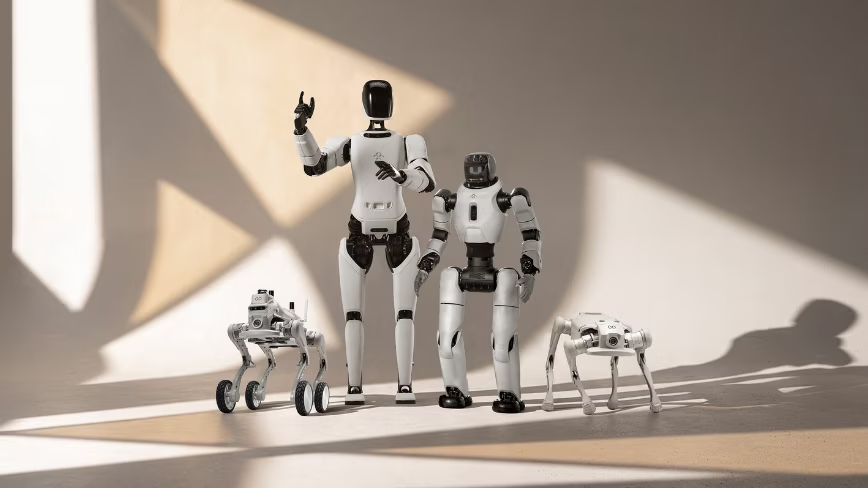
The trigger was an FCC order this week adding foreign-made “advanced robotic devices” to its restricted Covered List. It blocks new humanoids and robot dogs from the import approval they need to be sold in the US. Already-approved models can stay.
The rule is broader than it first looked. It sweeps up almost any new wireless, software-controlled robot over 4.4 pounds that can sense its surroundings, from robot lawnmowers to sidewalk delivery bots to Chinese robot vacuums. The FCC did not name China, but Chinese firms dominate the category.
Washington’s case rests on two fears. One is that connected robots could act as Trojan horses for data collection. The other is that robotics is strategically vital in an AI-driven economy. Chinese firm Unitree, one of the leaders, has already been flagged by the Pentagon over alleged military ties.
China’s leverage
The threat carries weight because China holds real cards. Analysts say the two obvious levers are rare earths, where China controls supply, and market access for US giants like Tesla and Nvidia. Both would sting.
The timing is also bad for Chinese robot makers. “This is bad news for Chinese humanoid producers planning their IPOs in the coming months,” said Counterpoint’s Marc Einstein. Unitree and Agibot have filed to go public, and Hong Kong-listed UBTech briefly fell more than 6 per cent.
The awkward truth
There is a catch that makes the ban tricky to enforce. It has become nearly impossible to build a competitive humanoid without Chinese-made parts, such as sensors and joints. China is also miles ahead on robots, running more factory robots than the rest of the world combined.
The clash lands at a delicate moment. Trump is due to host Xi Jinping in September, and tensions are already high. Treasury Secretary Scott Bessent has floated sanctions over AI model “theft”. Trump, for his part, hinted this week at a softer touch on AI controls to keep the US ahead.
Robots are now their own front in the tech war. The US has drawn a line around its market, and China is signalling that it can make that line expensive.
Get the TNW newsletter
Get the most important tech news in your inbox each week.


