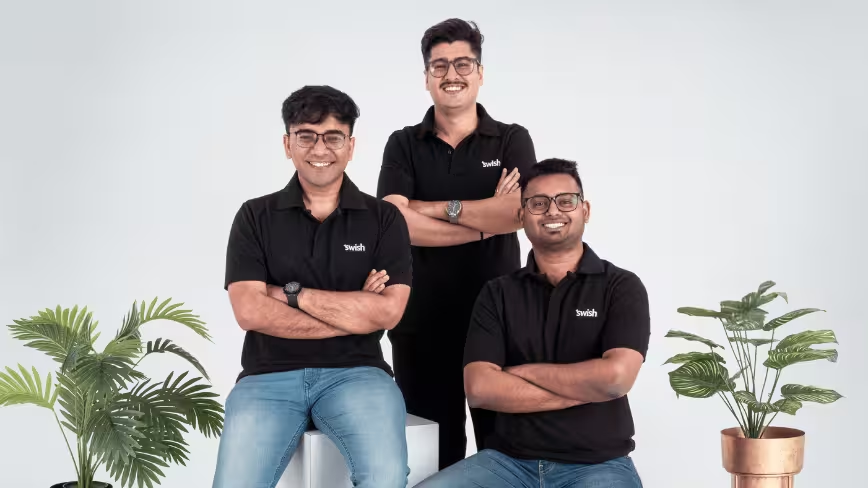
Bengaluru’s Swish has now raised $54M in 18 months, values itself at $139M, and is betting that owning the kitchen, the technology, and the last mile is the only way to make ultra-fast food delivery work at scale.
The timing is pointed. In the months before Swish announced its $38 million Series B, three of India’s largest food and quick-commerce platforms had quietly retreated from the 10-minute food delivery space they had each tried to colonise.
Swiggy shut down Snacc, its standalone rapid-delivery app, within a year of launch. Zomato paused Quick, its 15-minute delivery service, four months after its debut. Zepto shuttered roughly 200 of the 600 outlets it had opened for Zepto Café as part of an internal restructuring. Into that retreat, Swish announced that it has raised $38 million and is pressing forward.
The round is led by Hara Global and Bain Capital Ventures, with continued backing from Accel, which was among Swish’s earliest institutional investors. Alteria Capital and Stride Ventures also participated, providing venture debt alongside the equity.
The raise values Swish at $139 million post-money, more than double its $60 million valuation from its Series A in March 2025, and brings total funding to $54 million across three rounds in 18 months. Aniket Shah, Ujjwal Sukheja, and Saran S. co-founded the company in 2024.
The explanation Swish offers for why it succeeds where the larger players failed is structural. Swiggy, Zomato, and Zepto all operate as aggregators or marketplace platforms, taking commissions from partner restaurants and relying on third-party kitchens to prepare the food.
Swish owns its kitchens, operates its own consumer app, employs its own delivery staff, and focuses its operations within a roughly one-kilometre radius of each kitchen cluster. There are no third-party commissions leaving the system, which the company argues allows it to reinvest margin into food quality and delivery reliability in a way that aggregators cannot. More than 20,000 people now order from Swish every day.
Saanya Ojha, a partner at Bain Capital Ventures, argued that the company is targeting a different and larger opportunity than the existing food delivery incumbents: not competing for the planned dinner order that Swiggy and Zomato have long optimised for, but for the more frequent, lower-consideration moments, breakfast, a mid-morning coffee, an afternoon snack, a solo meal.
“Swish is targeting a much larger, more frequent surface area,” she said in a statement. “The opportunity is not just to take share within food delivery, but to expand the market by bringing more daily consumption online.”
The financial picture carries the usual caveats for an early-stage, growth-focused consumer startup. Regulatory filings analysed by Whalesbook show revenue of ₹4 crore between July 2024 and March 2025, against a net loss of ₹19 crore over the same period, a ratio that reflects heavy investment in kitchen infrastructure and team-building rather than a business generating meaningful near-term profit.
The new capital is earmarked for team expansion, multi-city growth beyond Bengaluru, and investment in kitchen automation and supply chain infrastructure. Accel partner Abhinav Chaturvedi framed the thesis plainly:
“Urban India’s relationship with food is changing rapidly. Consumers want meals that are fresh, delicious and delivered quick. Swish has identified the path to delivering this customer promise as it controls the kitchen, the tech, and the last mile.”
The question the Series B has to answer, and that the departure of Swiggy, Zomato, and Zepto from this category sharpens rather than settles, is whether the unit economics of vertically integrated, hyperlocal food delivery can survive the transition from dense Bengaluru clusters to the messier, more spread-out geographies of multi-city India. That is the experiment the next 18 months will run.
Get the TNW newsletter
Get the most important tech news in your inbox each week.


