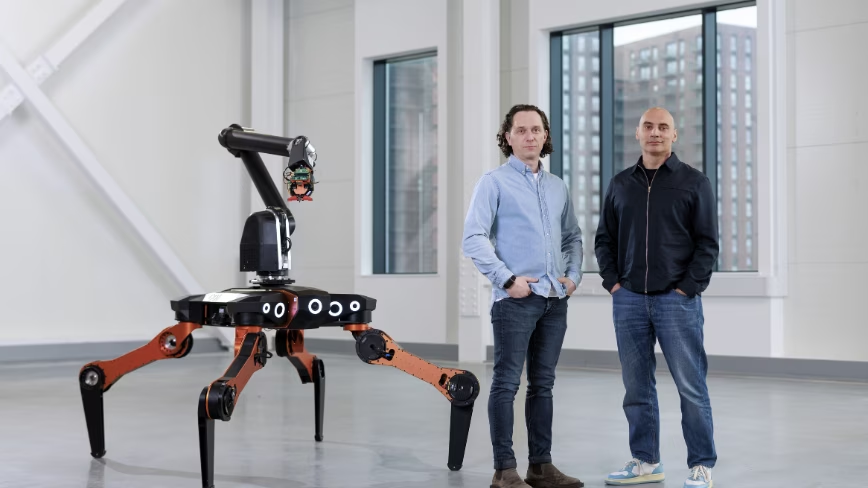
The London-founded startup wants to replace the entire construction value chain, from architect’s brief to move-in-ready building, using AI and a purpose-built on-site robot called the Mantis.
Construction is the world’s largest industry by value and one of its least automated. A typical building project today involves roughly the same sequence of hand-offs, on-site labour, and bureaucratic bottlenecks that it did half a century ago. Productivity in the sector has barely improved in 50 years, even as manufacturing, logistics, and services have been transformed by software and automation. That stagnation is what All3 was built to end.
The European construction robotics startup today announced a $25 million seed funding round. The round is led by RTP Global, the early-stage firm whose portfolio includes Datadog, Delivery Hero, and SumUp, with significant participation from SuperSeed and additional investment from Begin Capital, s16vc, and VNV Global. Jelmer de Jong, Partner at RTP Global, has joined the All3 board.
Founded by Rodion Shishkov, a serial entrepreneur with a background in industrial robotics and retail logistics, All3 operates across Europe with offices in Berlin and Zug and R&D facilities in London and Belgrade. It emerged from stealth in mid-2025, at which point it had already begun testing its robotic system in Belgrade.
All3’s pitch rests on vertical integration: unlike startups that sell one piece of the construction puzzle to builders who still manage the rest, All3 is positioning itself as an end-to-end replacement for the traditional construction value chain. “The developers find the sites and handle permits and financing, while we can do the rest,” Shishkov told The Robot Report in June 2025.
The company’s system has three integrated components. First, an AI-powered design platform that translates a brief or site address into a fully compliant building design, optimising for space, local planning regulations, and robotic production constraints. S
econd, robotic factories, described by All3 as compact, modular production cells, that fabricate custom timber composite components with claimed 0.2mm precision, without the need for programmer intervention. Third, the All3 Mantis: an autonomous legged robot with a 100kg payload and 4-metre reach, purpose-built for on-site assembly, covering placement, fastening, finishing, and inspection.
The choice of material is deliberate. All3 builds in structural timber composites, a renewable material that stores CO₂ rather than emitting it during production. Concrete, by contrast, accounts for around 7–8% of global carbon emissions.
The company claims its approach enables cost savings of up to 30%, timeline reductions of up to 50%, and up to 25% less embodied carbon compared to conventional construction, numbers drawn from its own modelling and marketing materials, which have not been independently audited at this stage.
The funding will go primarily towards advancing R&D in London and Belgrade and deploying the robot fleet across All3’s first commercial projects in Germany, the company’s initial launch market. A first building is due to break ground there later in 2026.
The choice of Germany is well-chosen for narrative purposes and operationally strategic. As TNW has reported on Europe’s construction crisis, the continent faces a chronic shortage of both homes and construction workers. Germany’s situation is particularly acute.
All3 has already processed over 100,000 square metres of residential projects through its AI design platform, forming the basis for its construction pipeline in Germany for 2026–2027. The company says this represents genuine customer engagement rather than internal modelling, though it has not disclosed the number or identity of the developers involved.
Yet, All3 is not the first European startup to bet that robotics can unlock construction’s missing productivity revolution. As we previously covered, Monumental, a Dutch startup, has built a working bricklaying robot that has already completed commercial projects in the Netherlands and raised $25 million at the seed stage. Spain’s 011h has taken a software-first prefab approach. All3’s differentiating claim is the degree of vertical integration: not just automating one part of construction, but redesigning the entire process around what robots can do.
That ambition is also its principal risk. Replacing a fragmented industry’s entire value chain requires not just working technology but regulatory approval, developer buy-in across multiple jurisdictions, and the ability to deploy a fleet of legged robots on active construction sites in dense urban environments, one of the most unpredictable physical settings imaginable. Shishkov’s background in industrial robotics and logistics gives him credibility in the manufacturing dimension; the construction site dimension is where the hard engineering problems remain unsolved for most players in the space.
Europe’s appetite for exactly this kind of deep physical AI is, nonetheless, growing. RTP Global partner de Jong framed the investment in terms that capture the broader investor narrative: “Europe needs its own physical AI champions.” Whether All3 becomes one of them will be determined not by what it claims to be able to build, but by what it actually delivers in Germany this year.
Get the TNW newsletter
Get the most important tech news in your inbox each week.
Also tagged with


