3TS Capital Partners led the round with Grazia Equity and existing investors. 25,000 users, 85% daily wear rate, 500,000+ emergency calls handled. The company is building an AI companion for the watch to address loneliness in the hours when no family member is present.
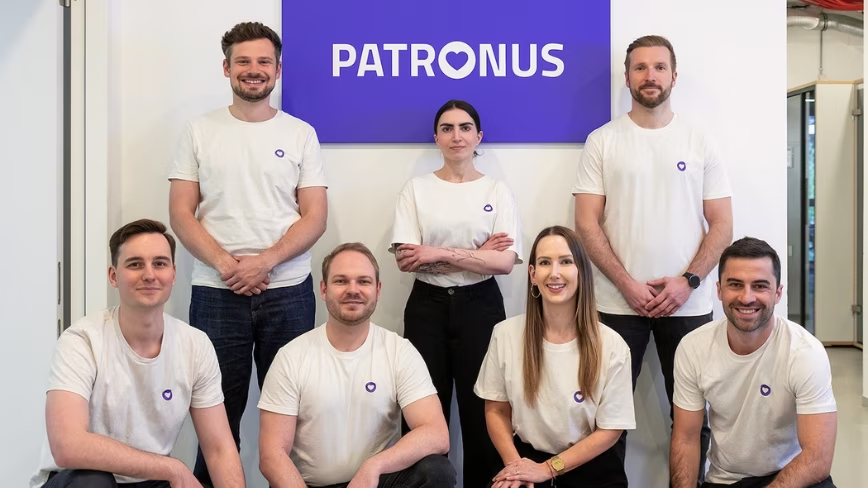
Patronus, the Berlin-based senior safety startup, has closed an €11 million funding round to expand its emergency smartwatch platform and develop new AI-powered companion features.
The round was led by 3TS Capital Partners, with participation from Grazia Equity and existing investors Singular, Burda Principal Investments, Adjacent, NAP, and UVC Partners.
The company was founded in 2021 by Ben Staudt and Tim Wagner and has previously raised approximately €33 million across a €6 million seed round and a €27 million Series A, the largest-ever Series A in European elderly care when it closed in October 2022.
The insight behind Patronus is captured in its own origin story, which the company recounts in its marketing and which the founding team took seriously enough to build a company around.
Staudt’s grandmother had a traditional emergency call button. It was supposed to hang around her neck. Instead, it sat on her bedside table. She called it “bedside decoration”: too bulky, too stigmatising, too much of a quiet admission that help was needed.
Before launching, Staudt and his team consulted with more than a thousand potential customers. The consistent message was that the issue was not technical but a matter of dignity. Traditional alarm buttons have existed for decades with little change; approximately 1.2 million people use them in Germany alone, but studies show only 14% wear them consistently.
Patronus’ smartwatch addresses this by looking like a normal wristwatch: it comes in different colours, tells the time, and does not signal “I need help” to every person the wearer encounters.
The results are commercially significant. 25,000 users are currently on the platform, with an 85% daily wear rate, sharply above the 14% consistency rate for traditional devices.
Patronus has handled more than 500,000 emergency calls for those users. 50,000 family members are connected via the companion Patronus app, which shows whether the watch is being worn, whether the user has left the house, and provides location data in an emergency.
The product is distributed in partnership with Deutsche Telekom, which provides the connectivity infrastructure.
The new funding will be used for two purposes. First, expanding the core emergency and family connectivity platform across additional European markets. Second, building an AI companion feature for the watch, a digital assistant that can hold conversations with elderly users during the long hours when no family member is available.
The company is explicit that this is not a replacement for human connection but a product designed for the hours when no one is present. The loneliness of older adults, which is itself a public health challenge with measurable impacts on mortality and cognitive decline, is the problem Patronus is targeting with the companion product, in addition to the emergency safety use case.
The broader market context is the demographic mathematics of ageing Europe. Germany has two workers retiring for every worker entering the labour market; across the EU, the over-65 population will reach 130 million by 2040.
The shortage of professional carers is structural and worsening. Technology that allows older adults to live safely and independently at home for longer, reducing the burden on families, on hospital emergency services, and on residential care facilities, has both a commercial market and a public health rationale.
Patronus’ €11 million round, at a company with 80 employees and 25,000 paying users, is a growth-stage investment in a business with proven unit economics in a market with clear structural tailwinds.
Get the TNW newsletter
Get the most important tech news in your inbox each week.


