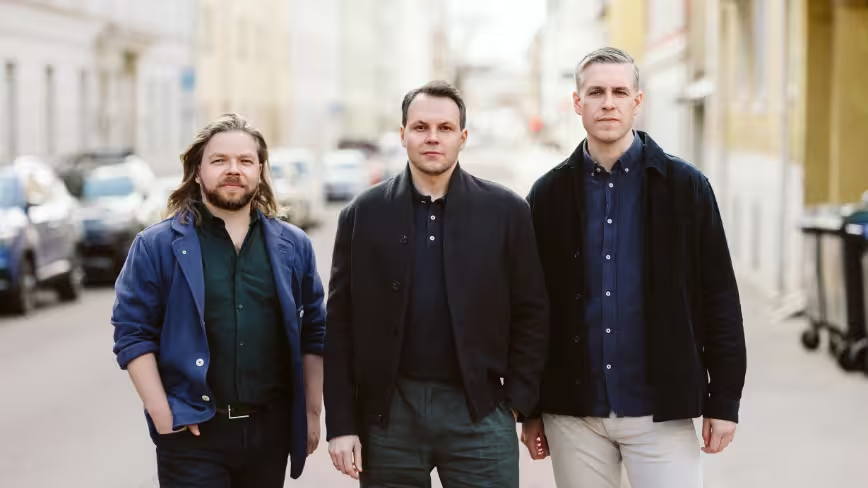
Stendr, a Norwegian counter-drone startup led by Aleksander Leonard Larsen, who co-founded blockchain gaming unicorn Sky Mavis, has raised a $5.4M oversubscribed pre-seed from RainFall, ACME, SkyFall, and a consortium of European defence and tech investors.
Stendr, a Norwegian defence technology startup developing AI-driven systems to detect and track drones, has raised $5.4 million in an oversubscribed pre-seed round.
The round was co-led by RainFall, ACME, and SkyFall, with participation from Sisyphus, Antler, StartupLab, Off Piste, and Andøya Ventures, alongside a syndicate of global technology founders and investors.
The company is headquartered in Oslo and is building what it describes as a vertically integrated stack of hardware, software, and artificial intelligence focused on drone defence.
Stendr’s CEO and co-founder is Aleksander Leonard Larsen, who spent seven years as co-founder and Chief Operating Officer of Sky Mavis, the Norwegian-founded gaming company behind Axie Infinity, one of the most prominent blockchain games of the early 2020s.
Sky Mavis reached a $3 billion valuation in October 2021 after a $150 million Series B led by Andreessen Horowitz, making it one of the few European-rooted unicorns in the blockchain gaming sector.
In March 2022, the company became the victim of the largest cryptocurrency hack in history at the time: North Korea’s Lazarus Group exploited a vulnerability in the Ronin Network, the Ethereum sidechain that underpins Axie Infinity, stealing approximately $620 million in cryptocurrency.
Sky Mavis reimbursed affected users from its own balance sheet and raised an additional $150 million from Binance to cover the shortfall. Larsen later cited the experience as formative: “After what I’ve seen, I no longer take security for granted. Resilience must be built deliberately. That’s where I’m putting my energy: defence.”
Stendr’s initial focus is on counter-drone technology: AI-driven multi-sensor systems embedded in cost-efficient hardware platforms that can detect, track, and provide situational awareness against low-cost autonomous drones in operational environments.
Larsen has framed the problem in terms that echo the Ukraine conflict, where mass-produced commercial drones costing a few hundred dollars have repeatedly neutralised assets worth millions: “At Stendr, we are building the technology to find them, track them, and give defenders the information to act, fully sovereign to Europe.”
The sovereignty framing is deliberate, Europe’s recent push to reduce defence dependence on the US has made indigenous capability a political priority, and Andøya Ventures, one of Stendr’s backers, is connected to Norway’s Andøya Space Centre, reflecting the Nordic region’s growing role in sovereign space and defence infrastructure.
The counter-drone market is one of the fastest-growing segments in defence technology. According to MarketsandMarkets, the global counter-UAS market is projected to grow from approximately $6.6 billion in 2025 to around $20.3 billion by 2030, representing a compound annual growth rate of roughly 25%.
The EU’s European Defence Industry Programme, adopted in March 2026 with a €1.47 billion budget for 2026–27, dedicates €30 million specifically to the joint procurement of integrated counter-drone systems by member states.
Stendr’s pre-seed funding will be used to accelerate development of its AI multi-sensor technology, expand its engineering and hardware capabilities, and support deployment for defence applications.
Get the TNW newsletter
Get the most important tech news in your inbox each week.


