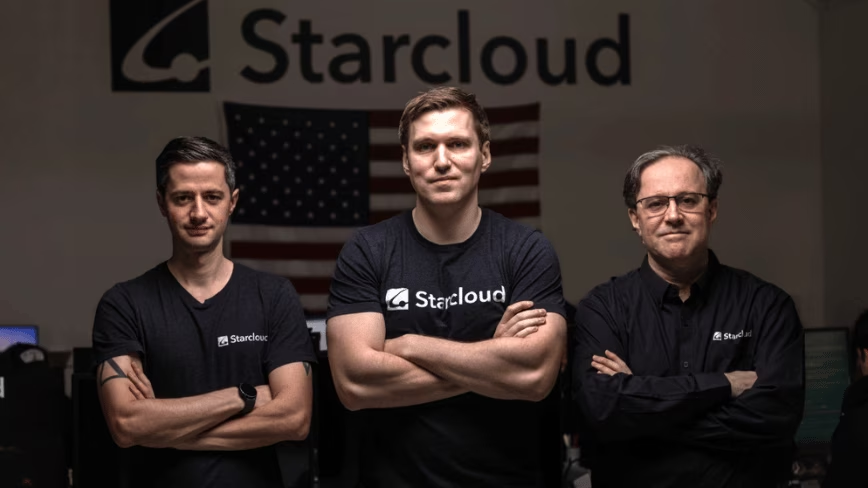
Starcloud founders from left: Ezra Feilden (CTO), Philip Johnston (CEO), Adi Oltean (Chief Engineer)
 Credit: Starcloud
Starcloud has raised $250mn to put AI compute in orbit, and a large part of the money is earmarked for rockets it cannot yet book.
The Series A extension values the company at $2.3bn post-money, the company said. Its total raised now stands at $450mn. Starcloud was founded in 2024, and its March round valued it at $1.1bn.
Manhattan West led. Nvidia and Cisco Investments joined as new backers, alongside Cedar Capital, Goanna Capital and Standard Capital. Benchmark, EQT, Soma, NFX and 776 all returned.
The release says the capital will fund manufacturing, engineering work with Nvidia, and “procurement of future launch allocation”. That third item is the difficult one.
Starcloud can build the satellites. Getting them off the ground is somebody else’s business.
What Starcloud has actually flown
The company is further along than most orbital compute startups, which is why the round is not speculative.
Starcloud-1 launched in November 2025 carrying an Nvidia H100. That was the first data centre-grade GPU to reach orbit. Starcloud says it offered roughly 100 times the GPU compute previously available up there.
Since then the company says it has trained the first AI model in space. It also says it ran a version of Google’s Gemini in orbit, and demonstrated inference and fine-tuning on flight hardware.
Most other chips sent to orbit are edge processors. Starcloud is running the same silicon that fills terrestrial data centres.
The plan is 88,000 satellites
Starcloud wants a constellation of 88,000 satellites delivering 20 gigawatts of orbital compute. It has already asked the US Federal Communications Commission for permission to operate that many spacecraft.
The near-term plan is smaller by several orders of magnitude. The company has booked two Starcloud-2 satellites, of 8 kilowatts each, on rideshare flights in 2027. They will run inference for customers including US government agencies.
That is 16 kilowatts against a 20 gigawatt target.
The company has 25 employees. It is moving into a 100,000 square foot facility in Woodinville, Washington. Chief executive Philip Johnston said on LinkedIn that Starcloud intends to ramp production to 100 satellites a week.
The launch problem
Johnston was direct with TechCrunch about what worries him.
“One of the biggest costs is now on securing your launch capacity,” he said. “Launch is pretty constrained right now because Falcon 9 is scheduled to end in 2028.”
SpaceX intends to replace Falcon 9 with Starship. Starship is larger, and nobody has yet flown one twice. This week Musk said SpaceX will delay its attempt to catch a returning Starship by a few months. It will try to re-fly one at the end of this year or early in 2027. TNW reported on 5 August that the company aimed to catch a Starship that month.
The alternatives are thin. Blue Origin still does not know why New Glenn exploded, ULA’s Vulcan is not flying regularly, and Rocket Lab’s Neutron has not reached the pad.
“Obviously if we can’t book any SpaceX launch capacity in 2029, that will be challenging for us,” Johnston said.
What Nvidia is getting
Nvidia put in $25mn, a person familiar with the deal told TechCrunch.
The two companies are developing the Nvidia Space-1 Vera Rubin Module, a version of Nvidia’s current architecture built for orbit. Nvidia said in July that Vera Rubin was shipping in full production for terrestrial customers.
The space part does not exist yet. Starcloud hopes to fly it in late 2028. Johnston said his engineers are working through three questions. How hot the chip runs sets how large the radiators must be. Where to place the radiation shielding is the second. The third is how to make the hardware survive a launch.
Johnston said Nvidia invested because of the flight data from Starcloud-1, and that it did more technical diligence than any venture investor.
The case for orbit
Starcloud describes itself as solving the AI energy bottleneck. In orbit there is continuous sunlight and no grid connection to wait for.
That constraint is real on the ground. TNW reported this week that 63% of Europe’s new capacity is going outside the five established hubs, pushed there by grid queues and land.
Cooling in orbit is the harder half. There is no air, so heat leaves only by radiating away, which is why radiator size drives the design.
Not everyone is convinced
Masayoshi Son dismissed space data centres in June as a bet on the AI race rather than a business.
TechCrunch has called the economics of orbital AI brutal, and reported in May that one rival concluded there were not enough rockets and raised $275mn to build its own.
Starcloud has hedged differently. In May it signed a deal to fit SpaceX Starlink mini laser terminals to its satellites. The contract covers more than 50 terminals across more than 25 spacecraft, giving intersatellite links of up to 25 gigabits per second.
What is not established
Nothing at constellation scale exists. Two satellites fly next year, on rideshares, and the chip the plan depends on has not been manufactured.
The $25mn Nvidia figure comes from one unnamed person and neither company has confirmed it. Nvidia is not quoted in the announcement.
The 88,000 figure is an FCC filing rather than an approval. Starcloud has not said what a launch contract would cost, or whether it holds one beyond the 2027 rideshares.
The company distributed the announcement over a newswire rather than having it independently reported. Its claimed firsts are its own, and nobody has verified them from outside.
Johnston also has to hope somebody else solves his hardest problem. Starcloud can build satellites at 100 a week and still not fly them.
Get the TNW newsletter
Get the most important tech news in your inbox each week.


