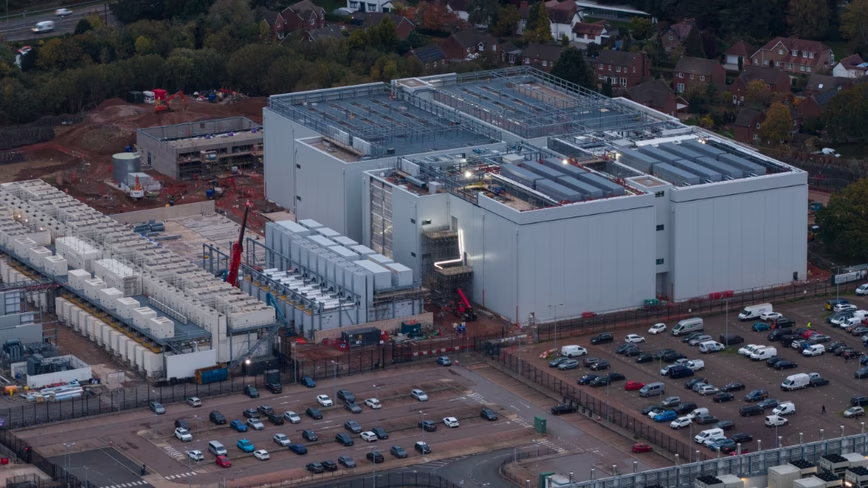
Cardiff, South Glamorgan, Wales, October, 30, 2025: Vantage Data Centers CWL1 Cardiff Hyperscale Data Center Campus
 Credit: Make more Aerials / Shutterstock.com
Europe’s data centre capacity will reach 13 gigawatts by the end of 2026, a fifth more than last year, and most of the new supply is no longer landing where the industry has always built.
Of the roughly 700 megawatts added in the second quarter, only 37% went to the five established markets of Frankfurt, London, Amsterdam, Paris, and Dublin.
The figures come from CBRE, which published its European update on Tuesday and attributes the shift to one thing: “Demand continues to outpace supply, mostly due to a lack of available power causing delays in data center construction.” More than half of all take-up in the quarter happened outside those five cities.
What is pushing developers out is time rather than money. Connecting a new site in the congested core markets can take “10 years or more”, according to RaboResearch analysts Owen Thomson and Coen Hutters, against waits they describe as significantly shorter in Belgium, Portugal, Spain, the Nordics, and Italy.
Amsterdam is the extreme case at roughly a decade, and the Dutch grid operator TenneT has said there is no additional capacity in much of Noord-Holland for the next ten years. The Netherlands separately bans hyperscale projects above 70 megawatts of IT capacity or ten hectares across most of the country.
Frankfurt’s central grid will not see meaningful upgrades until the 2030s, and London’s West London substation work is unlikely before the early part of that decade either. Britain’s waits are long enough that Nscale’s flagship Essex site has been unable to switch on.
Denmark shows the problem is not confined to the old core. Energinet paused new connections earlier this year after its queue reached 60 gigawatts against national peak demand of about seven.
Land tells a similar story, though not the one the phrase “cheaper” suggests. Prime powered land in Europe now costs €2.26m per megawatt, up 82% since 2021, on JLL’s figures, with primary markets carrying a 2.3 times premium over secondary sites and four times over tertiary ones.
Nothing here is cheap in absolute terms. It is cheaper than Frankfurt, which is a different claim, and developers are voting accordingly: greenfield sites jump from 8% to 39% of the 2026 to 2028 pipeline.
Electricity prices sit underneath all of it. European industrial power ran at roughly twice US levels in 2025 on IEA figures, a gap the bloc is trying to build around rather than close.
The clearest evidence of relocation is in the neocloud numbers. Signings by AI-focused providers reached 420 megawatts in the second quarter against 89 megawatts a year earlier, a 4.7-fold increase concentrated in the Nordics, which CBRE puts down to cheaper renewable power.
Spain has become the other destination. Installed capacity there reached 439 megawatts at the end of 2025 and the industry association Spain DC forecasts roughly 2,537 megawatts by 2030, with Amazon alone committing €33.7bn in Aragón.
In Finland, Nebius is building a €8.5bn, 310-megawatt site at Lappeenranta, and the Stargate Norway project near Narvik is starting at 230 megawatts on hydropower with a further 290 planned.
Ireland, meanwhile, has reopened. Its connection moratorium ended in December 2025, but the price of entry is behind-the-meter generation sized to the full grid connection, siting in unconstrained locations, and 80% of annual demand matched by renewable investment in the country.
That is less a welcome than a toll, and it reflects a country where data centres already draw more than 22% of national electricity.
Utilities have spotted the opening, with Uniper committing €5bn to repurpose old power plant sites whose grid connections already exist.
Hyperscalers building for themselves now account for 4.3 gigawatts across Europe, up 22% and a seventeenth consecutive year of double-digit growth.
Around 70% of that operational self-build sits in Ireland, the Netherlands, Sweden, and Belgium, which is a reminder that the old markets still hold the installed base even as the new capacity goes elsewhere.
Vacancy in the five core markets actually fell slightly last quarter, to 6.4%. Everywhere else in Europe it is forecast to reach 19% by the end of the year, which is what a building boom looks like when it happens somewhere new.
Get the TNW newsletter
Get the most important tech news in your inbox each week.


