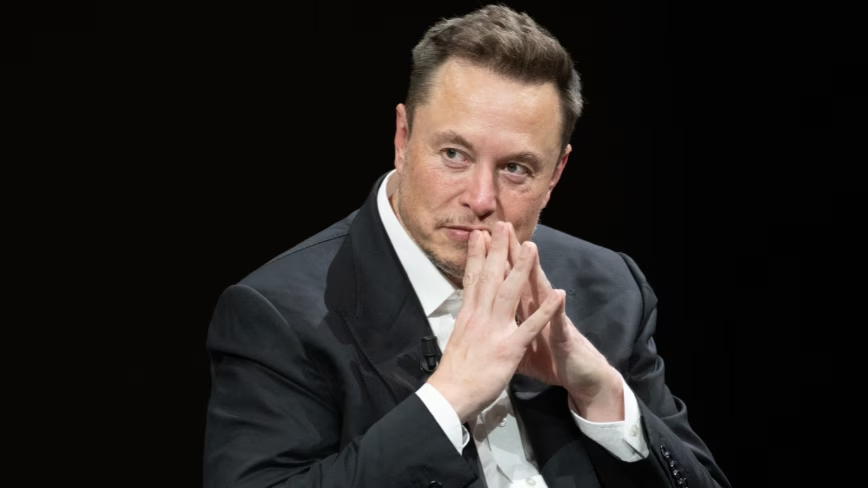
Elon Musk, founder, CEO, and chief engineer of SpaceX, CEO of Tesla, CTO and chairman of Twitter, Co-founder of Neuralink and OpenAI, at VIVA Technology (Vivatech)
 Credit: Frederic Legrand - COMEO via Shutterstock.com
Two days after taking SpaceX public in the largest stock-market debut on record, Elon Musk said the company could be earning roughly $1tn a year by 2030, and probably more in 2031.
He made the claim on X over the weekend, as Reuters reported, with the stock still settling after a debut that valued the rocket maker at more than $2tn.
The figure is large even by the standards of a founder given to large figures. SpaceX reported $18.7bn in revenue for 2025, against a loss of $4.9bn, in the filings prepared for the listing. Getting from there to $1tn in five years implies a fifty-fold expansion. No company of SpaceX’s size has grown at anything close to that pace.
The banks that took the company public do not see it either. Goldman Sachs put 2030 revenue at about $474bn, with a large share coming from a satellite-borne AI business. Morgan Stanley landed near $330bn for the same year, reaching $3.4tn only by 2040. Musk’s number for 2030 is roughly double the more bullish of the two underwriters’ estimates.
Where the growth is supposed to come from is, by every account, Starlink and the satellite-AI ambitions stacked on top of it, rather than launch.
Goldman’s model has the bulk of future revenue arriving from that direction, which is also where its assumptions are hardest to test. One analyst has questioned whether the AI revenue line can be justified at all.
The trajectory that gets SpaceX even to the banks’ numbers is steep on its own. Revenue stood near $10bn in 2023 and $14bn in 2024 before the $18.7bn reported for 2025, growth of roughly a third year on year.
Sustaining that rate would be an achievement; the leap Musk describes is a different category of claim, requiring the curve to bend far more sharply upward than it has so far.
The gap between founder and underwriter is not unusual for a Musk company, and investors who bought into the IPO presumably knew the pattern. He has a record of targets that arrive late rather than not at all, which is the charitable reading his backers tend to apply to the dates while taking the direction seriously.
The listing was priced at a valuation near $1.77tn and aimed to raise around $75bn, one of the largest debuts on record on either measure.
The next test is mundane by comparison: SpaceX is now a public company, with quarterly disclosure and an investor base that will mark the revenue line against the forecasts every three months. That is a new kind of accountability for a business that operated for two decades as a closely held private firm answerable mainly to its founder.
The market has a number from the founder and two lower numbers from the banks, and four and a half years to see which one the company grows into.
Get the TNW newsletter
Get the most important tech news in your inbox each week.
Also tagged with


