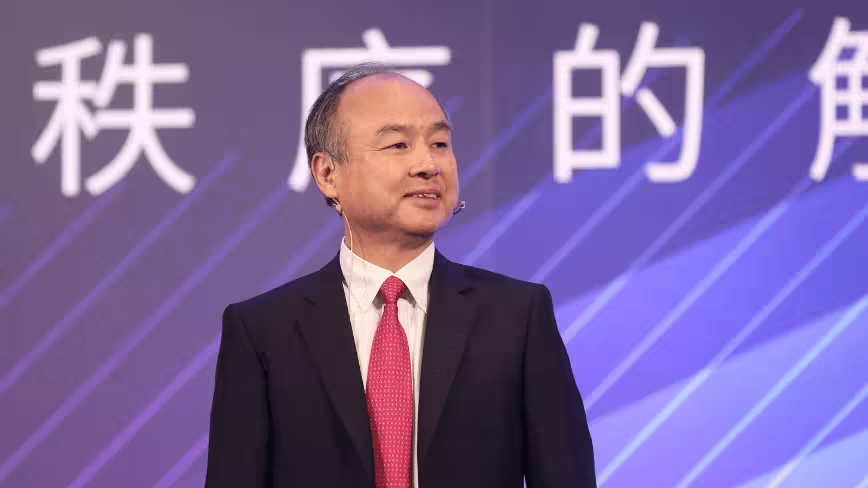
SoftBank founder and CEO Masayoshi Son on stage in Taipei, 22 June 2019.
 Credit: glen photo via Shutterstock.com
Sixty billion dollars is a lot of bond, even by SoftBank Group’s standards. The Japanese conglomerate is reportedly preparing to raise up to that much in fresh debt, according to Bloomberg, a target that would eclipse anything Masayoshi Son’s firm has sold before and that lands squarely behind its swelling bet on OpenAI.
The plan follows a run of smaller raises, including a record ¥600bn ($4.1bn) retail bond and a string of dollar and euro deals aimed at overseas buyers.
It also sits atop a tower of borrowing already built for OpenAI, from a $40bn bridge loan to a still-pending $10bn margin loan secured against SoftBank’s OpenAI shares.
The $60bn is best read as a ceiling rather than a single confirmed deal, a figure that would cover multiple tranches spread across currencies and investor types, not one institutional blockbuster.
SoftBank has issued roughly $7.8bn of bonds during 2026 so far, so treating the number as a programme target rather than a lump sum makes the arithmetic a shade less startling. Even framed that way, it signals an ambition to borrow at a pace the group has never attempted.
The purpose, at least, is not remotely subtle. Son has pledged more than $60bn to OpenAI, deployed in $10bn tranches, with the second closing on 1 July under a bridge facility and a third due in October.
Bridge debt was always a stopgap. That earlier facility was syndicated among eight banks, and a bond of this scale would let SoftBank term out its short-dated borrowing into something longer and calmer, swapping bank paper for the patience of retail and institutional investors.
Those investors have made SoftBank pay for the privilege. Its most recent yen retail bond carried a 5.12% coupon, the highest on any of its yen debt to date, up from 4.97% on a comparable deal earlier in the year.
The retail base is a deliberate choice. Japanese households have long lent to their national champion through the brokerages, and that captive demand lets SoftBank place vast sums at home even as global investors ask for steeper premiums on anything touched by AI.
The wider debt stack is where the story turns. SoftBank carries around ¥7tn in outstanding bonds and has told investors it wants to keep loan-to-value below 25%, a discipline that looks harder to hold each time an OpenAI cheque clears.
Analysts spent the spring warning of a possible liquidity squeeze, with the group leaning on prized holdings such as its Arm stake to backstop new borrowing.
The worry is less about solvency than timing, whether cash arrives as quickly as commitments fall due.
A raise of this size says the quiet part plainly. Son is prepared to lever the balance sheet to whatever the AI thesis demands, and to pay record coupons for the pleasure of doing so.
The ratings agencies have noticed. S&P moved its outlook to negative in March after a $30bn OpenAI top-up, citing concentration in early-stage and privately held ventures, while Moody’s keeps SoftBank at Ba2, firmly in speculative territory.
Part of the awkwardness is that SoftBank has become a listed proxy for OpenAI itself. Every wobble in the AI story shows up in its share price, and a delayed listing leaves public markets valuing the whole edifice on faith rather than a printed number.
None of this deters the founder, who has argued that AI will cost the world $5tn a year by 2040. On that maths, a $60bn bond is less a splurge than a down payment, and being early is the whole strategy.
The near-term test is timing. With OpenAI’s long-awaited listing still pending and the third $10bn tranche due in October, SoftBank needs the bond market open and hungry, and $60bn is a great deal to ask of any market to swallow in a single stretch.
Get the TNW newsletter
Get the most important tech news in your inbox each week.


