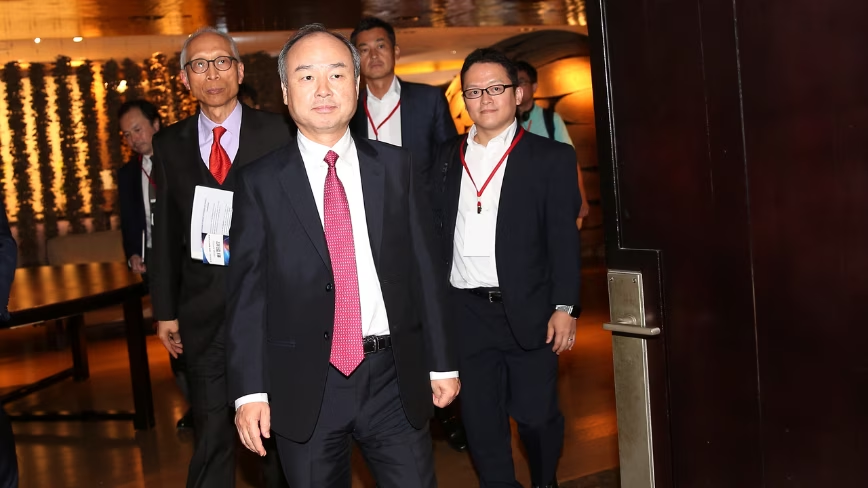
Masayoshi Son, founder and current chief executive officer of Japanese holding conglomerate SoftBank.
 Credit: glen photo via Shutterstock.com
“Every year $5 trillion, or 800 trillion yen, you might think that’s a lie, but I am confident that’s what it will cost.” That was Masayoshi Son on Tuesday, at SoftBank’s annual corporate conference in Tokyo, telling the room what building artificial intelligence will require each year by 2040. Yet, he did not say how he arrived at the figure.
The justification he offered was ratio rather than arithmetic. “The business model will be viable because by 2040, if AI revenue makes up 20% of global GDP, spending 800 trillion yen a year is a rounding error,” he said, a sentence that quietly does all its work in the first four words.
On the question that follows him everywhere now, he was blunt. “Asking if AI is a bubble is absurd. I don’t think people who ask that question know what AI is about.”
This is a familiar register. Son has previously called the same question blasphemy, and told shareholders at the group’s June annual meeting that it amounted to an insult. The escalation is in the adjectives, not the argument.
What sits underneath the rhetoric is a balance sheet with unusual concentration. SoftBank’s cumulative investment in OpenAI is set to exceed $60bn before the end of 2026, funded in part by a $40bn bridge loan syndicated across a group of banks.
The spending has been going on for two years already. SoftBank has poured tens of billions into OpenAI, financed data centres, and bought into robotics companies, an expansive programme whose stated aim is to turn the group itself into a core platform of the AI era rather than merely an investor in one.
Son’s record is the reason people still turn up. He backed Alibaba early and brought the iPhone to Japan’s mobile market, and he also put SoftBank’s money and reputation behind WeWork, which went bankrupt.
The energy forecast was the part of Tuesday’s speech that will be hardest to quietly forget. Son predicted AI data centres will need three terawatts of generation by 2040, which he put at 1.8 times total current global power consumption, initially met by gas before nuclear fusion takes over.
Fusion is not yet a commercial power source anywhere on earth. Son’s position is that it will be the cheaper and cleaner one when it arrives. He was asked, in effect, about the alternative.
“Will we use solar power in space as Elon Musk says? Maybe we will use both, but if you ask me fusion on earth will be the cheaper, cleaner energy source,” he said, having already dismissed orbital data centres as a bet on the race rather than a solution to it.
Then he went further out. By 2040, Son said, 100 trillion AI agents will make their own decisions, act on them, and communicate with each other without a person in the loop.
“We will go from a human-centric world to an agent-centric world,” he said. “The age when humans are the highest life form on earth will end. For better or for worse, it will happen and it can’t be stopped.”
None of the three predictions, the money, the power, and the agents, came with a model attached. They came with conviction, which in Son’s case has historically been the point.
The market that has to price all this is more equivocal. AI companies have soared in value while the capital expenditure needed to feed them has ballooned, and the open question, the one Son calls absurd, is whether the returns will ever cover the spend.
SoftBank itself is a live experiment in that question. The group briefly overtook Toyota as Japan’s most valuable listed company earlier this year, a position it last held in February 2000, shortly before its shares fell roughly 90%.
Son is 68 and has asked for another decade to see the thesis through. The $5tn figure, unshown working and all, is now on the record for anyone who wants to check it in 2040.
Get the TNW newsletter
Get the most important tech news in your inbox each week.


