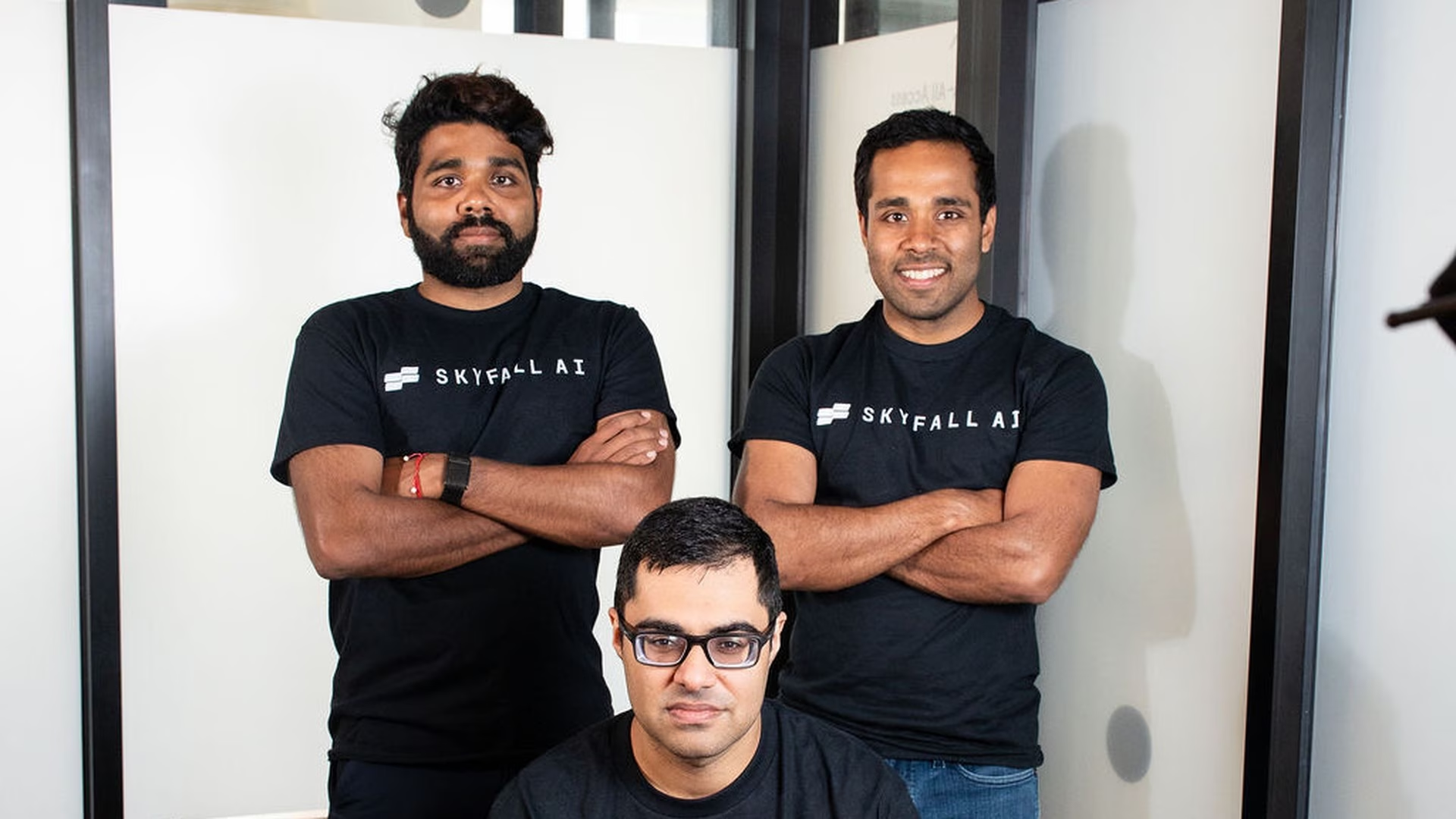
Skyfall AI’s co-founders, Sam Pasupalak, Kaheer Suleman, and Sumit Pasupalak.
 Credit: Skyfall AI
During a routine website update at one of Skyfall AI’s businesses, two software agents got stuck passing the same task back and forth. A growth agent assigned the deployment to an engineering agent, which sent it straight back.
The cycle continued because neither agent took responsibility, and one did not have the access needed to make the change.
Steve, the network of AI agents running the business, eventually changed its own rules to prevent this from happening again. It now has a coordinating agent that steps in when agents disagree and decides how to resolve the issue.
That incident gives a glimpse of what Skyfall is launching today: Steve-001, which the San Francisco startup describes as an autonomous business harness, now runs three small digital businesses that Skyfall has acquired. A human owner sets the direction and approves the decisions that matter most.
The early results, which Skyfall shared with us ahead of the launch, are mixed. One business has more than doubled its monthly revenue, another is still slightly below the level it was at when Skyfall bought it, and the third is too new to assess.
From a theme park to a balance sheet
Sam Pasupalak and Kaheer Suleman co-founded Maluuba, the Waterloo-based deep learning lab Microsoft bought in January 2017, and a few months after the sale a Maluuba team reached the maximum Ms. Pac-Man score of 999,990 by splitting the game among more than 150 cooperating agents.
Their new company, which they started with Pasupalak’s brother Sumit, practised on games before going near real money. Late last year, Skyfall published Mini Amusement Parks, a business simulator in the mould of RollerCoaster Tycoon, and found that human players ran a park several times better than the leading large language model agents.
In July, the company came out of stealth with a plan, first reported by Forbes, to spend up to $1 million on a small B2B SaaS or ecommerce business and double its revenue within six months.
“If you want a truly autonomous business, you have to buy a business and operate the whole thing end to end,” Pasupalak told Forbes at the time.
Skyfall was looking for software companies run by their owners or by a handful of contractors and staff, according to BetaKit, which reported that any workers would receive a “generous departure package.” The company has not said whether anyone worked at the three businesses it went on to buy.
Two businesses, two directions
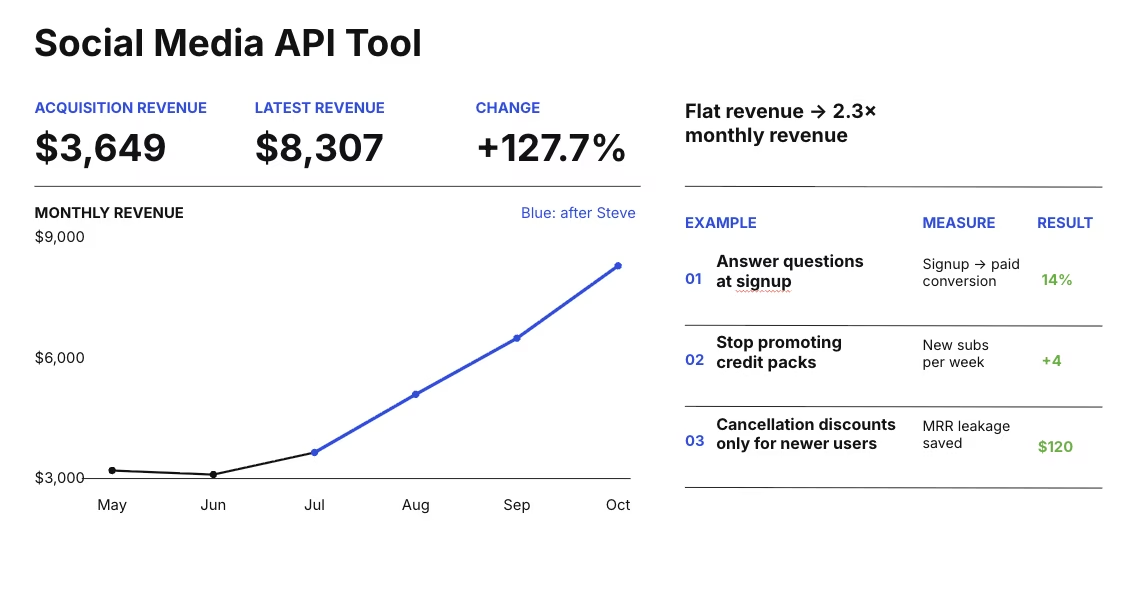
The clearest result comes from a social media API tool that Skyfall took over in July. Its monthly revenue had been flat through the spring and stood at $3,649 at the takeover, and by October it had reached $8,307, an increase of 127.7%.
Skyfall attributes the climb to a series of small decisions rather than one big bet. Steve started answering questions at signup, after which Skyfall puts signup-to-paid conversion at 14%, and stopped promoting one-off credit packs, which the company says added about four new subscriptions a week.
A third change targeted cancellations: discounts to stay are now offered only to newer users, which Skyfall says saves $120 a month in recurring revenue that would otherwise have leaked away.
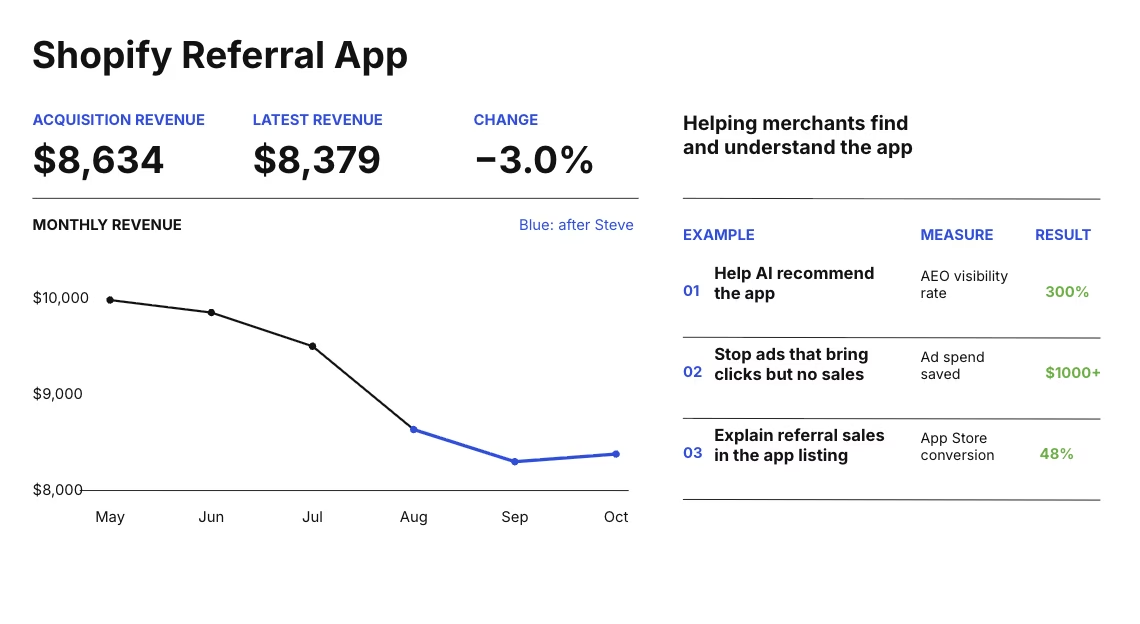
The second business, the Shopify referral app, had been losing revenue for five years, alongside heavy churn and a period when nobody new was paying at all, when Skyfall bought it in August at $8,634 a month.
It now brings in $8,379, about 3% less. Skyfall describes that as stabilisation, and its chart shows a September dip turning into a small rise in October, with new customers signing up again.
Most of Steve’s work there has been about getting the app found. It set out to make the app easier for AI assistants to recommend, rewrote the App Store listing to explain how referral sales work, and switched off ads that brought clicks without purchases, saving more than $1,000, according to Skyfall.
The third business joined Steve too recently to produce meaningful numbers.
A business written in code
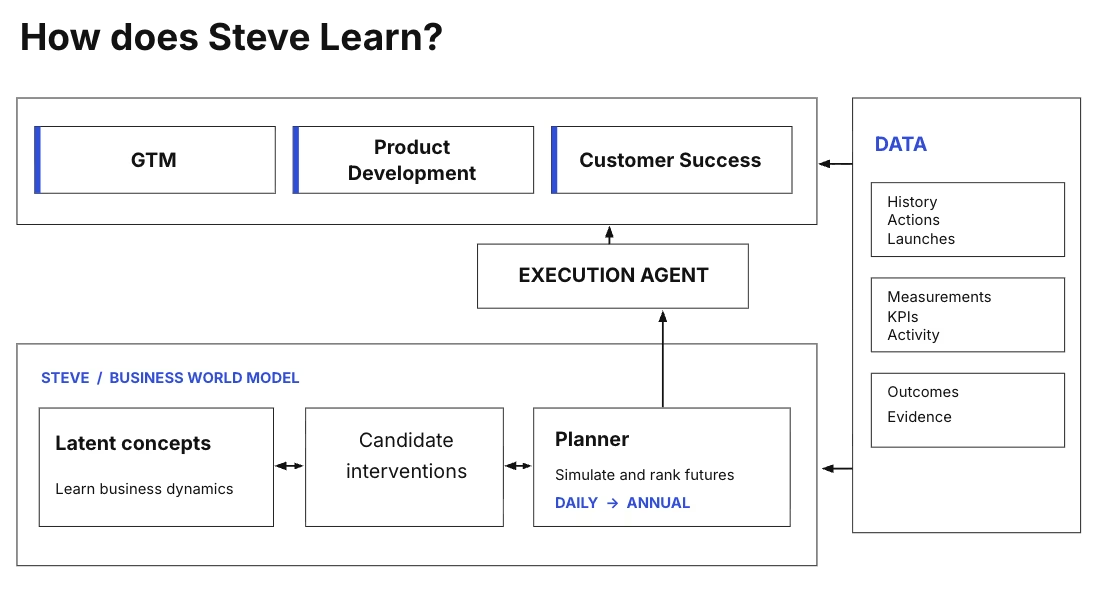
Underneath both results sits what Skyfall calls a code world model. Each business is represented as an executable program, built from its own records, that describes how customers, product usage, revenue, and costs push on one another.
Steve treats that model as a rehearsal space, running candidate moves through it before trying them for real. Each proposal carries a forecast, a timeframe, and a confidence level, and once the move plays out, the gap between prediction and result feeds the next version of both the model and the plan.
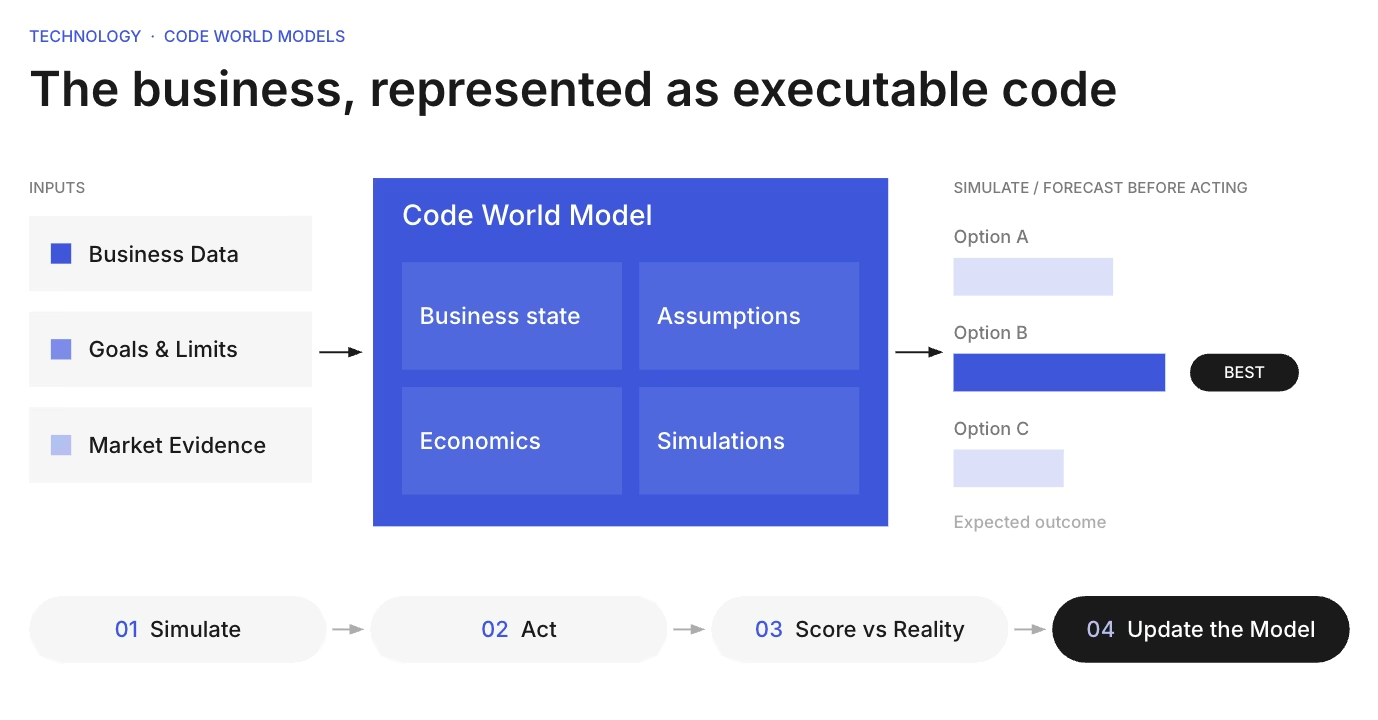
When a forecast misses, it traces the error to the part of the system that produced it, then rewrites its own code, skills, tests, or agent setup, keeping a record of each change and whether later runs improved.
Steve experimented with its lifecycle emails, compared how each variant did, kept the versions that performed best, and folded them into its own instructions, so that later emails started from what had already worked.
The deployment deadlock was the same principle applied to how the agents divide their work.
Self-modifying software running a company with paying customers raises the question of who is in charge. Skyfall’s answer is a policy engine that sits in front of every action and checks its type, the money involved, and the effect on customers against the owner’s rules, plus rules the system has learned along the way.
Every decision lands in one of four tiers: go ahead automatically, go ahead and alert the owner, wait for approval, or stop. A refund of $30 or less might go through automatically, for instance, while anything larger waits for a person, and the improvements Steve makes to itself have to stay inside those limits.
Investors and regulators are working on the same problem from the outside. Asymptote Labs raised $5.5 million last month for tools that record and block risky agent actions, and in October the UK’s data regulator began questioning AI developers about how their agents behave.
The record so far
Earlier attempts to hand a business to an AI have been humbling. In 2025, Anthropic let a version of Claude run a small shop in its San Francisco office, and it sold tungsten cubes below cost and ended the first month at a loss, although a later, upgraded version turned the shop profitable.
Skyfall’s experiment runs on real businesses whose customers can cancel, and the company intends to show its working. Each business will get a public dashboard under an anonymous name, where readers can follow its targets, metrics, agent activity, decisions, and the changes Steve makes to itself.
Skyfall plans to take Steve to other kinds of business next, but in the meantime, the target it set in July still stands: double a business within six months, a bar the social media tool has already cleared, and the Shopify app has yet to approach
Get the TNW newsletter
Get the most important tech news in your inbox each week.


