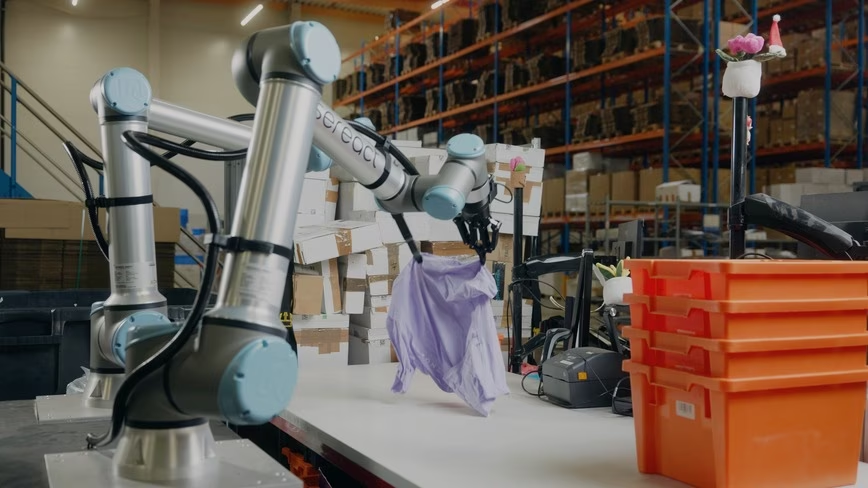
 Credit: Sereact
Robots from Stuttgart start-up Sereact are now sorting Zalando’s fashion returns in live operations in Germany and Poland. The two-armed machines work at CEVA Logistics sites in Greven, Germany, and Świebodzin, Poland, the three companies said on Wednesday.
It is the first step of a plan to automate returns across Europe. Zalando joined Sereact’s Series B round as a strategic investor in July.
“Returns are the hardest manipulation problem in fashion logistics,” said Ralf Gulde, Sereact’s chief executive and co-founder.
Why returns are hard for robots
Returned clothes often arrive badly packed and crumpled, so no two items look the same. That makes them difficult for robots programmed in advance.
Sereact’s software, called Cortex, lets the robots grasp, identify and sort items they have not seen before. It does not need training for each product or a fixed list of articles, the companies said.
“If a system only works on articles it has seen before, it does not work in a returns operation at all,” Gulde said.
The systems come under a robotics-as-a-service model, in which the robots are paid for as a service. Chris Walton, CEVA’s senior vice president for contract logistics, said the model sorts items faster and with fewer manual steps.
What happens to warehouse staff
The companies said the robots take on repetitive handling and reduce physical strain on workers. Staff move to supervising stations, handling exceptions and checking quality, according to the release.
Separately, Zalando planned to close its logistics centre in Erfurt, Germany, by September. The works council put the number of affected workers at more than 3,000, including temporary and service-provider staff, dpa reported when the closure was announced in January. That report did not link the closure to automation.
Who is involved
Gulde and Marc Tuscher founded Sereact in Stuttgart. The company raised a $116m Series B this year, and its customers include IKEA, DHL, BMW and Mercedes-Benz, according to the release.
Zalando, founded in Berlin in 2008, says it has 62 million active customers in 29 markets. It has also been working with Parloa on AI for customer conversations. CEVA, part of shipping group CMA CGM, reported revenue of $18.3bn in 2025.
China installed 59% of the world’s new factory robots while EU installations fell 11%, according to the World Robotics figures TNW reported in September. In Germany, NEURA and SECO are building robot compute modules.
Get the TNW newsletter
Get the most important tech news in your inbox each week.


