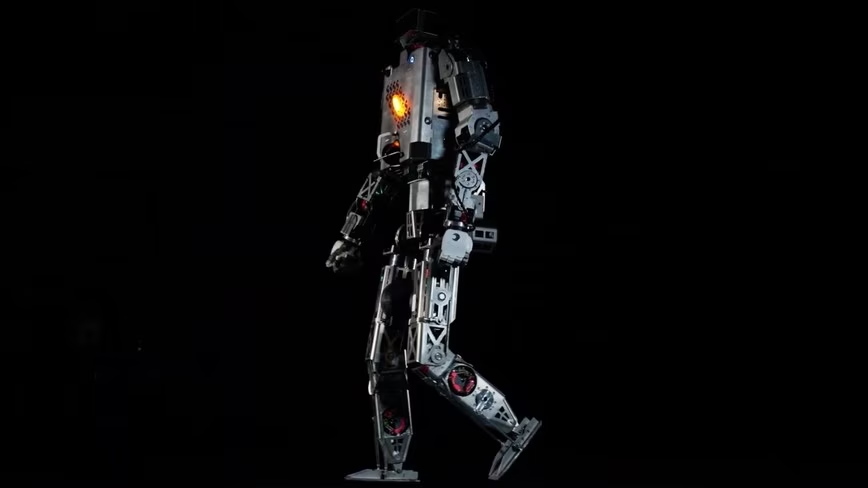
Roger, the semi-autonomous humanoid robot built by Minerva Humanoids
 Credit: Minerva Humanoids
Minerva Humanoids has raised about $10M in pre-seed funding to build humanoid robots for dangerous jobs. The San Francisco startup works on oil and gas and public safety. General Catalyst led the round, with Long Journey Ventures and Credo Ventures as co-leads, the company said on Tuesday. Hugging Face, Codecademy, RunwayVC and Compound are among the other backers.
The money brings Minerva out of stealth. It will start its first paid pilots this autumn.
“People are dying every day doing jobs the rest of the world takes for granted,” said Sandor Felber, the chief executive. “We didn’t set out to replace the people doing them.”
A robot steered through a VR headset
Minerva’s robot, Roger, is semi-autonomous. A trained specialist operates it through a VR headset and sees through the robot’s eyes. The specialist does fine manipulation work from a safe distance. Minerva’s own AI control system handles balance, fall recovery and navigation. Operators learn full-body control in minutes, the company said.
Minerva is aiming Roger at offshore oil rigs, high-voltage power plants, explosive ordnance disposal (EOD) and hazardous material response. It is exploring deployments at two of the world’s 10 busiest airports. It has already completed on-site testing for public safety work.
The company estimates that about 7,000 energy workers die on the job every year. It took the International Labour Organization’s global rate of fatal work accidents. Then it applied that rate to the 76 million energy workers counted by the International Energy Agency.
“Every EOD operator knows the long walk,” said Dominic Asquith, a British Special Forces veteran who heads hazardous operations at Minerva. “The tracked, single-arm systems we’ve relied on for decades send a lot of people on that walk because the task needs two hands and real dexterity.”
Built in Germany and the US
Minerva said it went from an idea to a walking humanoid in five months. Its engineers in the US write most of its software and AI. Its first Roger prototypes are built in Germany. It plans to build its robots in both countries without relying on single-source Chinese components. China builds almost every humanoid robot shipped worldwide.
Felber worked on Tesla’s Optimus humanoid robot and helped launch MIT CSAIL’s research on humanoid robots. Maurice Rahme, the chief technology officer, spent six years at Boston Dynamics. He was one of the technical leads on its Stretch robot.
Minerva gave a showcase and keynote at the NATO Explosive Ordnance Disposal Centre of Excellence in Slovakia. It is working with Abu Dhabi’s Mohamed bin Zayed University of Artificial Intelligence (MBZUAI) on robots for the energy sector. The University of Waterloo is helping it with robot vision in smoke and darkness.
The round follows other humanoid funding this year, including a $152M Series A for London’s Humanoid in July.
Get the TNW newsletter
Get the most important tech news in your inbox each week.


