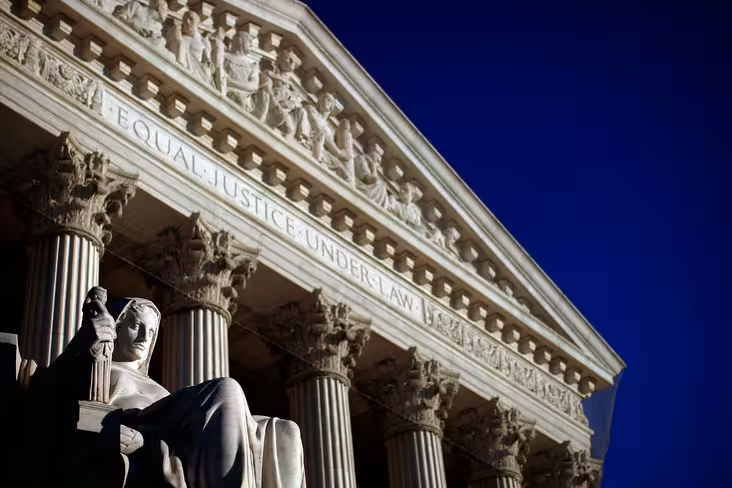
on February 5, 2009 in Washington, DC.
 Credit: Win McNamee
Your phone keeps a minute-by-minute diary of where you go. The US Supreme Court has now ruled that police cannot simply demand it. In a major win for digital privacy, the court said geofence searches need a warrant.
The 6-3 decision lands on a practice that has quietly spread through US policing. When investigators have a crime scene but no suspect, they draw a virtual box on a map and ask a tech company who was inside it. The court has just made that far harder to do.
What the court decided
The ruling came in Chatrie v. United States, a case built on a 2019 bank robbery in Midlothian, Virginia. The justices held that pulling a person’s phone-location records is a search under the Fourth Amendment. So police need a warrant backed by probable cause.
Justice Elena Kagan wrote the controlling opinion, joined by four colleagues, with Justice Neil Gorsuch agreeing on the result for his own reasons. “An individual has a reasonable expectation of privacy in his cell-phone location information,” the court said, TechCrunch reported. Justices Alito and Barrett dissented.
The reasoning leans on the 2018 Carpenter ruling, which protected the cell-tower data that maps a phone’s movements. Location data, the court noted, is sharper still. Google’s service logs a phone roughly every two minutes, around 720 times a day, pinpoints it to about 20 metres, and can even guess which floor of a building you are on.
How geofence searches work
A geofence warrant flips normal police work on its head. Officers usually name a suspect and then gather evidence. Here they gather data on everyone in an area first, then look for a suspect.
The Chatrie case shows why critics worry. Police asked Google for every phone within 150 metres of the bank around the time of the robbery. Google handed over anonymised data on 19 users, then more detail on nine, and finally identified three. Most of the people swept up were sitting in a nearby church.
The government argued that users gave their location to Google freely, so they could not claim privacy over it. The court rejected that. People treat their location history as a private journal, it said, not as something knowingly shared with the police.
What it does not do
The decision stops short of banning geofence warrants outright. Police can still seek location data. They just have to convince a judge, name a real basis for the search, and keep the request narrow.
The justices also left Chatrie’s own case unresolved. They sent it back to a lower court to decide whether his specific warrant was tight enough to pass. So the headline principle is settled, even as the messy details return to the appeals court.
Why it matters for tech
The ruling reaches well beyond one robbery. It sets a privacy floor for the location trails that phones, apps and platforms generate every day, and it shifts power back towards the user.
It also changes the calculus for big platforms. Police routinely ask tech firms to hand over user data, and companies have wrestled with how much to give. Google already moved most location history onto users’ own devices, partly to step out of these requests. Microsoft, Uber and Yahoo still field them.
For an industry under constant pressure over tracking and surveillance, the message is clear. A warrant is now the price of admission. The same logic could reshape how courts treat other sensitive trails, from search queries to smart-home logs.
None of this erases the wider fight over digital privacy. But after years of police testing the limits of what a phone can reveal, the highest court has drawn a line. The data is yours, and the state needs a good reason to see it.
Get the TNW newsletter
Get the most important tech news in your inbox each week.


