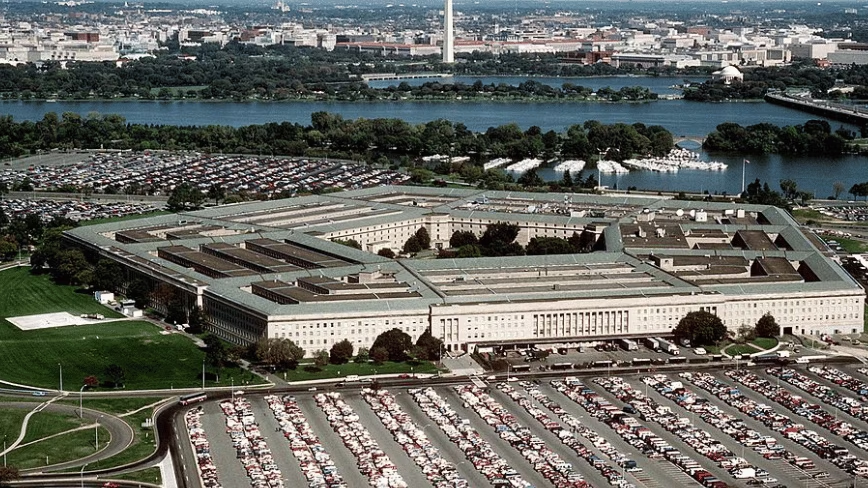
The agreement was signed with the Pentagon’s Chief Digital and Artificial Intelligence Office, the procurement vehicle driving the bulk of US military AI integration spending in 2025 and 2026. Microsoft, Amazon, and Google signed parallel classified-network deals the same week.
Scale AI has won a $500m contract from the US Department of Defense, Bloomberg reported today, in what is one of the larger individual AI procurement awards the Pentagon has made and a five-fold expansion of the company’s existing relationship with the department. The contract is structured to support the integration of AI tools into military decision-making and data-processing workflows.
The new agreement is five times larger than the $100m contract Scale received in September 2025. Dan Tadross, who leads Scale’s public-sector business, told Bloomberg that the Pentagon was already “pushing the limits” of the original deal. The expansion fits the broader pattern of Department of Defense AI procurement spending accelerating through 2025 and 2026.
The contract was signed with the Pentagon’s Chief Digital and Artificial Intelligence Office. CDAO is the office responsible for accelerating AI adoption across the military’s operational and back-office functions, and has emerged in 2025 and 2026 as the principal procurement vehicle for large-scale AI integration. Scale AI joins a small set of vendors with materially expanded CDAO commitments.
Microsoft, Amazon, and Google all signed major classified military-use AI agreements in May 2026. The Pentagon has now approved eight firms’ AI systems for use on classified networks, including the major hyperscalers. Scale AI’s $500m contract sits inside that wider expansion but is structurally different: where the hyperscaler contracts are largely about cloud-and-model infrastructure, Scale’s role is in the data-labelling and decision-support layer that sits on top.
Scale AI’s defense business is the part of the company that has been growing fastest. The company has been positioning specifically around the data-quality bottleneck that has held back operational deployment of AI in military contexts. Models perform well in benchmarks; they perform less well when the underlying training data is fragmented, mislabelled, or inconsistent with operational reality. Scale’s commercial proposition is that fixing that data layer is what enables reliable deployment.
Scale’s Meta-backed designation reflects the social-media company’s June 2024 investment that, alongside other strategic capital, valued Scale at over $14bn. The Meta link gives the company the capital base to expand its public-sector business at the speed the new contract requires. Scale’s chief executive, Alexandr Wang, has separately become one of the more visible faces of US AI policy advocacy, regularly testifying before Congress on military AI competitiveness.
Scale’s broader strategic positioning has shifted alongside its public-sector growth. The company has been moving into what the industry has begun calling “physical AI” applications, where AI systems are deployed onto autonomous platforms, robotics, and uncrewed military hardware. The data-labelling foundation translates into the same value proposition for those platforms as it has for traditional military AI workflows. The new $500m contract gives Scale the financial runway to expand in both directions simultaneously.
Three things follow from the announcement. The first is that the Pentagon’s AI procurement budget is now structurally large enough to support multiple competing vendors at the half-billion-dollar single-contract level, where it was concentrated in much smaller awards as recently as 2024.
The second is that the data-labelling and decision-support layer Scale occupies has been validated as a separate procurement category from cloud and model infrastructure, with its own budget line and its own competitive dynamics.
The third is that the Meta investment in Scale, which at the time was framed as a partnership for AI training-data quality, has produced a public-sector commercial outcome materially larger than the original commercial application.
What the contract does not yet resolve is the longer-term question of whether the data-labelling layer remains a separate category as foundation models continue to improve, or whether large model providers absorb that function into their own offerings. The $500m contract gives Scale roughly two to three years of runway to settle that question on its own terms. The broader Pentagon AI procurement cycle, on the available evidence, is moving fast enough that the
Get the TNW newsletter
Get the most important tech news in your inbox each week.