The Y Combinator-backed AI-native insurance carrier closed its Series A in January at a $630m valuation. The Series B doubles that figure and funds expansion beyond startup insurance into trucking, where the company says quoting and risk modelling can be similarly compressed.
Corgi, a Y Combinator-backed AI-native insurance carrier built for startups, has raised a $160m Series B at a $1.3bn valuation, and TCV led the round. The deal closes roughly four months after Corgi’s combined seed and Series A, and effectively doubles the $630m valuation the company carried at the start of the year.
The pace is the most striking part of the announcement. The four-month interval between Series A and unicorn-status Series B is unusual even by current AI-startup standards. Corgi’s January 2026 funding round, combined a previously undisclosed seed and a Series A into a single $108m raise, with Y Combinator, Kindred Ventures, Contrary, Oliver Jung, Glade Brook Capital Partners, Seven Stars, and Leblon Capital among the investors.
The same announcement confirmed regulatory approval for what the company described as the first full-stack insurance carrier built for startups.
What makes Corgi structurally different from most insurtech operators is precisely that full-stack model. The company writes its own policies and underwrites its own risk rather than acting as a broker for established carriers, and uses an AI underwriting layer to compress the quoting cycle from days to minutes.
The company’s site frames the experience as “Startup Insurance, Quoted in Minutes”.
The Series B will fund a new vertical. Corgi is expanding from its initial startup-insurance market into trucking, where it says it can apply the same AI-native quoting and adaptive risk modelling that defined its first product. The bet is that the underwriting infrastructure built for startup risk profiles transfers more cleanly to trucking than legacy insurance systems can manage.
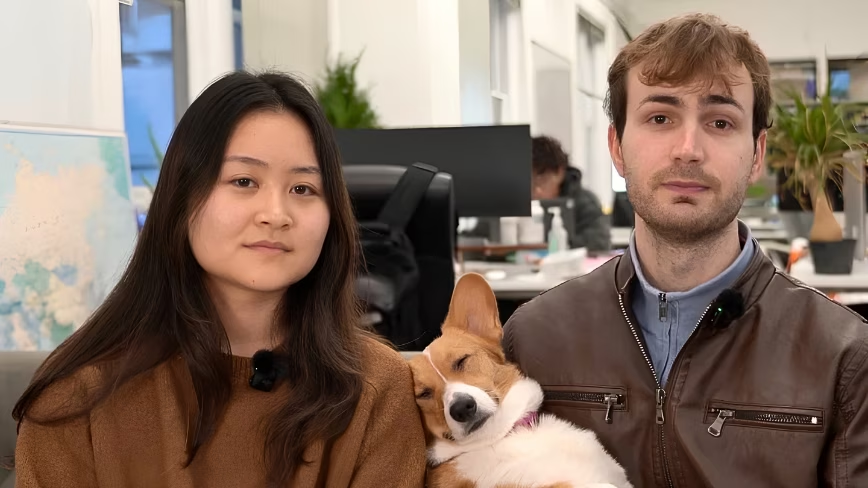
The founders are CEO Nico Laqua and COO Emily Yuan. Yuan, a former product manager at OpenAI, leads operations and product. Laqua, formerly of fintech and underwriting roles, leads the company’s commercial expansion. Corgi’s pitch is a structural challenge to the broker-led incumbents that dominate small-business and specialty insurance.
The trajectory of Corgi’s valuation is the kind of pattern that has, in 2026, become the marker of AI-infrastructure-adjacent companies that combine speed and regulated-industry positioning.
The company’s first cohort of customers is concentrated in early-stage technology businesses, but the underlying carrier infrastructure is licensed broadly. Trucking is the first announced vertical extension, but the company has indicated others will follow.
TCV, the Series B lead, is one of the larger US-based growth-stage technology investors. The original investor cohort had been concentrated among AI- and fintech-focused funds; the addition of a generalist growth-stage lead at the Series B changes the cap table’s centre of gravity. The terms beyond the headline valuation have not been disclosed.
What is clear from the announcement is that Corgi has decided that its commercial timeline now runs faster than its initial fundraising plan anticipated. The Series B is a step-up in capital and a step-up in expansion ambition, both of which are consistent with the company’s positioning as an AI-native insurance carrier rather than only an insurtech broker.
The next checkpoint will be the trucking pilot’s underwriting performance and whether the AI-quoting-in-minutes proposition holds up against the operational complexity of an end market that incumbent carriers have been slow to disrupt.
Get the TNW newsletter
Get the most important tech news in your inbox each week.


