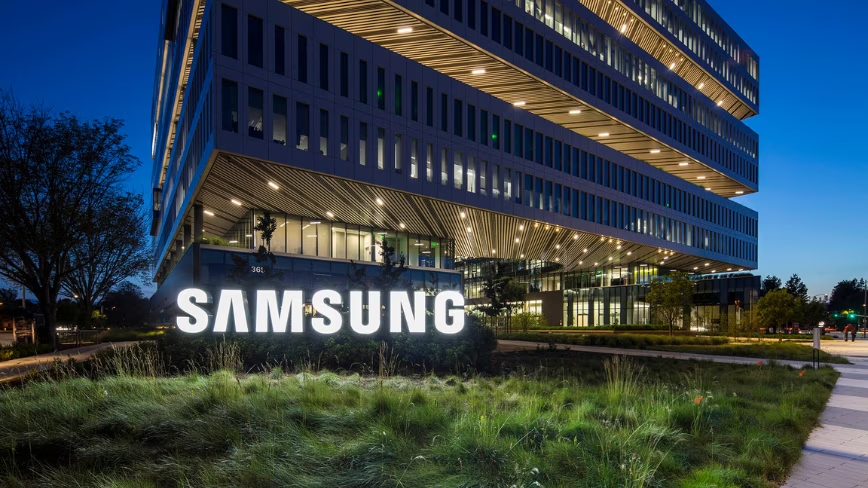
 Credit: Samsung
Samsung Electronics is moving to begin operations at the first chip plant in its Yongin cluster in 2029, one to two years earlier than planned, industry sources told Yonhap. The pull-forward lands inside a national build-out that already carries an $880bn commitment to chips, data centres and robots, and it follows a year in which every Korean memory maker has been trying to buy back time.
The site in question is the Yongin National Industrial Complex, just south of Seoul, a designated national strategic project meant to serve as Samsung’s next-generation manufacturing hub. Six fabs are planned there in total, and the first had been scheduled to come online in 2030 or 2031.
The accelerated timeline follows the government’s own decision to speed up development of the complex. Land, power and water provisioning have been the pacing items at Yongin since the cluster was announced, and none of them are things a chipmaker can solve on its own.
“An earlier start of operations at the first plant will enable Samsung to respond more quickly to rapidly growing global demand for artificial intelligence chips,” an industry official told Yonhap. Neither Samsung nor the Ministry of Trade, Industry and Energy has confirmed the 2029 date on the record, and the reporting rests on unnamed industry sources.
The reason to hurry is not hard to find. Samsung’s semiconductor division has been carried almost entirely by high-bandwidth memory sold into AI servers, and the company crossed a $1tn market value on the strength of that single product line.
Its rivals are racing for the same window. SK Hynix is spending $51bn on a new NAND plant in Cheongju, with production targeted for the first half of 2029, which means two of the world’s three largest memory makers are now aiming to switch on major new capacity in the same year.
Samsung said last month that, under South Korea’s “mega project” framework, it would invest 2,030 trillion won (about $1.35tn) across its Pyeongtaek and Yongin semiconductor clusters. A further 400 trillion won is earmarked for two new chip plants in Gwangju, 270km south of Seoul, per Yonhap.
Those figures form part of a wider domestic package unveiled on 29 June at a national reporting meeting chaired by President Lee Jae Myung, and they cover horizons long enough that the annual spend matters more than the headline. The Gwangju leg is the piece that pushes Samsung into the country’s chip-starved southwest, a region that has spent two decades watching the semiconductor belt form elsewhere.
Samsung has not said which products the first Yongin fab will make, whether it will run logic, memory, or both, or how the accelerated schedule affects the five plants behind it. Nor has it published a construction sequence, and the reporting so far concerns a single date rather than a plan.
The wider picture is one of everyone building at once. Samsung, SK Hynix and Micron, the three largest memory makers in the world, are all expanding capacity into the same demand curve, and Korea’s mega-project framework exists in large part to stop those schedules from slipping against one another.
What has not been solved is the grid. Korea’s chip clusters have historically been held up by transmission lines rather than by lithography, and no announcement has yet confirmed that power provisioning at Yongin can be compressed by the same one to two years as the buildings.
Samsung will give its next public read on capacity at its second-quarter earnings call. Until then, the only thing that has formally moved is a date, which in this industry is usually the hardest thing to move at all.
Get the TNW newsletter
Get the most important tech news in your inbox each week.
Also tagged with


